293 posters, 56 videos, 24 topics, 13 sessions, 658 authors, 215 institutions
ePostersLive by SciGen Technologies S.A. All rights reserved.
ISMICS 2025 Annual Meeting
28 - 31 May, 2025 | Istanbul, Turkey

D144
Robotic Right-Sided Pericardial Window Procedure
Poster Presenter
Part of Topic
Education, Imaging and Facilitating Technologies
Robotic Right Sided Pericardial Window Procedure
Objective
Massive pericardial effusion can arise from infectious, inflammatory, malignant, or traumatic etiologies and requires prompt intervention to prevent significant morbidity.1 Surgical creation of a pericardial window is a definitive treatment, offering both continuous drainage and prevention of fluid reaccumulation.2 This procedure is usually performed from the left side, which may not be applicable in every patient due to right-sided effusions, adhesions or thoracic masses preventing left-sided entry. We present two cases of massive right-sided pericardial effusion successfully managed using a robotic pericardial window procedure.
Methods
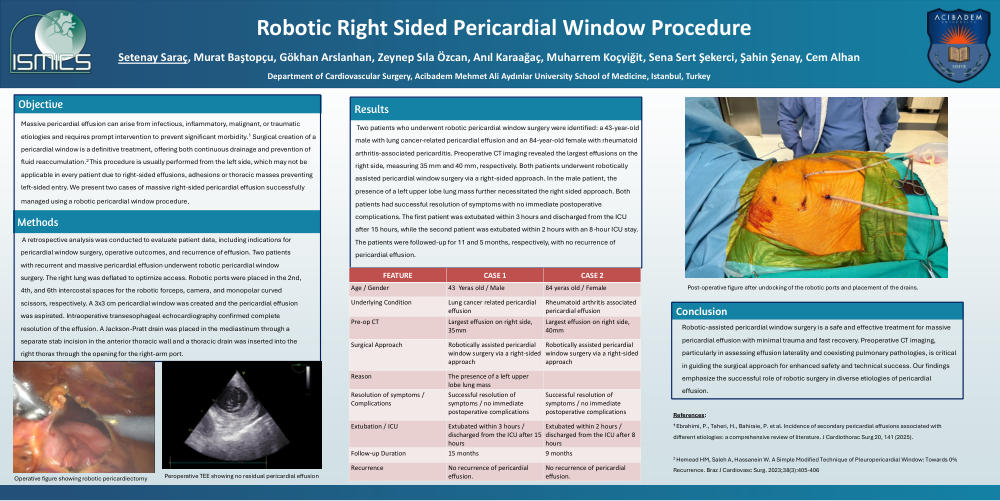
A retrospective analysis was conducted to evaluate patient data, including indications for pericardial window surgery, operative outcomes, and recurrence of effusion. Two patients with recurrent and massive pericardial effusion underwent robotic pericardial window surgery. The right lung was deflated to optimize access. Robotic ports were placed in the 2nd, 4th, and 6th intercostal spaces for the robotic forceps, camera, and monopolar curved scissors, respectively. A 3x3 cm pericardial window was created and the pericardial effusion was aspirated. Intraoperative transesophageal echocardiography confirmed complete resolution of the effusion. A Jackson-Pratt drain was placed in the mediastinum through a separate stab incision in the anterior thoracic wall and a thoracic drain was inserted into the right thorax through the opening for the right-arm port.
Results
Two patients who underwent robotic pericardial window surgery were identified: a 43-year-old male with lung cancer-related pericardial effusion and an 84-year-old female with rheumatoid arthritis-associated pericarditis. Preoperative CT imaging revealed the largest effusions on the right side, measuring 35 mm and 40 mm, respectively. Both patients underwent robotically assisted pericardial window surgery via a right-sided approach. In the male patient, the presence of a left upper lobe lung mass further necessitated the right sided approach. Both patients had successful resolution of symptoms with no immediate postoperative complications. The first patient was extubated within 3 hours and discharged from the ICU after 15 hours, while the second patient was extubated within 2 hours with an 8-hour ICU stay. The patients were followed-up for 11 and 5 months, respectively, with no recurrence of pericardial effusion.
Conclusion
Robotic-assisted pericardial window surgery is a safe and effective treatment for massive pericardial effusion with minimal trauma and fast recovery. Preoperative CT imaging, particularly in assessing effusion laterality and coexisting pulmonary pathologies, is critical in guiding the surgical approach for enhanced safety and technical success. Our findings emphasize the successful role of robotic surgery in diverse etiologies of pericardial effusion.