293 posters, 56 videos, 24 topics, 13 sessions, 658 authors, 215 institutions
ePostersLive by SciGen Technologies S.A. All rights reserved.
ISMICS 2025 Annual Meeting
28 - 31 May, 2025 | Istanbul, Turkey

D2
Minimally Invasive Valve SurgeryDigital Teaching
Poster Presenter
Part of Topic
Education, Imaging and Facilitating Technologies
Digital clinical teaching of cardiovascular surgery supported by precision imaging and 3D printing technology
Cardiovascular surgery necessitates advanced three-dimensional spatial skills, which are frequently insufficiently cultivated by conventional pedagogical approaches. A study was conducted comparing two cohorts of medical students: one group utilized digital tools incorporating precision imaging and three-dimensional printing, while the other employed a hybrid approach combining Case-Based Learning (CBL), Problem-Based Learning (PBL), and Team-Based Learning (TBL). The cohort utilizing digital teaching methodologies demonstrated superior performance relative to the CBL-PBL-TBL group in terms of theoretical knowledge, clinical competencies, and overall assessment outcomes. Additionally, students in the digital cohort reported enhanced abilities in self-directed learning, spatial visualization, and problem-solving. The integration of digital technologies with traditional educational methodologies significantly augments both the quality of medical education and student satisfaction.
Cardiovascular surgery necessitates a comprehensive understanding of the three-dimensional anatomy of the heart and its spatial interrelationships. There has been a pedagogical shift from conventional lecture-based instruction to active learning methodologies, such as CBL, PBL, and TBL, aimed at enhancing clinical reasoning and collaborative skills. In contemporary medical education, precision imaging and three-dimensional printing technologies are being incorporated to augment spatial visualization capabilities. This paper examines the integration of digital tools in the pedagogy of cardiovascular surgery, proposing an innovative model that combines Case-Problem-Team-Based Learning (C-P-TBL) with advanced imaging and three-dimensional printing technologies.
A study was conducted with a cohort of 80 medical students to compare the efficacy of two pedagogical approaches: Case-Problem-Team-Based Learning (C-P-TBL) and digital instruction. The C-P-TBL cohort engaged in collaborative problem-solving of clinical cases using a combination of case-based, problem-based, and team-based learning strategies. Conversely, the digital instruction cohort employed 3D reconstructions and 3D-printed heart models derived from CT scans, building upon the C-P-TBL framework to enhance spatial visualization and anatomical comprehension. Both cohorts were assessed through objective measures, including theoretical and practical examinations, as well as subjective evaluations via a teaching quality questionnaire.
The objective evaluation comprised theoretical examinations, which constituted 60% of the total weight and included 100 multiple-choice questions, alongside practical examinations, accounting for 40% of the weight, which assessed surgical competencies such as history taking, case analysis, and cardiac examinations. The subjective evaluation employed a questionnaire designed to assess various dimensions, including self-directed learning capability, comprehension of theoretical concepts, problem-solving proficiency, teamwork, communication skills, spatial imagination, clinical competencies, and overall self-comprehensive ability. Levels of satisfaction were classified into four categories: dissatisfied, general, satisfied, and very satisfied.
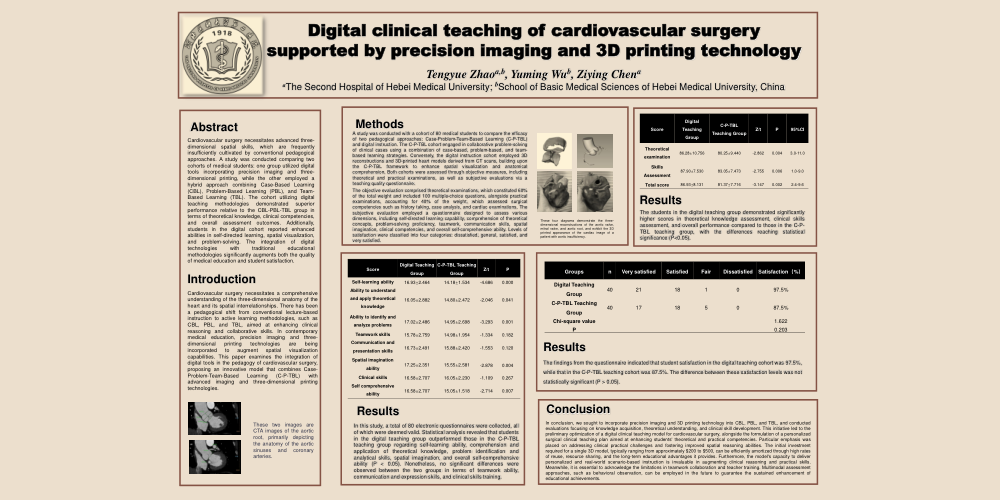
The students in the digital teaching group demonstrated significantly higher scores in theoretical knowledge assessment, clinical skills assessment, and overall performance compared to those in the C-P-TBL teaching group, with the differences reaching statistical significance (P<0.05).
In this study, a total of 80 electronic questionnaires were collected, all of which were deemed valid. Statistical analysis revealed that students in the digital teaching group outperformed those in the C-P-TBL teaching group regarding self-learning ability, comprehension and application of theoretical knowledge, problem identification and analytical skills, spatial imagination, and overall self-comprehensive ability (P < 0.05). Nonetheless, no significant differences were observed between the two groups in terms of teamwork ability, communication and expression skills, and clinical skills training.
The findings from the questionnaire indicated that student satisfaction in the digital teaching cohort was 97.5%, while that in the C-P-TBL teaching cohort was 87.5%. The difference between these satisfaction levels was not statistically significant (P > 0.05).
In conclusion, we sought to incorporate precision imaging and 3D printing technology into CBL, PBL, and TBL, and conducted evaluations focusing on knowledge acquisition, theoretical understanding, and clinical skill development. This initiative led to the preliminary optimization of a digital clinical teaching model for cardiovascular surgery, alongside the formulation of a personalized surgical clinical teaching plan aimed at enhancing students' theoretical and practical competencies. Particular emphasis was placed on addressing clinical practical challenges and fostering improved spatial reasoning abilities. The initial investment required for a single 3D model, typically ranging from approximately $200 to $500, can be efficiently amortized through high rates of reuse, resource sharing, and the long-term educational advantages it provides. Furthermore, the model's capacity to deliver personalized and real-world scenario-based instruction is invaluable in augmenting clinical reasoning and practical skills. Meanwhile, it is essential to acknowledge the limitations in teamwork collaboration and teacher training. Multimodal assessment approaches, such as behavioral observation, can be employed in the future to guarantee the sustained enhancement of educational achievements.