
Background:
Despite the advancement in surgical techniques, neurological complications encountered post-cardiac surgery remain significant. Stroke, seizure, and deep coma are major postoperative neurological complications reported in numerous patients. This study aims to identify perioperative predictors for neurological complications and focus on the relationship between these predictors and major neurological complications, particularly stroke, seizure, and deep coma.
Materials and Methods:
This retrospective cohort study was conducted among patients who underwent cardiac surgery between January 2014 and December 2020 at King Fahd Hospital of University, Khobar, Saudi Arabia. Out of 432 patients who had surgery, only 331 patients met the inclusion criteria. A comparison was made between patients who developed postoperative neurological complications and those who did not. The collected data was analyzed using the Statistical Package of Social Sciences program version 29 (Armonk, NY: IBM Corp. USA).
Results:
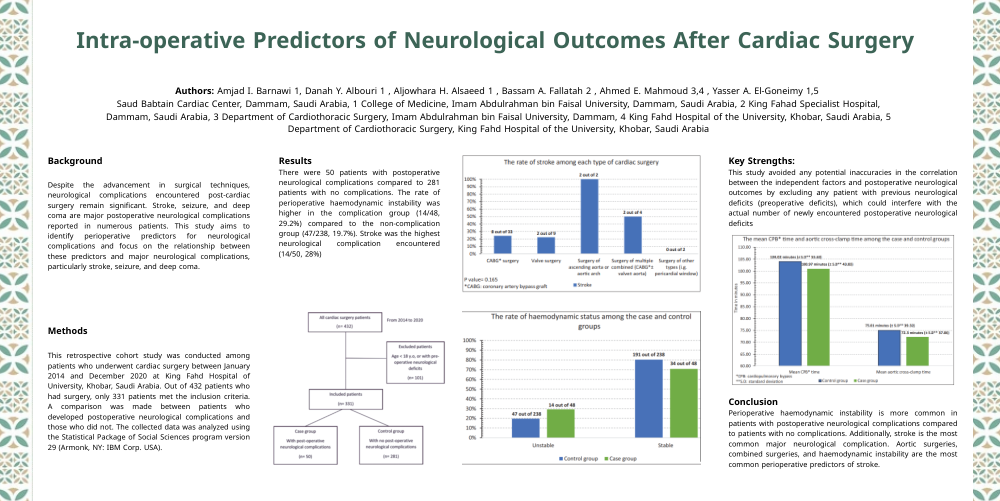
There were 50 patients with postoperative neurological complications compared to 281 patients with no complications. The rate of perioperative haemodynamic instability was higher in the complication group (14/48, 29.2%) compared to the non-complication group (47/238, 19.7%). Stroke was the highest neurological complication encountered (14/50, 28%).
Conclusions:
Perioperative haemodynamic instability is more common in patients with postoperative neurological complications compared to patients with no complications. Additionally, stroke is the most common major neurological complication. Aortic surgeries, combined surgeries, and haemodynamic instability are the most common perioperative predictors of stroke.