293 posters, 56 videos, 24 topics, 13 sessions, 658 authors, 215 institutions
ePostersLive by SciGen Technologies S.A. All rights reserved.
ISMICS 2025 Annual Meeting
28 - 31 May, 2025 | Istanbul, Turkey

D66
The Future Of Minimally Invasive Surgery In Hypertrophic Obstructive Cardiomyopathy: New Horizons And Clinical Experience
Poster Presenter
Authors
Part of Topic
Education, Imaging and Facilitating Technologies
Video
The Future Of Minimally Invasive Surgery In Hypertrophic Obstructive Cardiomyopathy: New Horizons And Clinical Experience
Furkan Burak Akyol, Murat Kadan, Tuna Demirkıran, Tayfun Özdem, Emre Kubat, Kubilay Karabacak
Gülhane Training and Research Hospital, University of Health Sciences, Department of Cardiovascular Surgery, Ankara, Turkey, Postal Code: +90 06010
OBJECTIVE
Hypertrophic obstructive cardiomyopathy (HOCM) is an autosomal dominant genetic disorder characterized by myocardial hypertrophy with a small left ventricular cavity in the absence of other cardiac, systemic, or metabolic causes of hypertrophy. Septal myectomy is the gold standard procedure with excellent long-term efficacy and safety. As a tertiary center frequently using minimally invasive approaches in our clinical practice, we wanted to share our surgical experience of patients with HOCM successfully treated with surgical myectomy.
METHODS and RESULTS
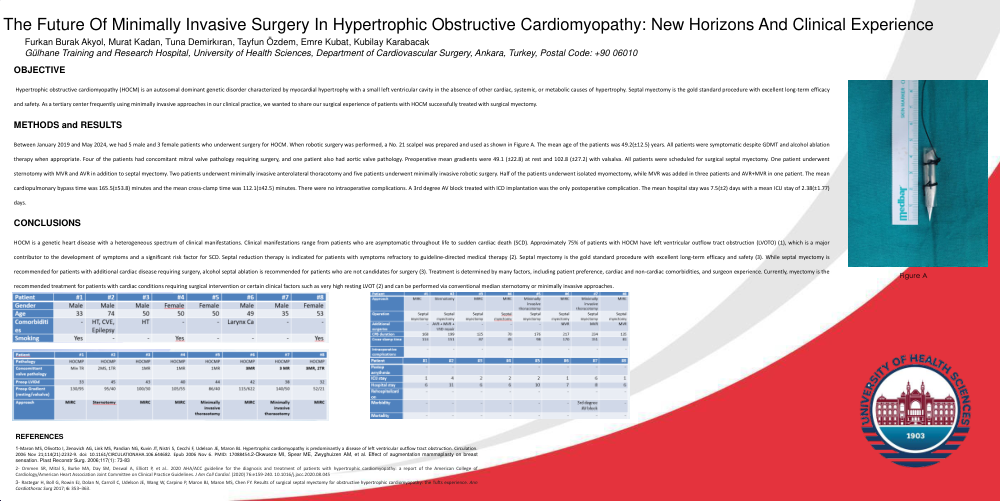
Between January 2019 and May 2024, we had 5 male and 3 female patients who underwent surgery for HOCM. When robotic surgery was performed, a No. 21 scalpel was prepared and used as shown in Figure A. The mean age of the patients was 49.2(±12.5) years. All patients were symptomatic despite GDMT and alcohol ablation therapy when appropriate. Four of the patients had concomitant mitral valve pathology requiring surgery, and one patient also had aortic valve pathology. Preoperative mean gradients were 49.1 (±22.8) at rest and 102.8 (±27.2) with valsalva. All patients were scheduled for surgical septal myectomy. One patient underwent sternotomy with MVR and AVR in addition to septal myectomy. Two patients underwent minimally invasive anterolateral thoracotomy and five patients underwent minimally invasive robotic surgery. Half of the patients underwent isolated myomectomy, while MVR was added in three patients and AVR+MVR in one patient. The mean cardiopulmonary bypass time was 165.5(±53.8) minutes and the mean cross-clamp time was 112.1(±42.5) minutes. There were no intraoperative complications. A 3rd degree AV block treated with ICD implantation was the only postoperative complication. The mean hospital stay was 7.5(±2) days with a mean ICU stay of 2.38(±1.77) days.
CONCLUSIONS
HOCM is a genetic heart disease with a heterogeneous spectrum of clinical manifestations. Clinical manifestations range from patients who are asymptomatic throughout life to sudden cardiac death (SCD). Approximately 75% of patients with HOCM have left ventricular outflow tract obstruction (LVOTO) (1), which is a major contributor to the development of symptoms and a significant risk factor for SCD. Septal reduction therapy is indicated for patients with symptoms refractory to guideline-directed medical therapy (2). Septal myectomy is the gold standard procedure with excellent long-term efficacy and safety (3). While septal myectomy is recommended for patients with additional cardiac disease requiring surgery, alcohol septal ablation is recommended for patients who are not candidates for surgery (3). Treatment is determined by many factors, including patient preference, cardiac and non-cardiac comorbidities, and surgeon experience. Currently, myectomy is the recommended treatment for patients with cardiac conditions requiring surgical intervention or certain clinical factors such as very high resting LVOT (2) and can be performed via conventional median sternotomy or minimally invasive approaches.
REFERENCES
1-Maron MS, Olivotto I, Zenovich AG, Link MS, Pandian NG, Kuvin JT, Nistri S, Cecchi F, Udelson JE, Maron BJ. Hypertrophic cardiomyopathy is predominantly a disease of left ventricular outflow tract obstruction. Circulation. 2006 Nov 21;114(21):2232-9. doi: 10.1161/CIRCULATIONAHA.106.644682. Epub 2006 Nov 6. PMID: 17088454.2-Okwueze MI, Spear ME, Zwyghuizen AM, et al. Effect of augmentation mammaplasty on breast sensation. Plast Reconstr Surg. 2006;117(1): 73‐83
2- Ommen SR, Mital S, Burke MA, Day SM, Deswal A, Elliott P, et al.. 2020 AHA/ACC guideline for the diagnosis and treatment of patients with hypertrophic cardiomyopathy: a report of the American College of Cardiology/American Heart Association Joint Committee on Clinical Practice Guidelines. J Am Coll Cardiol. (2020) 76:e159-240. 10.1016/j.jacc.2020.08.045
3- Rastegar H, Boll G, Rowin EJ, Dolan N, Carroll C, Udelson JE, Wang W, Carpino P, Maron BJ, Maron MS, Chen FY. Results of surgical septal myectomy for obstructive hypertrophic cardiomyopathy: the Tufts experience. Ann Cardiothorac Surg 2017; 6: 353–363.