293 posters, 56 videos, 24 topics, 13 sessions, 658 authors, 215 institutions
ePostersLive by SciGen Technologies S.A. All rights reserved.
ISMICS 2025 Annual Meeting
28 - 31 May, 2025 | Istanbul, Turkey

D65
One-year Outcome Of No-touch Endoscopic Saphenous Vein Graft Harvesting
Poster Presenter
Authors
Rihito Tamaki, Kunihiko Yoshino, Jingge Zhao, Ryota Nakamura, Hidefumi Nishida, Kohei Abe
Affiliations
Part of Topic
Coronary Revascularization
Video
Background
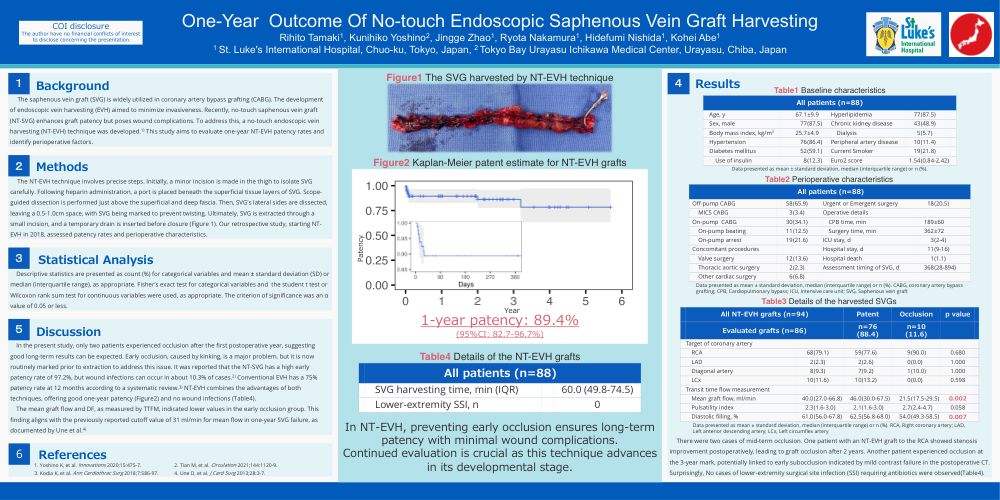
The saphenous vein graft (SVG) is widely utilized in coronary artery bypass grafting (CABG). The development of endoscopic vein harvesting (EVH) aimed to minimize invasiveness. Recently, no-touch saphenous vein graft (NT-SVG) enhances graft patency but poses wound complications. To address this, a no-touch endoscopic vein harvesting (NT-EVH) technique was developed.1) This study aims to evaluate one-year NT-EVH patency rates and identify perioperative factors.
Methods
The NT-EVH technique involves precise steps. Initially, a minor incision is made in the thigh to isolate SVG carefully. Following heparin administration, a port is placed beneath the superficial tissue layers of SVG. Scope-guided dissection is performed just above the superficial and deep fascia. Then, SVG's lateral sides are dissected, leaving a 0.5-1.0cm space, with SVG being marked to prevent twisting. Ultimately, SVG is extracted through a small incision, and a temporary drain is inserted before closure (Figure 1). Our retrospective study, starting NT-EVH in 2018, assessed patency rates and perioperative characteristics.
Statistical Analysis
Descriptive statistics are presented as count (%) for categorical variables and mean ± standard deviation (SD) or median (interquartile range), as appropriate. Fisher’s exact test for categorical variables and the student t test or Wilcoxon rank sum test for continuous variables were used, as appropriate. The criterion of significance was an α value of 0.05 or less.
Results
There were two cases of mid-term occlusion. One patient with an NT-EVH graft to the RCA showed stenosis improvement postoperatively, leading to graft occlusion after 2 years. Another patient experienced occlusion at the 3-year mark, potentially linked to early subocclusion indicated by mild contrast failure in the postoperative CT. Surprisingly, No cases of lower-extremity surgical site infection (SSI) requiring antibiotics were observed(Table4).
Discussion
In the present study, only two patients experienced occlusion after the first postoperative year, suggesting good long-term results can be expected. Early occlusion, caused by kinking, is a major problem, but it is now routinely marked prior to extraction to address this issue. It was reported that the NT-SVG has a high early patency rate of 97.2%, but wound infections can occur in about 10.3% of cases.2) Conventional EVH has a 75% patency rate at 12 months according to a systematic review.3) NT-EVH combines the advantages of both techniques, offering good one-year patency (Figure2) and no wound infections (Table4).The mean graft flow and DF, as measured by TTFM, indicated lower values in the early occlusion group. This finding aligns with the previously reported cutoff value of 31 ml/min for mean flow in one-year SVG failure, as documented by Une et al.4)
In NT-EVH, preventing early occlusion ensures long-term patency with minimal wound complications.
Continued evaluation is crucial as this technique advances in its developmental stage.