293 posters, 56 videos, 24 topics, 13 sessions, 658 authors, 215 institutions
ePostersLive by SciGen Technologies S.A. All rights reserved.
ISMICS 2025 Annual Meeting
28 - 31 May, 2025 | Istanbul, Turkey

D64
Outcomes Simultaneous Carotid Endarterectomy And Coronary Artery Bypass Grafting “No Touch Aorta“ Technique
Poster Presenter
Authors
Eugene Minin, Anatoliy Zavrazhnov, Vidadi Efendiev, Mikhail Snegirev, Ekaterina Golovacheva, Vladimir Noginov
Affiliations
null,
Part of Topic
Coronary Revascularization
Video
OUTCOMES OF SIMULTANEOUS CAROTID ENDARTERECTOMY AND CORONARY ARTERY BYPASS GRAFTING WITH “NO TOUCH AORTA“ TECHNIQUE
Eugene Minin, Anatoliy Zavrazhnov, Vidadi Efendiev, Mikhail Snegirev, Ekaterina Golovacheva, Vladimir Noginov Mariinsky Hospital, St.-Petersburg, Russian Federation
|
Background |
|
The occurrence of severe carotid artery disease in more than 12% of patients requiring coronary artery bypass grafting (CABG) results in a discrepancy concerning best treatment for both diseases. We reviewed the early outcomes of patients with CABG and simultaneous carotid endarterectomy (CEA). |
|
Material and methods |
|
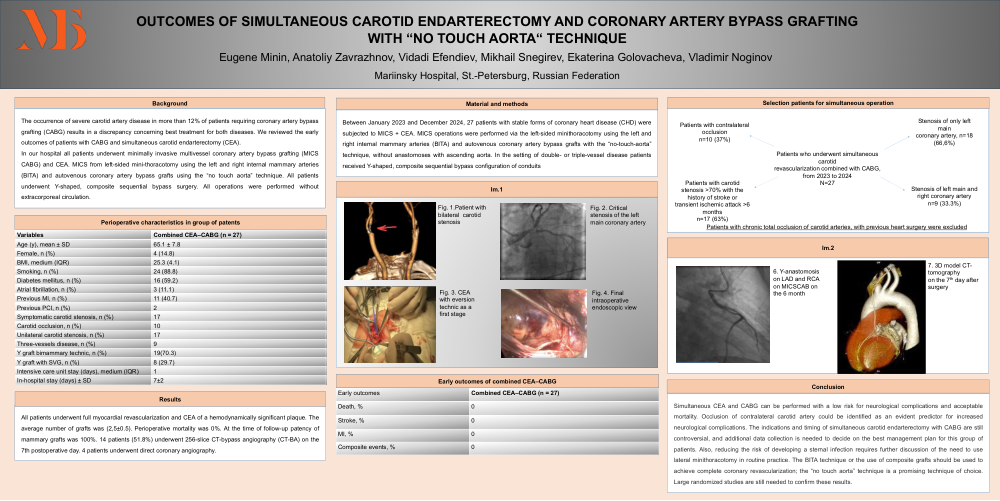
Between January 2023 and December 2024, 27 patients with stable forms of coronary heart disease (CHD) were subjected to MICS + CEA. MICS operations were performed via the left-sided minithoracotomy using the left and right internal mammary arteries (BITA) and autovenous coronary artery bypass grafts with the “no-touch-aorta”technique, without anastomoses with ascending aorta. In the setting of double- or triple-vessel disease patients received Y-shaped, composite sequential bypass configuration of conduits |
|
Results |
|
All patients underwent full myocardial revascularization and CEA of a hemodynamically significant plaque. The average number of grafts was (2,5±0.5). Perioperative mortality was 0%. At the time of follow-up patency of mammary grafts was 100%. 14 patients (51.8%) underwent 256-slice CT-bypass angiography (CT-BA) on the 7th postoperative day. 4 patients underwent direct coronary angiography. |
|
Conclusion |
|
Simultaneous CEA and CABG can be performed with a low risk for neurological complications and acceptable mortality. Occlusion of contralateral carotid artery could be identified as an evident predictor for increased neurological complications. The indications and timing of simultaneous carotid endarterectomy with CABG are still controversial, and additional data collection is needed to decide on the best management plan for this group of patients. Also, reducing the risk of developing a sternal infection requires further discussion of the need to use lateral minithoracotomy in routine practice. The BITA technique or the use of composite grafts should be used to achieve complete coronary revascularization; the “no touch aorta” technique is a promising technique of choice. Large randomized studies are still needed to confirm these results. |