293 posters, 56 videos, 24 topics, 13 sessions, 658 authors, 215 institutions
ePostersLive by SciGen Technologies S.A. All rights reserved.
ISMICS 2025 Annual Meeting
28 - 31 May, 2025 | Istanbul, Turkey
D41
Development Of A Comprehensive Robotic Coronary Artery Bypass Grafting Program: Lessons Learned From Our First Ten Multivessel Bypass Cases
Poster Presenter
Part of Topic
Coronary Revascularization
Development of a comprehensive robotic coronary artery bypass grafting program: lessons learned from our first ten multi-vessel bypass cases.
Background:
- One of the limitations of robotic-assisted minimally invasive direct coronary artery bypass grafting (RA-MIDCAB) is the challenge of achieving surgical multivessel revascularization with minimally invasive access.
- However, with appropriate conduit harvest, conduit configuration, and target vessel exposure, multivessel grafting is feasible.
Objective:
- Herein we report the outcomes of the first 10 multivessel RA-MIDCABs performed in our newly established RA-MIDCAB program.
Patient Selection:
- In December 2022, a RA-MIDCAB program was re-established at the University of Pennsylvania. From 12/2022-12/2024, a single surgeon completed 108 consecutive RA-MIDCAB procedures.
- Among these, 10 consecutive multivessel, total arterial RA-MIDCAB procedures were performed from 1/2024-12/2024, composing 9.3% of all RA-MIDCAB procedures.
- Conduits utilized included left internal mammary artery (LIMA), right internal mammary artery (RIMA), and radial artery; targets were revascularized using in situ mammary arteries, Y-grafts, and sequenced anastomoses.
Variables and Clinical Outcomes:
- Patient characteristics, graft configuration, intraoperative graft flow rates, and perioperative outcomes were retrospectively collected and analyzed.
Results:
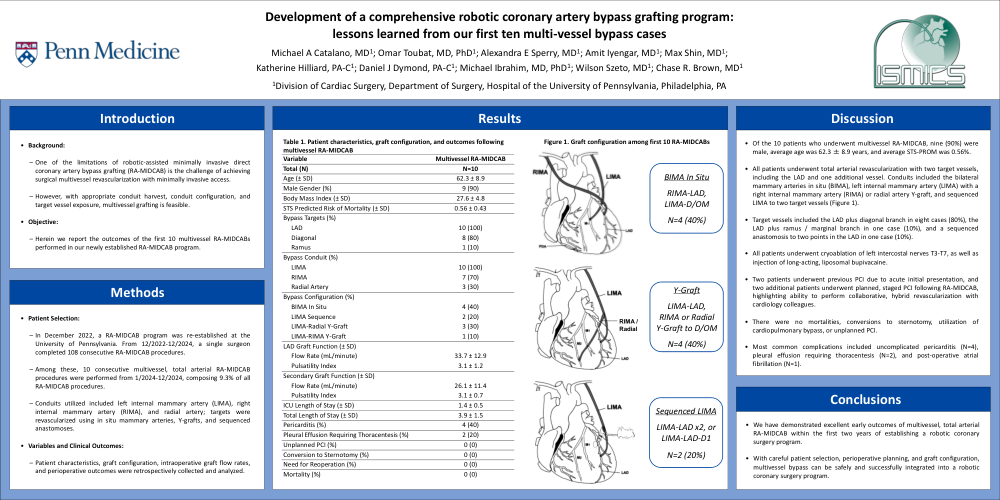
- Of the 10 patients who underwent multivessel RA-MIDCAB, nine (90%) were male, average age was 62.3 ± 8.9 years, and average STS-PROM was 0.56%.
- All patients underwent total arterial revascularization with two target vessels, including the LAD and one additional vessel. Conduits included the bilateral mammary arteries in situ (BIMA), left internal mammary artery (LIMA) with a right internal mammary artery (RIMA) or radial artery Y-graft, and sequenced LIMA to two target vessels (Figure 1).
- Target vessels included the LAD plus diagonal branch in eight cases (80%), the LAD plus ramus / marginal branch in one case (10%), and a sequenced anastomosis to two points in the LAD in one case (10%).
- All patients underwent cryoablation of left intercostal nerves T3-T7, as well as injection of long-acting, liposomal bupivacaine.
- Two patients underwent previous PCI due to acute initial presentation, and two additional patients underwent planned, staged PCI following RA-MIDCAB, highlighting ability to perform collaborative, hybrid revascularization with cardiology colleagues.
- There were no mortalities, conversions to sternotomy, utilization of cardiopulmonary bypass, or unplanned PCI.
- Most common complications included uncomplicated pericarditis (N=4), pleural effusion requiring thoracentesis (N=2), and post-operative atrial fibrillation (N=1).
Conclusions:
- We have demonstrated excellent early outcomes of multivessel, total arterial RA-MIDCAB within the first two years of establishing a robotic coronary surgery program.
- With careful patient selection, perioperative planning, and graft configuration, multivessel bypass can be safely and successfully integrated into a robotic coronary surgery program.