293 posters, 56 videos, 24 topics, 13 sessions, 658 authors, 215 institutions
ePostersLive by SciGen Technologies S.A. All rights reserved.
ISMICS 2025 Annual Meeting
28 - 31 May, 2025 | Istanbul, Turkey

P13
Concomitant Surgical Ablation For Treatment Of Atrial Fibrillation In Patients Undergoing Minimally Invasive Mitral Valve Surgery
Poster Presenter
Authors
Affiliations
Part of Topic
Arrhythmia
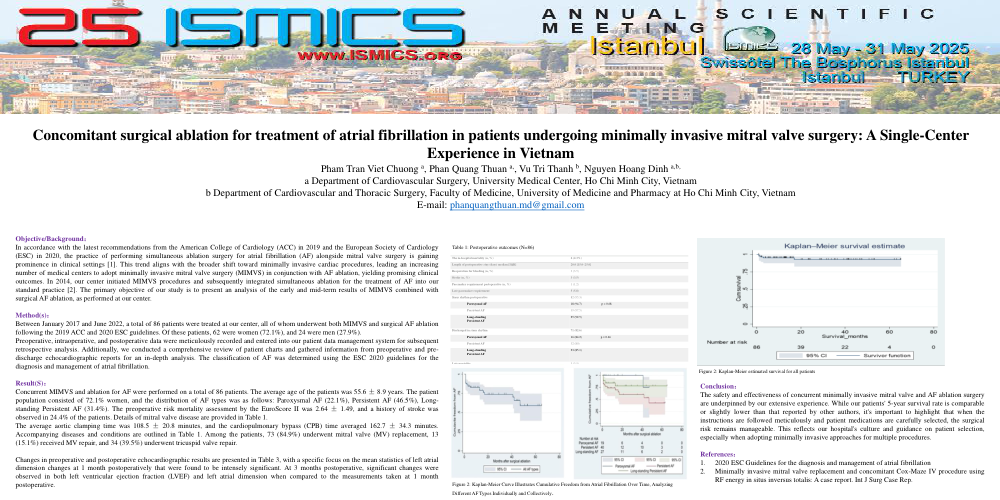
Concomitant surgical ablation for treatment of atrial fibrillation in patients undergoing minimally invasive mitral valve surgery: A Single-Center Experience in Vietnam Pham Tran Viet Chuong a, Phan Quang Thuan a,, Vu Tri Thanh b, Nguyen Hoang Dinh a,b, a Department of Cardiovascular Surgery, University Medical Center, Ho Chi Minh City, Vietnam b Department of Cardiovascular and Thoracic Surgery, Faculty of Medicine, University of Medicine and Pharmacy at Ho Chi Minh City, Vietnam E-mail: phanquangthuan.md@gmail.com Objective/Background: In accordance with the latest recommendations from the American College of Cardiology (ACC) in 2019 and the European Society of Cardiology (ESC) in 2020, the practice of performing simultaneous ablation surgery for atrial fibrillation (AF) alongside mitral valve surgery is gaining prominence in clinical settings [1]. This trend aligns with the broader shift toward minimally invasive cardiac procedures, leading an increasing number of medical centers to adopt minimally invasive mitral valve surgery (MIMVS) in conjunction with AF ablation, yielding promising clinical outcomes. In 2014, our center initiated MIMVS procedures and subsequently integrated simultaneous ablation for the treatment of AF into our standard practice [2]. The primary objective of our study is to present an analysis of the early and mid-term results of MIMVS combined with surgical AF ablation, as performed at our center. Table 1: Postoperative outcomes (N=86) The in-hospital mortality (n, %) 2 (2.3%) Length of postoperative stay (days) median [IQR] 20.0 [15.0–25.0] Reoperation for bleeding (n, %) Stroke (n, %) 3 (3.5) 3 (3.5) Pacemaker requirement postoperative (n, %) Late pacemaker requirement 1 (1.2) 5 (5.8) Sinus rhythm postoperative Paroxysmal AF 82 (95.3) 18 (94.7) p=0.68 Persistent AF Method(s): Between January 2017 and June 2022, a total of 86 patients were treated at our center, all of whom underwent both MIMVS and surgical AF ablation following the 2019 ACC and 2020 ESC guidelines. Of these patients, 62 were women (72.1%), and 24 were men (27.9%). Long-standing Persistent AF Discharged in sinus rhythm Paroxysmal AF 39 (97.5) 25 (92.5) 71 (82.6) 16 (84.2) p=0.66 Preoperative, intraoperative, and postoperative data were meticulously recorded and entered into our patient data management system for subsequent retrospective analysis. Additionally, we conducted a comprehensive review of patient charts and gathered information from preoperative and pre discharge echocardiographic reports for an in-depth analysis. The classification of AF was determined using the ESC 2020 guidelines for the diagnosis and management of atrial fibrillation. Persistent AF Long-standing Persistent AF 32 (80) 23 (85.1) Late mortality 3 (3.5) Result(S): Concurrent MIMVS and ablation for AF were performed on a total of 86 patients. The average age of the patients was 55.6 ± 8.9 years. The patient population consisted of 72.1% women, and the distribution of AF types was as follows: Paroxysmal AF (22.1%), Persistent AF (46.5%), Long standing Persistent AF (31.4%). The preoperative risk mortality assessment by the EuroScore II was 2.64 ± 1.49, and a history of stroke was observed in 24.4% of the patients. Details of mitral valve disease are provided in Table 1. The average aortic clamping time was 108.5 ± 20.8 minutes, and the cardiopulmonary bypass (CPB) time averaged 162.7 ± 34.3 minutes. Accompanying diseases and conditions are outlined in Table 1. Among the patients, 73 (84.9%) underwent mitral valve (MV) replacement, 13 (15.1%) received MV repair, and 34 (39.5%) underwent tricuspid valve repair. Changes in preoperative and postoperative echocardiographic results are presented in Table 3, with a specific focus on the mean statistics of left atrial dimension changes at 1 month postoperatively that were found to be intensely significant. At 3 months postoperative, significant changes were observed in both left ventricular ejection fraction (LVEF) and left atrial dimension when compared to the measurements taken at 1 month postoperative. Figure 2: Kaplan-Meier Curve Illustrates Cumulative Freedom from Atrial Fibrillation Over Time, Analyzing Different AF Types Individually and Collectively. Figure 2: Kaplan-Meier estimated survival for all patients Conclusion: The safety and effectiveness of concurrent minimally invasive mitral valve and AF ablation surgery are underpinned by our extensive experience. While our patients' 5-year survival rate is comparable or slightly lower than that reported by other authors, it's important to highlight that when the instructions are followed meticulously and patient medications are carefully selected, the surgical risk remains manageable. This reflects our hospital's culture and guidance on patient selection, especially when adopting minimally invasive approaches for multiple procedures. References: 1. 2020 ESC Guidelines for the diagnosis and management of atrial fibrillation 2. Minimally invasive mitral valve replacement and concomitant Cox-Maze IV procedure using RF energy in situs inversus totalis: A case report. Int J Surg Case Rep