293 posters, 56 videos, 24 topics, 13 sessions, 658 authors, 215 institutions
ePostersLive by SciGen Technologies S.A. All rights reserved.
ISMICS 2025 Annual Meeting
28 - 31 May, 2025 | Istanbul, Turkey

D27
Epicardial Cryoablation With A Liquid Nitrogen-based Device In A Patient With Electrical Storm - Case Report
Poster Presenter
Authors
Mariusz Kowalewski, Grzegorz Wroblewski, Sebastian Stec, Natalia Ogorzelec, Piotr Suwalski
Affiliations
Institute of Metrology and Biomedical Engineering, Warsaw University of Technology, Warsaw, Poland, Department of Cardiac Surgery and Transplantology, National Medical Institute of the Ministry of Interior and Administration, Warsaw, Poland, Division of Electrophysiology, Catheter Ablation and Cardiac Stimulation, Subcarpathian Center for Cardiovascular Intervention, Sanok, Poland
Part of Topic
Arrhythmia Surgery & Interventions
EpicardialCryoablation With A Liquid Nitrogen-based Device In A Patient With Electrical Storm - Case Report
BACKGROUND
The most common treatment for electrical storm involves pharmacotherapy. However, recurrent ventricular arrhythmias may necessitate thoracic sympathectomy [1-3] and surgical ablation, particularly when catheter-based techniques prove ineffective. In cases where the patient's condition precludes heart arrest, surgical ablation on a beating heart becomes the preferred approach. Currently available surgical cryoablation systems, which rely on argon or nitrous oxide gases, are limited in such scenarios due to insufficient freezing power. In contrast, the use of liquid nitrogen, with its superior heat capacity, addresses these limitations. It enables effective ablation regardless of heart wall thickness or heat generated by warm blood circulation.
METHODS
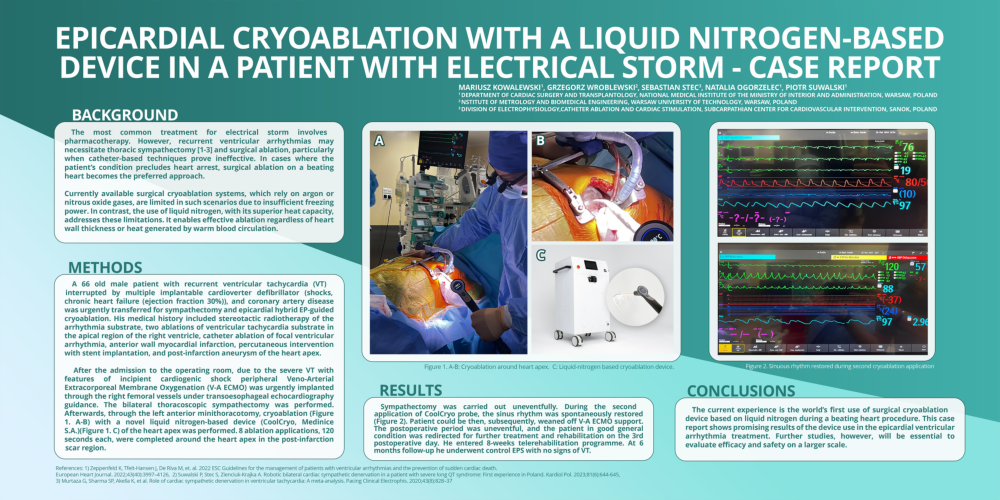
A 66 old male patient with recurrent ventricular tachycardia (VT) interrupted by multiple implantable cardioverter defibrillator (shocks, chronic heart failure (ejection fraction 30%)), and coronary artery disease was urgently transferred for sympathectomy and epicardial hybrid EP-guided cryoablation. His medical history included stereotactic radiotherapy of the arrhythmia substrate, two ablations of ventricular tachycardia substrate in the apical region of the right ventricle, catheter ablation of focal ventricular arrhythmia, anterior wall myocardial infarction, percutaneous intervention with stent implantation, and post-infarction aneurysm of the heart apex. After the admission to the operating room, due to the severe VT with features of incipient cardiogenic shock peripheral Veno-Arterial Extracorporeal Membrane Oxygenation (V-A ECMO) was urgently implanted through the right femoral vessels under transoesophageal echocardiography guidance. The bilateral thoracoscopic sympathectomy was performed. Afterwards, through the left anterior minithoracotomy, cryoablation (Figure 1. A-B) with a novel liquid nitrogen-based device (CoolCryo, Medinice S.A.)(Figure 1. C) of the heart apex was performed. 8 ablation applications, 120 seconds each, were completed around the heart apex in the post-infarction scar region.
RESULTS
Sympathectomy was carried out uneventfully. During the second application of CoolCryo probe, the sinus rhythm was spontaneously restored (Figure 2). Patient could be then, subsequently, weaned off V-A ECMO support. The postoperative period was uneventful, and the patient in good general condition was redirected for further treatment and rehabilitation on the 3rd postoperative day. He entered 8-weeks telerehabilitation programme. At 6 months follow-up he underwent control EPS with no signs of VT.
CONCLUSIONS
The current experience is the world's first use of surgical cryoablation device based on liquid nitrogen during a beating heart procedure. This case report shows promising results of the device use in the epicardial ventricular arrhythmia treatment. Further studies, however, will be essential to evaluate efficacy and safety on a larger scale.
REFERENCES:
1) Zeppenfeld K, Tfelt-Hansen J, De Riva M, et. al. 2022 ESC Guidelines for the management of patients with ventricular arrhythmias and the prevention of sudden cardiac death. European Heart Journal. 2022;43(40):3997–4126,
2) Suwalski P, Stec S, Zienciuk-Krajka A. Robotic bilateral cardiac sympathetic denervation in a patient with severe long QT syndrome: First experience in Poland. Kardiol Pol. 2023;81(6):644-645,
3) Murtaza G, Sharma SP, Akella K, et al. Role of cardiac sympathetic denervation in ventricular tachycardia: A meta‐analysis. Pacing Clinical Electrophis. 2020;43(8):828–37