293 posters, 56 videos, 24 topics, 13 sessions, 658 authors, 215 institutions
ePostersLive by SciGen Technologies S.A. All rights reserved.
ISMICS 2025 Annual Meeting
28 - 31 May, 2025 | Istanbul, Turkey

D127
Comparison Of Apixaban Versus Warfarin In Tissue Valve Prostheses And Atrial Fibrillation Patients: Literature Review
Poster Presenter
Authors
Part of Topic
Arrhythmia Surgery & Interventions
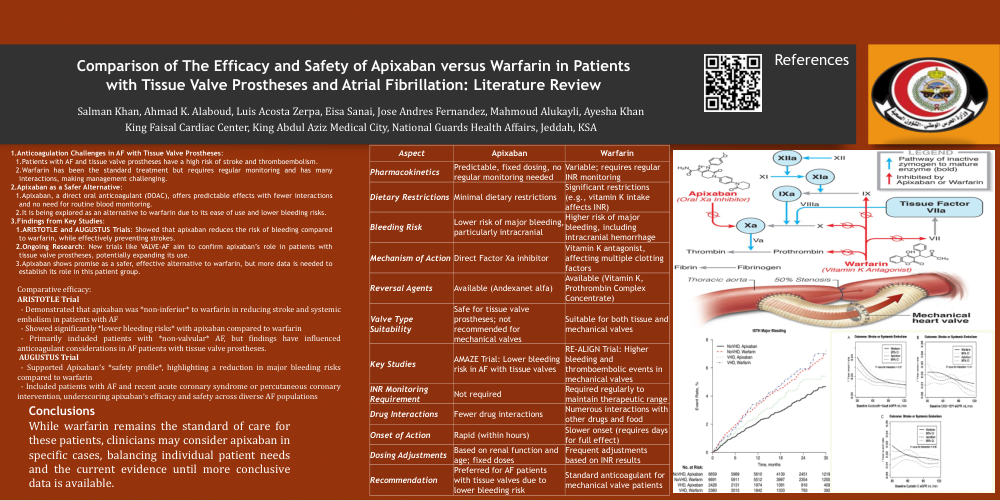
Comparative Efficacy and Safety of Apixaban versus Warfarin in Patients with Tissue Valve Prostheses and Atrial Fibrillation: A Review of Current Evidence and Ongoing Trials.
Salman Khan, Ahmad K. Alaboud, Luis Acosta Zerpa, Eisa Sanai, Mosteiro Andres Jose, Ayesha Khan.
King Faisal Cardiac Center, King Abdul Aziz Medical City, National Guards Health Affairs,
Jeddah, KSA.
Abstract:
Atrial fibrillation (AF) in patients with tissue valve prostheses presents a unique challenge in anticoagulation management. Historically, warfarin has been the cornerstone of therapy, but the advent of direct oral anticoagulants (DOACs) like apixaban has reshaped this landscape. This study compares the efficacy and safety of apixaban versus warfarin in patients with tissue valve prostheses and AF. A comprehensive review of current literature, including randomized controlled trials and real-world studies, reveals that apixaban offers a favorable safety profile, particularly in reducing major bleeding events, without compromising efficacy in stroke prevention. Emerging evidence suggests that apixaban may be a viable alternative to warfarin, offering consistent anticoagulation without the need for regular monitoring. However, data on apixaban in this specific population is still evolving, with ongoing trials expected to provide more definitive conclusions. This paper underscores the need for more focused research to establish clear guidelines, considering the nuances of anticoagulation in patients with tissue valve prostheses and AF.
Introduction:
Atrial fibrillation (AF) is a common arrhythmia associated with a significant risk of thromboembolism, particularly in patients with tissue valve prostheses. Anticoagulation therapy is essential in mitigating this risk, with warfarin being the traditional agent of choice. However, the development of direct oral anticoagulants (DOACs), including apixaban, has provided an alternative approach that does not require the frequent monitoring associated with warfarin. This paper compares the efficacy and safety of apixaban versus warfarin in patients with tissue valve prostheses and AF, drawing on recent studies and ongoing clinical trials.
Mode of Action:
Warfarin, a vitamin K antagonist, works by inhibiting the synthesis of vitamin K-dependent clotting factors II, VII, IX, and X, as well as proteins C and S. This results in a reduced ability of the blood to clot, thereby preventing thromboembolic events [1]. However, warfarin’s effectiveness is highly variable, influenced by dietary vitamin K intake, interactions with other drugs, and genetic factors, necessitating regular INR monitoring to maintain therapeutic levels [2].
Apixaban, on the other hand, is a direct factor Xa inhibitor. It works by selectively inhibiting factor Xa, an enzyme critical in the coagulation cascade that converts prothrombin to thrombin, leading to clot formation. By directly inhibiting factor Xa, apixaban reduces thrombin generation and thrombus development without the need for frequent monitoring, thanks to its predictable pharmacokinetic profile [3][4].
Comparative Efficacy:
Several studies have explored the use of apixaban in patients with AF and tissue valve prostheses, although data remains less robust compared to warfarin. A pivotal study published in the New England Journal of Medicine indicated that apixabanwas non-inferior to warfarin in preventing stroke and systemic embolism in patients with AF [1]. However, this study included only a small proportion of patients with tissue valve prostheses.
The ARISTOTLE trial, which compared apixaban with warfarin in a large cohort of AF patients, demonstrated a significant reduction in stroke, systemic embolism, and major bleeding events with apixaban [5]. Though the ARISTOTLE trial primarily involved patients with non-valvular AF, its findings have influenced the consideration of apixaban in patients with tissue valve prostheses.
Additionally, the AUGUSTUS trial, which evaluated apixabanin patients with AF and recent acute coronary syndrome or percutaneous coronary intervention, found that apixabansignificantly reduced the risk of bleeding compared to warfarin, further supporting its safety profile [6].
Safety Profile:
The safety of apixaban in patients with tissue valve prostheses and AF is of particular interest given the associated risks of anticoagulation in this population. The RE-ALIGN trial, which tested another DOAC, dabigatran, in mechanical heart valves, was prematurely halted due to increased thromboembolic and bleeding events [7]. This raised concerns about the safety of DOACs in valve prosthesis patients. However, tissue valves differ significantly from mechanical valves in terms of thrombotic risk, and the data on apixabanspecifically is more encouraging.
The AMAZE trial, which evaluated apixaban in patients with AF and mechanical heart valves, found that while apixabanwas effective in reducing thromboembolic events, the results were less favorable compared to warfarin. The trial highlighted that apixaban might not be as effective as warfarin in patients with mechanical valves, which are associated with a higher thrombotic risk compared to tissue valves [8]. However, the data for patients with tissue valves remain less conclusive.
A meta-analysis published in Thrombosis Research in 2023 reviewed available evidence and suggested that apixaban is associated with a lower risk of major bleeding compared to warfarin, without a significant increase in thromboembolic events [9]. The ongoing VALVE-AF trial is expected to provide more definitive data, specifically targeting patients with AF and bioprosthetic valves [10].
Ongoing Trials:
Several ongoing trials aim to clarify the role of apixaban in patients with tissue valve prostheses and AF. The VALVE-AF trial, listed on ClinicalTrials.gov, is a multicenter study designed to evaluate the efficacy and safety of apixabancompared to warfarin in patients with AF and bioprostheticheart valves [10]. Preliminary results are anticipated to be published in 2025. Another ongoing study, the BRIDGE-AF trial, is focusing on the perioperative management of anticoagulation in these patients, providing insights into the optimal timing and transition between anticoagulants [11].
Conclusion:
The emergence of apixaban as a potential alternative to warfarin in patients with tissue valve prostheses and AF marks a significant development in anticoagulation therapy. While current evidence suggests that apixaban may offer a safer profile with comparable efficacy, the data remains limited. Ongoing trials are expected to more highlight on this issue, potentially leading to a paradigm shift in the management of anticoagulation in this patient population. Until more definitive evidence is available, warfarin remains the preferred anticoagulant, but apixaban presents a promising option that warrants consideration in appropriate clinical scenarios.