293 posters, 56 videos, 24 topics, 13 sessions, 658 authors, 215 institutions
ePostersLive by SciGen Technologies S.A. All rights reserved.
ISMICS 2025 Annual Meeting
28 - 31 May, 2025 | Istanbul, Turkey

D8
Train Like An Athlete: Quantifying Surgeon Physiology During New Skill Acquisition
Poster Presenter
Authors
Affiliations
Part of Topic
Education, Imaging and Facilitating Technologies
Train Like an Athlete: Quantifying Surgeon Physiology During New Skill Acquisition
Brian Ayers, Jawad Hoballah, and Aaron Aguirre
Background:
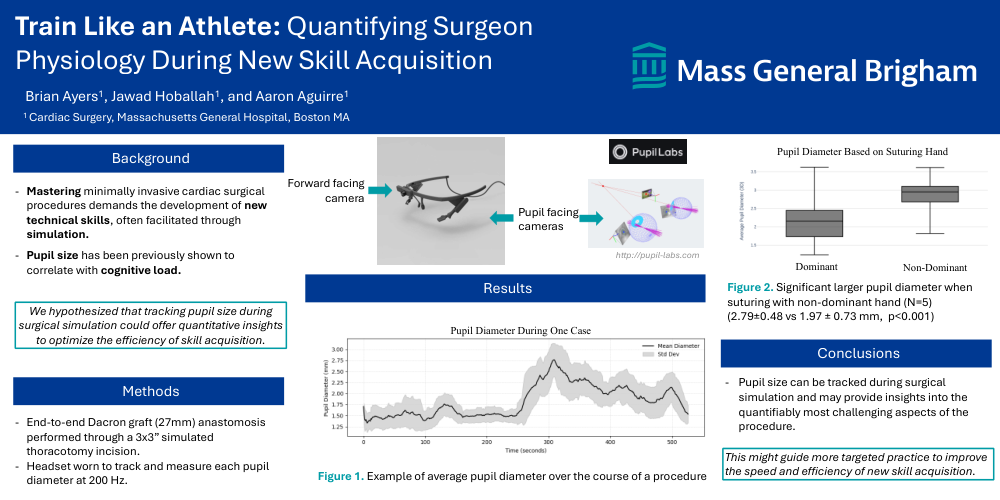
Mastering minimally invasive cardiac surgical procedures demands the development of new technical skills, often facilitated through simulation. Pupil size has been previously shown to correlate with cognitive load. We hypothesized that tracking pupil size during surgical simulation could offer quantitative insights to optimize the efficiency of skill acquisition.
Methods:
An end-to-end Dacron graft (27mm) anastomosis was performed through a 3x3” simulated thoracotomy incision. The surgeon wore a headset consisting of two reverse facing cameras with software to track and measure each pupil diameter at 200 Hz. The anastomosis was performed suturing with the dominant hand and then repeated while suturing with the non-dominant hand to simulate practicing a challenging new technical skill. Mean pupil diameter was compared between suturing with the dominant and non-dominant hand.
Results:
Pupils could be successfully tracked during all simulations and were an average diameter of 2.20 ±0.76 mm across 10 simulations. An example of pupil diameter over time during one simulation is shown in Figure 1A. The increase in pupil size seen at approximately 300 seconds into the case corresponds with the surgeon’s subjective opinion of the hardest part of the procedure. Comparing the simulation of new vs known technical skill, mean pupil size was significantly greater when suturing with the non-dominant hand compared with the dominant hand (2.79±0.48 vs 1.97 ± 0.73 mm, p<0.001, Figure 1B).
Conclusions:
These data demonstrate pupil size can be tracked during surgical simulation and may provide insights into the quantifiably most challenging aspects of the procedure. Further research is warranted to determine if these insights can be used to guide more targeted practice to improve the speed and efficiency of new skill acquisition.