293 posters, 56 videos, 24 topics, 13 sessions, 658 authors, 215 institutions
ePostersLive by SciGen Technologies S.A. All rights reserved.
ISMICS 2025 Annual Meeting
28 - 31 May, 2025 | Istanbul, Turkey

D7
Pushing The Boundaries Of Mics Beyond The Heart: The World's First Concomitant Robotic Assisted Off-pump Cabg And Orthotopic Liver Transplant
Poster Presenter
Authors
Lucian Lozonschi, Leonardo Paim Nicolau da Costa, Nicholas Prinz, Diego Reino, Vijay Subramanian, Kiran Dhanireddy
Affiliations
null,
Part of Topic
Coronary Revascularization
Background:
•Patients with cirrhosis present unique challenges for surgical management due to increased risk for perioperative complications.
•Patients with cirrhosis and coronary artery disease (CAD) are often not suitable candidates to undergo conventional coronary artery bypass grafting (CABG) due to risk of hepatic decompensation with increased morbidity and mortality.
•Robotic assisted off-pump CABG may be a promising alternative that can help reduce risk of bleeding, surgical trauma, and recovery to offer a safer pathway for management of CAD in patients with cirrhosis.
Objectives
•This case highlights a novel approach to performing concomitant CABG and orthotopic liver transplantation (OLT) in patients who present with severe CAD and cirrhosis.
Methods
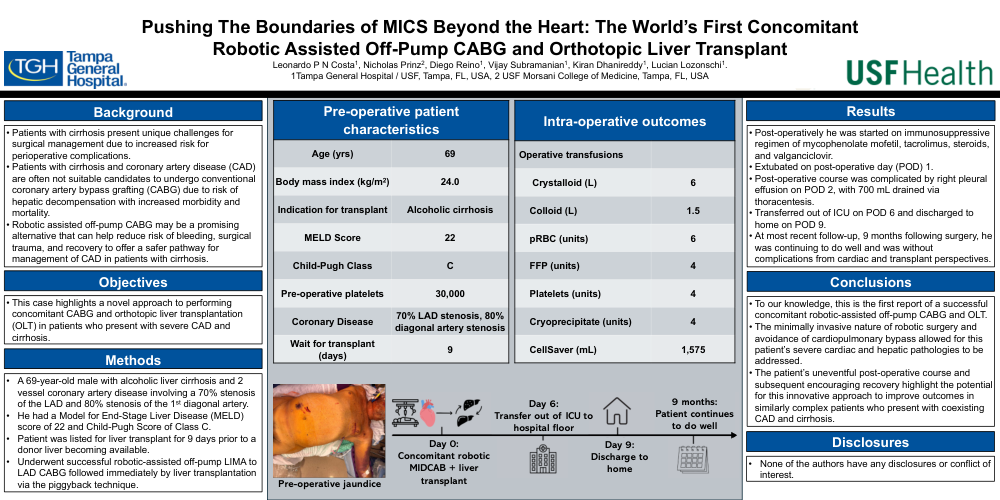
•A 69-year-old male with alcoholic liver cirrhosis and 2 vessel coronary artery disease involving a 70% stenosis of the LAD and 80% stenosis of the 1st diagonal artery.
•He had a Model for End-Stage Liver Disease (MELD) score of 22 and Child-Pugh Score of Class C.
•Patient was listed for liver transplant for 9 days prior to a donor liver becoming available.
•Underwent successful robotic-assisted off-pump LIMA to LAD CABG followed immediately by liver transplantation via the piggyback technique.
Results
•Post-operatively he was started on immunosuppressive regimen of mycophenolate mofetil, tacrolimus, steroids, and valganciclovir.
•Extubated on post-operative day (POD) 1.
•Post-operative course was complicated by right pleural effusion on POD 2, with 700 mL drained via thoracentesis.
•Transferred out of ICU on POD 6 and discharged to home on POD 9.
•At most recent follow-up, 9 months following surgery, he was continuing to do well and was without complications from cardiac and transplant perspectives.
Conclusions
•To our knowledge, this is the first report of a successful concomitant robotic-assisted off-pump CABG and OLT.
•The minimally invasive nature of robotic surgery and avoidance of cardiopulmonary bypass allowed for this patient’s severe cardiac and hepatic pathologies to be addressed.
•The patient’s uneventful post-operative course and subsequent encouraging recovery highlight the potential for this innovative approach to improve outcomes in similarly complex patients who present with coexisting CAD and cirrhosis.