293 posters, 56 videos, 24 topics, 13 sessions, 658 authors, 215 institutions
ePostersLive by SciGen Technologies S.A. All rights reserved.
ISMICS 2025 Annual Meeting
28 - 31 May, 2025 | Istanbul, Turkey

D4
How To Robotically Harvest The Internal Mammary Artery In A Skeletonized Fashion Using Bipolar Micro Forceps
Poster Presenter
Authors
Affiliations
Part of Topic
Coronary Revascularization
Video
HOW TO ROBOTICALLY HARVEST THE INTERNAL MAMMARY ARTERY IN A SKELETONIZED FASHION USING A BIPOLAR MICRO FORCEPS
Tugba Arslan, Wouter Oosterlinck
INTRODUCTION
In low mortality cardiac procedures, the paradigm is
changing to a minimally invasive approach, mini-mizing thoracic trauma and avoiding cardio-pulmonary bypass (1,2). In Europe, more than 95% of MIDCAB procedures are performed on a beating heart (3), providing excellent long-term outcomes in coronary revascularization (3–9). The quality of the mammary graft is mainly defined by the degree of trauma to the artery during harvest. The superiority of bipolar cauterization of the side branches was documented before in animal studies (10,11).
METHODS
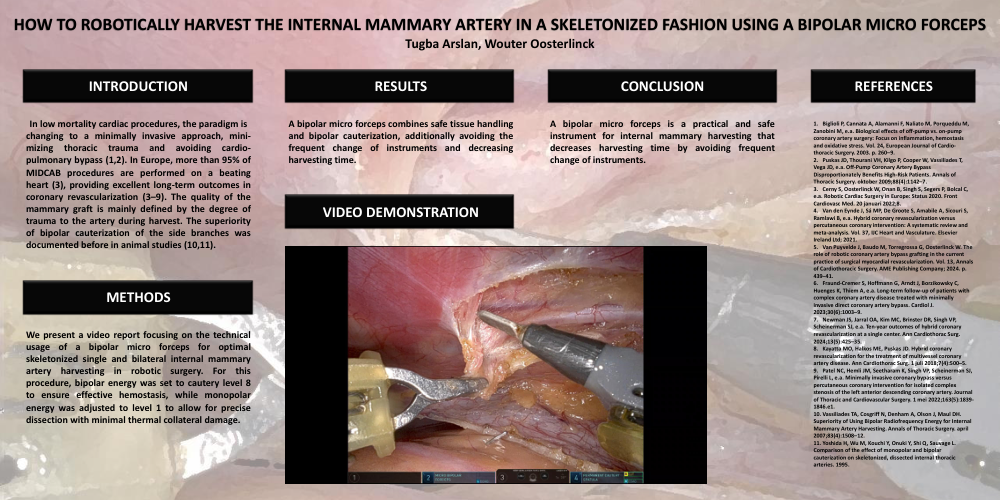
We present a video report focusing on the technical usage of a bipolar micro forceps for optimal skeletonized single and bilateral internal mammary artery harvesting in robotic surgery. For this procedure, bipolar energy was set to cautery level 8 to ensure effective hemostasis, while monopolar energy was adjusted to level 1 to allow for precise dissection with minimal thermal collateral damage.
RESULTS
A bipolar micro forceps combines safe tissue handling and bipolar cauterization, additionally avoiding the frequent change of instruments and decreasing harvesting time.
VIDEO DEMONSTRATION
CONCLUSION
A bipolar micro forceps is a practical and safe instrument for internal mammary harvesting that decreases harvesting time by avoiding frequent change of instruments.
REFERENCES
1. Biglioli P, Cannata A, Alamanni F, Naliato M, Porqueddu M, Zanobini M, e.a. Biological effects of off-pump vs. on-pump coronary artery surgery: Focus on inflammation, hemostasis and oxidative stress. Vol. 24, European Journal of Cardio-thoracic Surgery. 2003. p. 260–9.
2. Puskas JD, Thourani VH, Kilgo P, Cooper W, Vassiliades T, Vega JD, e.a. Off-Pump Coronary Artery Bypass Disproportionately Benefits High-Risk Patients. Annals of Thoracic Surgery. oktober 2009;88(4):1142–7.
3. Cerny S, Oosterlinck W, Onan B, Singh S, Segers P, Bolcal C, e.a. Robotic Cardiac Surgery in Europe: Status 2020. Front Cardiovasc Med. 20 januari 2022;8.
4. Van den Eynde J, Sá MP, De Groote S, Amabile A, Sicouri S, Ramlawi B, e.a. Hybrid coronary revascularization versus percutaneous coronary intervention: A systematic review and meta-analysis. Vol. 37, IJC Heart and Vasculature. Elsevier Ireland Ltd; 2021.
5. Van Puyvelde J, Baudo M, Torregrossa G, Oosterlinck W. The role of robotic coronary artery bypass grafting in the current practice of surgical myocardial revascularization. Vol. 13, Annals of Cardiothoracic Surgery. AME Publishing Company; 2024. p. 439–41.
6. Fraund-Cremer S, Hoffmann G, Arndt J, Borzikowsky C, Huenges K, Thiem A, e.a. Long-term follow-up of patients with complex coronary artery disease treated with minimally invasive direct coronary artery bypass. Cardiol J. 2023;30(6):1003–9.
7. Newman JS, Jarral OA, Kim MC, Brinster DR, Singh VP, Scheinerman SJ, e.a. Ten-year outcomes of hybrid coronary revascularization at a single center. Ann Cardiothorac Surg. 2024;13(5):425–35.
8. Kayatta MO, Halkos ME, Puskas JD. Hybrid coronary revascularization for the treatment of multivessel coronary artery disease. Ann Cardiothorac Surg. 1 juli 2018;7(4):500–5.
9. Patel NC, Hemli JM, Seetharam K, Singh VP, Scheinerman SJ, Pirelli L, e.a. Minimally invasive coronary bypass versus percutaneous coronary intervention for isolated complex stenosis of the left anterior descending coronary artery. Journal of Thoracic and Cardiovascular Surgery. 1 mei 2022;163(5):1839-1846.e1.
10. Vassiliades TA, Cosgriff N, Denham A, Olson J, Maul DH. Superiority of Using Bipolar Radiofrequency Energy for Internal Mammary Artery Harvesting. Annals of Thoracic Surgery. april 2007;83(4):1508–12.
11. Yoshida H, Wu M, Kouchi Y, Onuki Y, Shi Q, Sauvage L. Comparison of the effect of monopolar and bipolar cauterization on skeletonized, dissected internal thoracic arteries. 1995.