293 posters, 56 videos, 24 topics, 13 sessions, 658 authors, 215 institutions
ePostersLive by SciGen Technologies S.A. All rights reserved.
ISMICS 2025 Annual Meeting
28 - 31 May, 2025 | Istanbul, Turkey

P112
Modified right vertical axillary thoracotomy: 2-5 cm incision approach to repair various congenital heart diseases in all age groups
Poster Presenter
Authors
Affiliations
Lwj3781@126.com, 2429181829@qq.com, 1125563523@qq.com, donghaoju@163.com, fantaibing@163.com
Part of Topic
China Innovations
Background
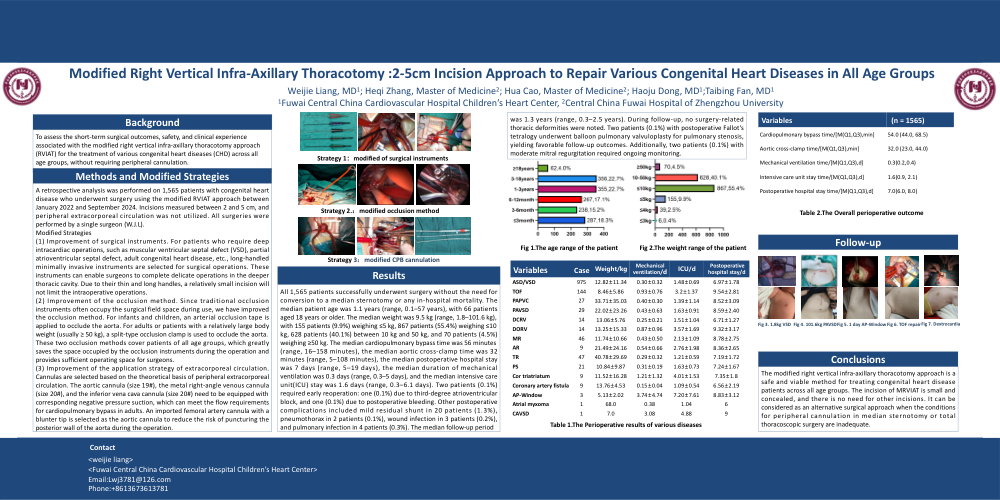
To assess the short-term surgical outcomes, safety, and clinical experience associated with the modified right vertical infra-axillary thoracotomy approach (RVIAT) for the treatment of various congenital heart diseases (CHD) across all age groups, without requiring peripheral cannulation.
Methods and Modified Strategies
A retrospective analysis was performed on 1,565 patients with congenital heart disease who underwent surgery using the modified RVIAT approach between January 2022 and September 2024. Incisions measured between 2 and 5 cm, and peripheral extracorporeal circulation was not utilized. All surgeries were performed by a single surgeon (W.J.L). Modified Strategies (1) Improvement of surgical instruments. For patients who require deep intracardiac operations, such as muscular ventricular septal defect (VSD), partial atrioventricular septal defect, adult congenital heart disease, etc., long-handled minimally invasive instruments are selected for surgical operations. These instruments can enable surgeons to complete delicate operations in the deeper thoracic cavity. Due to their thin and long handles, a relatively small incision will not limit the intraoperative operations. (2) Improvement of the occlusion method. Since traditional occlusion instruments often occupy the surgical field space during use, we have improved the occlusion method. For infants and children, an arterial occlusion tape is applied to occlude the aorta. For adults or patients with a relatively large body weight (usually ≥ 50 kg), a split-type occlusion clamp is used to occlude the aorta. These two occlusion methods cover patients of all age groups, which greatly saves the space occupied by the occlusion instruments during the operation and provides sufficient operating space for surgeons. (3) Improvement of the application strategy of extracorporeal circulation. Cannulas are selected based on the theoretical basis of peripheral extracorporeal circulation. The aortic cannula (size 19#), the metal right-angle venous cannula (size 20#), and the inferior vena cava cannula (size 20#) need to be equipped with corresponding negative pressure suction, which can meet the flow requirements for cardiopulmonary bypass in adults. An imported femoral artery cannula with a blunter tip is selected as the aortic cannula to reduce the risk of puncturing the posterior wall of the aorta during the operation.
Results
All 1,565 patients successfully underwent surgery without the need for conversion to a median sternotomy or any in-hospital mortality. The median patient age was 1.1 years (range, 0.1–57 years), with 66 patients aged 18 years or older. The median weight was 9.5 kg (range, 1.8–101.6 kg), with 155 patients (9.9%) weighing ≤5 kg, 867 patients (55.4%) weighing ≤10 kg, 628 patients (40.1%) between 10 kg and 50 kg, and 70 patients (4.5%) weighing ≥50 kg. The median cardiopulmonary bypass time was 56 minutes (range, 16–158 minutes), the median aortic cross-clamp time was 32 minutes (range, 5–108 minutes), the median postoperative hospital stay was 7 days (range, 5–19 days), the median duration of mechanical ventilation was 0.3 days (range, 0.3–5 days), and the median intensive care unit(ICU) stay was 1.6 days (range, 0.3–6.1 days). Two patients (0.1%) required early reoperation: one (0.1%) due to third-degree atrioventricular block, and one (0.1%) due to postoperative bleeding. Other postoperative complications included mild residual shunt in 20 patients (1.3%), pneumothorax in 2 patients (0.1%), wound infection in 3 patients (0.2%), and pulmonary infection in 4 patients (0.3%). The median follow-up period was 1.3 years (range, 0.3–2.5 years). During follow-up, no surgery-related thoracic deformities were noted. Two patients (0.1%) with postoperative Fallot's tetralogy underwent balloon pulmonary valvuloplasty for pulmonary stenosis, yielding favorable follow-up outcomes. Additionally, two patients (0.1%) with moderate mitral regurgitation required ongoing monitoring.
Conclusions
The modified right vertical infra-axillary thoracotomy approach is a safe and viable method for treating congenital heart disease patients across all age groups. The incision of MRVIAT is small and concealed, and there is no need for other incisions. It can be considered as an alternative surgical approach when the conditions for peripheral cannulation in median sternotomy or total thoracoscopic surgery are inadequate.