293 posters, 56 videos, 24 topics, 13 sessions, 658 authors, 215 institutions
ePostersLive by SciGen Technologies S.A. All rights reserved.
ISMICS 2025 Annual Meeting
28 - 31 May, 2025 | Istanbul, Turkey

P110
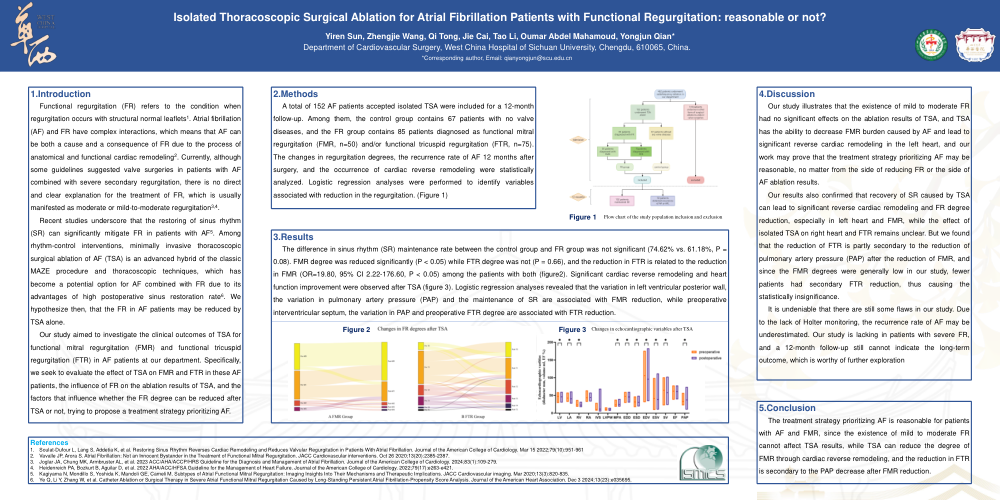
Isolated Thoracoscopic Surgical Ablation For Atrial Fibrillation Patients With Functional Regurgitation: Reasonable Or Not?
Part of Topic
China Innovations
1.Introduction
Functional regurgitation (FR) refers to the condition when regurgitation occurs with structural normal leaflets1. Atrial fibrillation (AF) and FR have complex interactions, which means that AF can be both a cause and a consequence of FR due to the process of anatomical and functional cardiac remodeling2. Currently, although some guidelines suggested valve surgeries in patients with AF combined with severe secondary regurgitation, there is no direct and clear explanation for the treatment of FR, which is usually manifested as moderate or mild-to-moderate regurgitation3,4.
Recent studies underscore that the restoring of sinus rhythm (SR) can significantly mitigate FR in patients with AF5. Among rhythm-control interventions, minimally invasive thoracoscopic surgical ablation of AF (TSA) is an advanced hybrid of the classic MAZE procedure and thoracoscopic techniques, which has become a potential option for AF combined with FR due to its advantages of high postoperative sinus restoration rate6. We hypothesize then, that the FR in AF patients may be reduced by TSA alone.
Our study aimed to investigate the clinical outcomes of TSA for functional mitral regurgitation (FMR) and functional tricuspid regurgitation (FTR) in AF patients at our department. Specifically, we seek to evaluate the effect of TSA on FMR and FTR in these AF patients, the influence of FR on the ablation results of TSA, and the factors that influence whether the FR degree can be reduced after TSA or not, trying to propose a treatment strategy prioritizing AF.
2.Methods
A total of 152 AF patients accepted isolated TSA were included for a 12-month follow-up. Among them, the control group contains 67 patients with no valve diseases, and the FR group contains 85 patients diagnosed as functional mitral regurgitation (FMR, n=50) and/or functional tricuspid regurgitation (FTR, n=75). The changes in regurgitation degrees, the recurrence rate of AF 12 months after surgery, and the occurrence of cardiac reverse remodeling were statistically analyzed. Logistic regression analyses were performed to identify variables associated with reduction in the regurgitation. (Figure 1)
3.Results
The difference in sinus rhythm (SR) maintenance rate between the control group and FR group was not significant (74.62% vs. 61.18%, P = 0.08). FMR degree was reduced significantly (P < 0.05) while FTR degree was not (P = 0.66), and the reduction in FTR is related to the reduction in FMR (OR=19.80, 95% CI 2.22-176.60, P < 0.05) among the patients with both (figure2). Significant cardiac reverse remodeling and heart function improvement were observed after TSA (figure 3). Logistic regression analyses revealed that the variation in left ventricular posterior wall, the variation in pulmonary artery pressure (PAP) and the maintenance of SR are associated with FMR reduction, while preoperative interventricular septum, the variation in PAP and preoperative FTR degree are associated with FTR reduction.
4.Discussion
Our study illustrates that the existence of mild to moderate FR had no significant effects on the ablation results of TSA, and TSA has the ability to decrease FMR burden caused by AF and lead to significant reverse cardiac remodeling in the left heart, and our work may prove that the treatment strategy prioritizing AF may be reasonable, no matter from the side of reducing FR or the side of AF ablation results.
Our results also confirmed that recovery of SR caused by TSA can lead to significant reverse cardiac remodeling and FR degree reduction, especially in left heart and FMR, while the effect of isolated TSA on right heart and FTR remains unclear. But we found that the reduction of FTR is partly secondary to the reduction of pulmonary artery pressure (PAP) after the reduction of FMR, and since the FMR degrees were generally low in our study, fewer patients had secondary FTR reduction, thus causing the statistically insignificance.
It is undeniable that there are still some flaws in our study. Due to the lack of Holter monitoring, the recurrence rate of AF may be underestimated. Our study is lacking in patients with severe FR, and a 12-month follow-up still cannot indicate the long-term outcome, which is worthy of further exploration
5.Conclusion
The treatment strategy prioritizing AF is reasonable for patients with AF and FMR, since the existence of mild to moderate FR cannot affect TSA results, while TSA can reduce the degree of FMR through cardiac reverse remodeling, and the reduction in FTR is secondary to the PAP decrease after FMR reduction.