293 posters, 56 videos, 24 topics, 13 sessions, 658 authors, 215 institutions
ePostersLive by SciGen Technologies S.A. All rights reserved.
ISMICS 2025 Annual Meeting
28 - 31 May, 2025 | Istanbul, Turkey

P109
A Single Center Initial Experience With Robotic-assisted Coronary Artery Bypass
Poster Presenter
Authors
Affiliations
Part of Topic
China Innovations
A Single Center Initial Experience with Robotic-Assisted Coronary Artery Bypass
BACKGROUND
The application of robotic technology in coronary artery bypass grafting (CABG) has been proven to be safe and feasible. However, the widespread adoption of this technique remains limited. Furthermore, the majority of centers currently performing robotic CABG are still restricted to single-vessel bypass procedures. In a mature minimally invasive cardiac surgery center, whether robotic CABG can be routinely implemented and what its future clinical prospects are require further validation through dedicated research.
OBJECTIVES
This study retrospectively analyzes the early clinical experience of a single center in expanding robotic-assisted CABG(RACAB) from single-vessel to multi-vessel procedures, with the aim of routine implementation.
METHODS
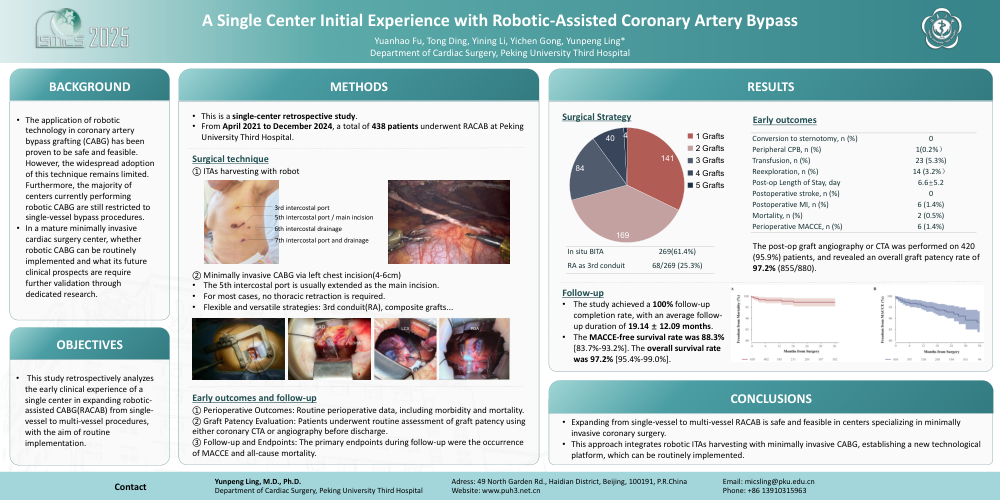
This is a single-center retrospective study. From April 2021 to December 2024, a total of 438 patients underwent RACAB at Peking University Third Hospital.
Surgical technique
① ITAs harvesting with robot
② Minimally invasive CABG via left chest incision(4-6cm) The 5th intercostal port is usually extended as the main incision. For most cases, no thoracic retraction is required. Flexible and versatile strategies: 3rd conduit(RA), composite grafts...
Early outcomes and follow-up ① Perioperative Outcomes: Routine perioperative data, including morbidity and mortality. ② Graft Patency Evaluation: Patients underwent routine assessment of graft patency using either coronary CTA or angiography before discharge. ③ Follow-up and Endpoints: The primary endpoints during follow-up were the occurrence of MACCE and all-cause mortality.
RESULTS
The post-op graft angiography or CTA was performed on 420 (95.9%) patients, and revealed an overall graft patency rate of 97.2% (855/880).
The study achieved a 100% follow-up completion rate, with an average follow-up duration of 19.14 ± 12.09 months. The MACCE-free survival rate was 88.3% [83.7%-93.2%]. The overall survival rate was 97.2% [95.4%-99.0%].
CONCLUSIONS
Expanding from single-vessel to multi-vessel RACAB is safe and feasible in centers specializing in minimally invasive coronary surgery. This approach integrates robotic ITAs harvesting with minimally invasive CABG, establishing a new technological platform, which can be routinely implemented.