293 posters, 56 videos, 24 topics, 13 sessions, 658 authors, 215 institutions
ePostersLive by SciGen Technologies S.A. All rights reserved.
ISMICS 2025 Annual Meeting
28 - 31 May, 2025 | Istanbul, Turkey
P111
Evaluation Of The Safety And Efficacy Of Radiofrequency Ablation In Managing Atrial Fibrillation During Total Thoracoscopic Heart Valve Surgery
Part of Topic
China Innovations
Evaluation of the safety and efficacy of radiofrequency ablation in managing atrial fibrillation during total thoracoscopic heart valve surgery.
Abstract
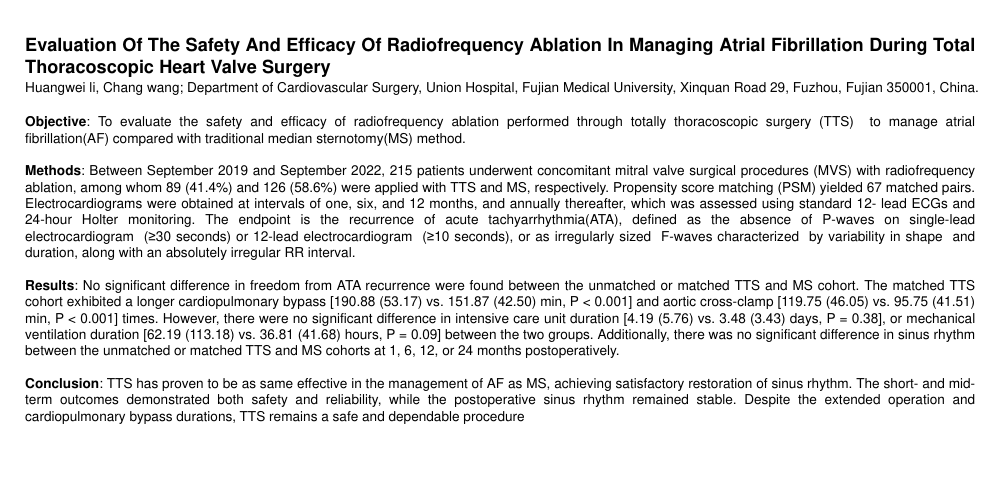
Objective: To evaluate the safety and efficacy of radiofrequency ablation performed through totally thoracoscopic surgery (TTS) to manage atrial fibrillation(AF) compared with traditional median sternotomy(MS) method.
Methods: Between September 2019 and September 2022, 215 patients underwent concomitant mitral valve surgical procedures (MVS) with radiofrequency ablation, among whom 89 (41.4%) and 126 (58.6%) were applied with TTS and MS, respectively. Propensity score matching (PSM) yielded 67 matched pairs. Electrocardiograms were obtained at intervals of one, six, and 12 months, and annually thereafter, which was assessed using standard 12- lead ECGs and 24-hour Holter monitoring. The endpoint is the recurrence of acute tachyarrhythmia(ATA), defined as the absence of P-waves on single-lead electrocardiogram (≥30 seconds) or 12-lead electrocardiogram (≥10 seconds), or as irregularly sized F-waves characterized by variability in shape and duration, along with an absolutely irregular RR interval.
Results: No significant difference in freedom from ATA recurrence were found between the unmatched or matched TTS and MS cohort. The matched TTS cohort exhibited a longer cardiopulmonary bypass [190.88 (53.17) vs. 151.87 (42.50) min, P < 0.001] and aortic cross-clamp [119.75 (46.05) vs. 95.75 (41.51) min, P < 0.001] times. However, there were no significant difference in intensive care unit duration [4.19 (5.76) vs. 3.48 (3.43) days, P = 0.38], or mechanical ventilation duration [62.19 (113.18) vs. 36.81 (41.68) hours, P = 0.09] between the two groups. Additionally, there was no significant difference in sinus rhythm between the unmatched or matched TTS and MS cohorts at 1, 6, 12, or 24 months postoperatively.
Conclusion: TTS has proven to be as same effective in the management of AF as MS, achieving satisfactory restoration of sinus rhythm. The short- and mid-term outcomes demonstrated both safety and reliability, while the postoperative sinus rhythm remained stable. Despite the extended operation and cardiopulmonary bypass durations, TTS remains a safe and dependable procedure.