167 posters, 28 videos, 9 topics, 12 sessions, 337 authors, 160 institutions
ePostersLive by SciGen Technologies S.A. All rights reserved.
ISMICS 2023 Annual Meeting
31 May - 3 June, 2023 | Boston, MA

PC72
Sensorized Vessel Simulator For Training In Robot-assisted Thoracoscopic Surgery
Poster Presenter
Authors
Beatrice Manfredini, Carmelina Cristina Zirafa, Gaetano Romano, Federico Davini, Selene Tognarelli, Arianna Menciassi, Andrea Mariani, Giulia Gamberini, Sabina Maglio, Fabrizia Calabrò, Franca Melfi
Affiliations
University of Modena and Reggio Emilia, University of Modena and Reggio Emilia, Modena, Italy, University of Pisa, Pisa, Italy, BioRobotics Institute, Scuola Superiore Sant'Anna, Pisa, Italy
Part of Topic
Education, Imaging and Facilitating Technologies
SENSORIZED VESSEL SIMULATOR FOR TRAINING IN ROBOT-ASSISTED THORACOSCOPIC SURGERY
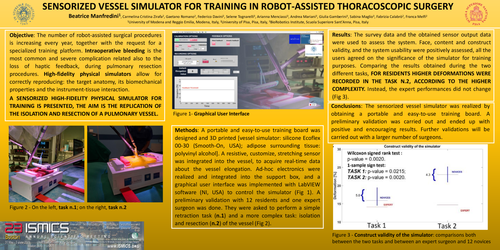
Objective: The number of robot-assisted surgical procedures is increasing every year, together with the request for a specialized training platform. Intraoperative bleeding is the most common and severe complication related also to the loss of haptic feedback, during pulmonary resection procedures. High-fidelity physical simulators allow for correctly reproducing: the target anatomy, its biomechanical properties and the instrument-tissue interaction.
A SENSORIZED HIGH-FIDELITY PHYSICAL SIMULATOR FOR TRAINING IS PRESENTED, THE AIM IS THE REPLICATION OF THE ISOLATION AND RESECTION OF A PULMONARY VESSEL.
Methods: A portable and easy-to-use training board was designed and 3D printed [vessel simulator: silicone Ecoflex 00-30 (Smooth-On, USA); adipose surrounding tissue: polyvinyl alcohol]. A resistive, customize, stretching sensor was integrated into the vessel, to acquire real-time data about the vessel elongation. Ad-hoc electronics were realized and integrated into the support box, and a graphical user interface was implemented with LabVIEW software (NI, USA) to control the simulator (Fig 1). A preliminary validation with 12 residents and one expert surgeon was done. They were asked to perform a simple retraction task (n.1) and a more complex task: isolation and resection (n.2) of the vessel (Fig 2).
Results: The survey data and the obtained sensor output data were used to assess the system. Face, content and construct validity, and the system usability were positively assessed, all the users agreed on the significance of the simulator for training purposes. Comparing the results obtained during the two different tasks, FOR RESIDENTS HIGHER DEFORMATIONS WERE RECORDED IN THE TASK N.2, ACCORDING TO THE HIGHER COMPLEXITY. Instead, the expert performances did not change (Fig 3).
Conclusions: The sensorized vessel simulator was realized by obtaining a portable and easy-to-use training board. A preliminary validation was carried out and ended up with positive and encouraging results. Further validations will be carried out with a larger number of surgeons.