167 posters, 28 videos, 9 topics, 12 sessions, 337 authors, 160 institutions
ePostersLive by SciGen Technologies S.A. All rights reserved.
ISMICS 2023 Annual Meeting
31 May - 3 June, 2023 | Boston, MA

PC34
Morphometric Measurements Prior To Mkr-mic: Technical And Educational Aspects
Poster Presenter
Authors
Wilfried Wisser, Marie-Elisabeth Stelzmueller, Sabine Kappl, Guenther Laufer
Affiliations
Part of Topic
Education, Imaging and Facilitating Technologies
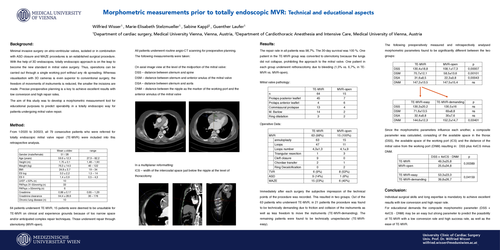
Morphometric measurements prior to totally endoscopic MVR: Technical and educational aspects
Background:
Minimal invasive surgery on atrio-ventricular valves, isolated or in combination with ASD closure and MAZE procedures is an established surgical procedure. With the help of 3D endoscopes, totally endoscopic approach is on the leap to become the new standard in mitral valve surgery. Thus, operations can be carried out through a single working port without any rib spreading. Whereas visualisation with 3D cameras is even superior to conventional surgery, the freedom of movements of instruments is reduced, the smaller the incisions are made. Precise preoperative planning is a key to achieve excellent results with low conversion and high repair rates.
The aim of this study was to develop a morphometric measurement tool for educational purposes to predict operability in a totally endoscopic way for patients undergoing mitral valve repair.
Method:
From 1/2020 to 3/2023, all 79 consecutive patients who were referred for totally endoscopic mitral valve repair (TE-MVR) were included into this retrospective analysis.
64 patients underwent TE-MVR, 15 patients were deemed to be unsuitable for TE-MVR on clinical and experience grounds because of too narrow space and/or anticipated complex repair techniques. Those underwent repair through sternotomy (MVR-open).
All patients underwent routine angio-CT scanning for preoperative planning.
The following measurements were taken:
On axial image view at the level of the midportion of the mitral valve:
DSS – distance between sternum and spine
DSM – distance between sternum and anterior anulus of the mitral valve
DSA – distance between sternum and aorta
DNM – distance between the nipple as the marker of the working port and the anterior annulus of the mitral valve
In a multiplanar reformatting:
ICS – width of the intercostal space just below the nipple at the level of thoracotomy
Results:
The repair rate in all patients was 98,7%. The 30-day survival was 100 %. One patient in the TE-MVR group was converted to sternotomy because the lungs did not collapse, prohibiting the approach to the mitral valve. One patient in each group underwent rethoracotomydue to bleeding (1,5% vs. 6,7%, in TE-MVR vs. MVR-open).
Immediately after each surgery the subjective impression of the technical points of the procedure was recorded. This resulted in two groups. Out of the 63 patients who underwent TE-MVR, in 21 patients the procedure was found to be technically demanding due to friction and collision of the instruments as well as less freedom to move the instruments (TE-MVR-demanding). The remaining patients were found to be technically unspectacular (TE-MVR-easy).
The following preoperatively measured and retrospectively analysed morphometric parameters found to be significantly different between the two groups:
Since the morphometric parameters influence each another, a composite parameter was calculated, consisting of the available space in the thorax (DSS), the available space of the working port (ICS) and the distance of the mitral valve from the working port (DNM) resulting in: DSS plus 4xICS minus DNM.
Conclusion:
Individual surgical skills and long expertise is mandatory to achieve excellent results with low conversion and high repair rate.
For educational demands the composite morphometric parameter (DSS + 4xICS - DNM) may be an easy but strong parameter to predict the possibility of TE-MVR with a low conversion rate and high success rate, as well as the ease of TE-MVR.