167 posters, 28 videos, 9 topics, 12 sessions, 337 authors, 160 institutions
ePostersLive by SciGen Technologies S.A. All rights reserved.
ISMICS 2023 Annual Meeting
31 May - 3 June, 2023 | Boston, MA

PC40
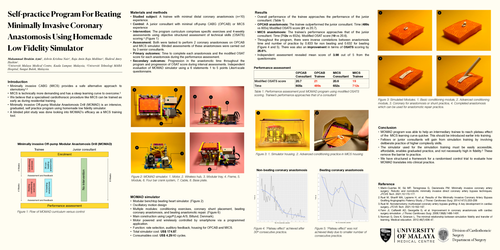
Self-practice Program For Beating Minimally Invasive Coronary Anastomosis Using Homemade Low Fidelity Simulator
Poster Presenter
Part of Topic
Education, Imaging and Facilitating Technologies
Self-practice Program For Beating Minimally Invasive Coronary Anastomosis Using Homemade Low Fidelity Simulator
Introduction
Minimally invasive CABG (MICS) provides a safe alternative approach to sternotomy1,2
MICS is technically more demanding and has a steep learning curve to overcome.3
We believe that a specialised cardiothoracic procedure like MICS can be trained as early as during residential training.
Minimally invasive Off-pump Modular Anastomosis Drill (MOMAD) is an intensive, graduated, self practice program using homemade low fidelity simulator.
A blinded pilot study was done looking into MOMAD’s efficacy as a MICS training tool.
Materials and methods
Studied subject: A trainee with minimal distal coronary anastomosis (n<10) experience.
Control: A junior consultant with minimal off-pump CABG (OPCAB) or MICS experience
Intervention: The program curriculum comprises specific exercises and 4-weekly assessments using objective structured assessment of technical skills (OSATS) scoring.4 (Figure 1)
Assessment: Both were tasked to perform 2 coronary anastomoses on OPCAB and MICS simulator. Blinded assessments of these anastomoses were carried out by 3 senior consultants.
Primary outcomes: Time to complete each anastomosis and the modified OSAT score for each anastomosis during the performance assessment.
Secondary outcomes: Progression in the anastomotic time throughout the program and progression of OSAT score during interval assessments. Independent evaluation of MOMAD simulator using a 6 statements 1 to 5 points Likert-scale questionnaire.
MOMAD simulator
Modular benchtop beating heart simulator. (Figure 2)
Oscillatory motion design
Multiple modules: conditioning exercises, coronary shunt placement, beating coronary anastomosis, and beating anastomotic repair. (Figure 6)
Main construction using Lego® (Lego A/S, Billund, Denmark).
Motor powered and wirelessly controlled by smartphone via a programmed application.
Function: rate selection, auditory feedback, housing for OPCAB and MICS.
Total simulator cost: US$ 174.87.
Consumables cost: US$ 4.29/40 cycles.
Results
Overall performance of the trainee approaches the performance of the junior consultant. (Table 1)
OPCAB anastomosis: The trainee outperformed the junior consultant. Time (489s vs 605s) Modified OSATS score (21 vs 20.7).
MICS anastomosis: The trainee’s performance approaches that of the junior consultant. Time (712s vs 652s). Modified OSAT score (19 vs 20.6).
Throughout the program, there were inverse correlations between anastomosis time and number of practice by 0.833 for non beating and 0.632 for beating (Figure 4 and 5). There was also an improvement in terms of OSATS scoring by 26.6%.
Independent assessment revealed mean score of 3.98 out of 5 from the questionnaire.
Conclusion
MOMAD program was able to help an intermediary trainee to reach plateau effect of the MICS learning curve quicker. This should be introduced earlier into training.
Fellows or junior consultants will gain from simulation training by involving deliberate practice of higher complexity skills.
The simulator used for the simulation training must be easily accessible, affordable, enables graduated practice, and not necessarily high in fidelity.5 These remove the barrier to practice.
We have structured a framework for a randomised control trial to evaluate how MOMAD translates into clinical practice.