167 posters, 28 videos, 9 topics, 12 sessions, 337 authors, 160 institutions
ePostersLive by SciGen Technologies S.A. All rights reserved.
ISMICS 2023 Annual Meeting
31 May - 3 June, 2023 | Boston, MA

PC38
How To Successfully Perform Minimally Invasive Cardiac Surgery In A Resource Limited Setting
Poster Presenter
Authors
Affiliations
Part of Topic
Education, Imaging and Facilitating Technologies
How To Successfully Perform Minimally Invasive Cardiac Surgery In A Resource Limited Setting
Abstract: The advent of minimally invasive cardiac surgery (MICS) has led to significant reduction in patient morbidity. Apart from the cosmetic benefit of a small scar, there are a myriad of other benefits viz. earlier mobilization, less transfusion requirement, reduction of systemic inflammatory response, early return to work, less pain etc. However, providing the benefit of MICS to the patient involves training of the team along with other resources designed for MICS viz. specialized instruments, cannulae, endoscope, disposables etc. The cost of a full MICS instrument set costs no less than 100,000 USD. Apart from that we need specialized scopes and endo-camera unit along with various disposables. However, with slight changes in the standard techniques, these procedures are possible with conventional instruments meant for open surgery with same level of patient safety and outcome. In this article we share our experience of 3 cases: one atrial septal defect closure and two mitral valve replacements done using a 6cm small right thoracotomy without using any specialized instruments, along with the tips and tricks to successfully perform such surgeries in a resource limited setting.
Introduction: Minimally invasive cardiac surgery (MICS) is not just for cosmetic benefits. Avoiding sternotomy leads to a significant reduction in post-operative morbidity and faster return to normal activities. As more and more surgeons are being trained in MICS, it’s reach is extending beyond select centers. Apart from the training and the know-how, performing MICS requires specific type of shafted instruments and clamps to ease the performance of the procedure through small incision. Since these instruments bear formidable cost and their procurement is not justified at low volume centers, it can act as a hindrance to earlier adaptation of MICS among certain institutions and surgeons. We here demonstrate 3 cases of MICS done through a 6cm right mini thoracotomy without the use of any specialized instruments.
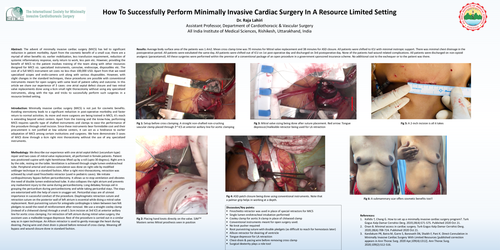
Methodology: We describe our experience with one atrial septal defect (secundum type) repair and two cases of mitral valve replacement, all performed in female patients. Patient was positioned supine with right hemithorax lifted up by a roll (upto 30 degress). Right arm is by the side, resting on the table. Ventilation is achieved through single lumen endotracheal tube. Peripheral arterial and venous cannulation was done on right side by modified seldinger technique in a standard fashion. After a right mini-thoracotomy, retraction was achieved by small sized finochietto retractor (used in pediatric cases). We initiate cardiopulmonary bypass before pericardiectomy. It allows us to stop ventilation and obviates the need of double lumen endotracheal tube. It also collapses the right atrium and prevents any inadvertent injury to the same during pericardiectomy. Long debakey forceps aid in grasping the pericardium during pericardiectomy and while taking pericardial stays. The stays are exteriorized with the help of snare in snugger-set. Pericardial stays are of utmost importance in successful conduct of the procedure. Diaphragmatic retraction suture and retraction suture on the posterior wall of left atrium is essential while doing a mitral valve replacement. Root pursestring suture for antegrade cardioplegia is taken between two felt pledgets to avoid the need of reinforcement after removal. We use a straight cooley clamp (instead of a chitwood clamp) through a small 1.5cm incision at 3rd ICS at anterior axillary line for aortic cross clamping. For retraction of left atrium during mitral valve surgery, the assistant uses a malleable tongue depressor. Rest of the procedure is carried out in a similar way as in open technique. An Allison retractor is used to gently massage the heart during deairing. Pacing wire and chest drain is placed before removal of cross clamp. Weaning off bypass and wound closure done in standard fashion.
Results: Average body surface area of the patients was 1.4m2. Mean cross clamp time was 70 minutes for Mitral valve replacement and 38 minutes for ASD closure. All patients were shifted to ICU with minimal inotropic support. There was minimal chest drainage in the postoperative period. All patients were extubated the same day. All patients were shifted out of ICU on 1st post-operative day and discharged on 3rd postoperative day. None of the patients had wound related complications. All patients were discharged on non-opioid analgesic (paracetamol). All these surgeries were performed within the premise of a conventional package of an open procedure in a government sponsored insurance scheme. No additional cost to the exchequer or to the patient was there.
Discussion/Key points:
- Finochietto retractor was used in place of special retractors for MICS
- Single lumen endotracheal intubation performed
- Cooley clamp for aortic X-clamp in place of chitwood clamp
- Conventional instruments meant for open surgery used.
- No knot pusher required
- Root pursestring suture with double pledgets (as difficult to reach for hemostasis later)
- Allison retractor for deairing of ventricle
- Tongue depressor for LA retraction
- Chest-drain & pacing wire before removing cross clamp
References:
- Kofidis T, Chang G. How to set up a minimally invasive cardiac surgery program?. Turk Gogus Kalp Damar Cerrahisi Derg. 2020;28(4):571-575. Published 2020 Oct 21.
- Onan B. Minimal access in cardiac surgery. Turk Gogus Kalp Damar Cerrahisi Derg. 2020;28(4):708-724. Published 2020 Oct 21.
- Kandakure PR, Batra M, Garre S, Banovath SN, Shaikh F, Pani K. Direct Cannulation in Minimally Invasive Cardiac Surgery With Limited Resources [published correction appears in Ann Thorac Surg. 2020 Apr;109(4):1312]. Ann Thorac Surg. 2020;109(2):512-516.