167 posters, 28 videos, 9 topics, 12 sessions, 337 authors, 160 institutions
ePostersLive by SciGen Technologies S.A. All rights reserved.
ISMICS 2023 Annual Meeting
31 May - 3 June, 2023 | Boston, MA

PC35
Robotic Training: Virtual Vs Real Simulator
Poster Presenter
Authors
Affiliations
Part of Topic
Education, Imaging and Facilitating Technologies
Background: The increasing spread of robotic surgery requires the standardization of an adequate training program for residents and young surgeons. To date, real and virtual simulators for robotic surgery are available, but a global training program for robotic thoracic surgery has not been standardized, yet. The goal of this study is the validation of a real model for training in robotic surgery and its subsequent inclusion in a specific training program.
Methods: 30 residents coming from the first three years of different surgical specialties were enrolled. The study protocol was designed in three steps:
-Phase I: all learners performed specific exercises on the virtual simulator.
-Phase II: the 30 participants were divided into two groups, respecting a fair distribution based on the year of residency. The group 1 was trained on the physical simulator, the group 2 on the virtual one.
-Phase III: all the residents performed the same exercise on the virtual simulator, in order to compare the results obtained between the two groups.
The physical simulator is a chest model purposely built through the 3D recontruction of a CT scan of an adult a normotype adult. Within the model, animal tissues are integrated. In this study, bovine lungs were used.
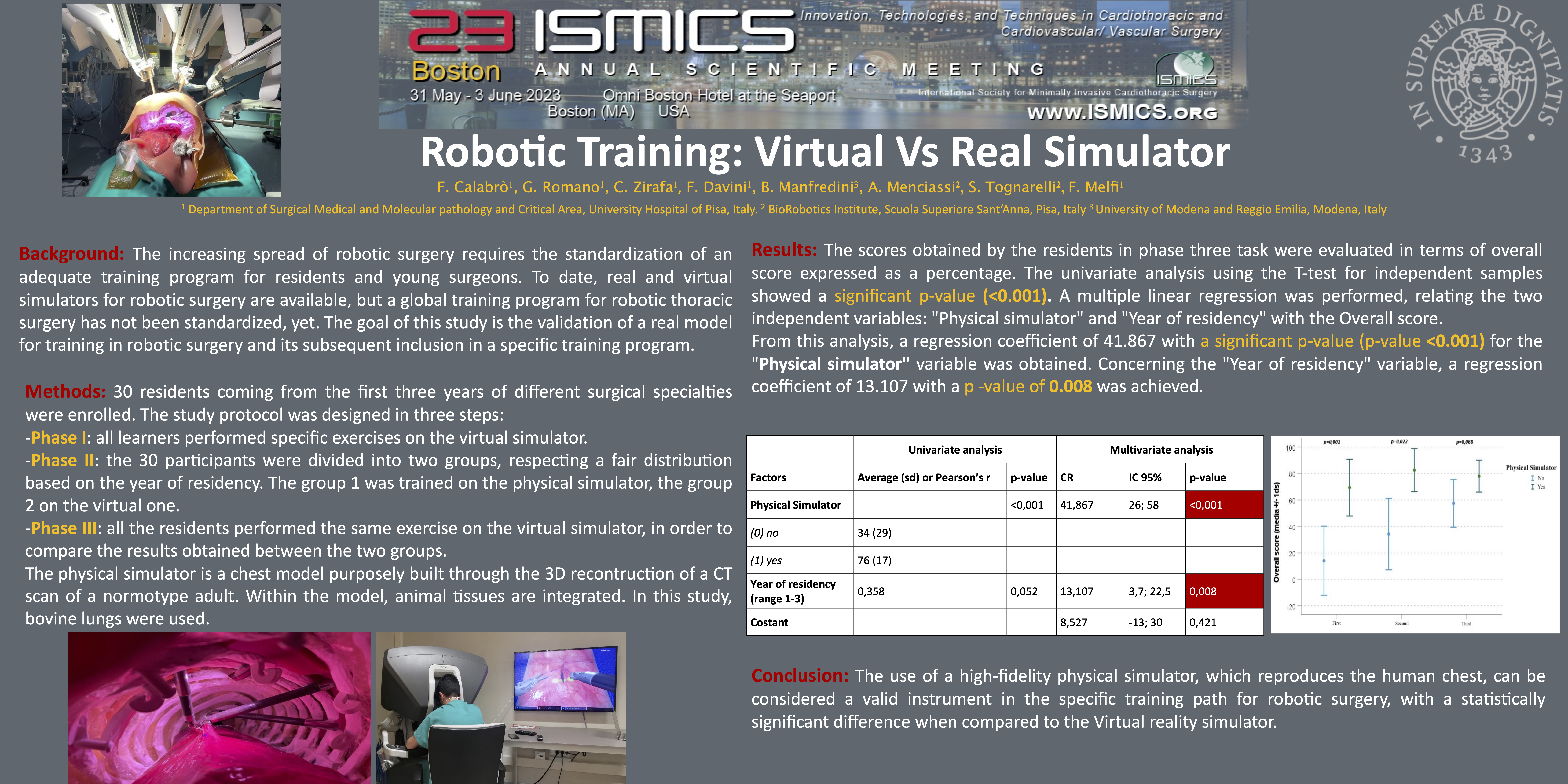
Results: The scores obtained by the residents in phase three task were evaluated in terms of overall score expressed as a percentage. The univariate analysis using the T-test for independent samples showed a significant p-value (<0.001). A multiple linear regression was performed, relating the two independent variables: "Physical simulator" and "Year of residency" with the Overall score.
From this analysis, a regression coefficient of 41.867 with a significant p-value (p-value <0.001) for the "Physical simulator" variable was obtained. Concerning the "Year of residency" variable, a regression coefficient of 13.107 with a p -value of 0.008 was achieved.
Conclusion: The use of a high-fidelity physical simulator, which reproduces the human chest, can be considered a valid instrument in the specific training path for robotic surgery, with a statistically significant difference when compared to the Virtual reality simulator.