477 posters, 14 topics, 2,065 authors, 1,055 institutions
ePostersLive by SciGen Technologies S.A. All rights reserved.
The Joint EBJIS-MSIS 2026 Conference
17 - 19 September, 2026 | Porto, Portugal

PP09
Transcriptomic analysis of knee periprosthetic joint infection highlights an active immune response
Poster Presenter
Authors
Nicolas Piuzzi, Ryan Musich, Suan Sin Foo, Weiqiang Chen, Thaddeus Stappenbeck, Anabelle Visperas
Affiliations
Cleveland Clinic Department of Orthopaedic Surgery, Cleveland, United States, Cleveland Clinic, Cleveland Clinic Department of Inflammation and Immunity, Cleveland, United States, Agency for Science, Technology and Research (A*STAR), Singapore, Singapore; Cleveland Clinic Department of Infection Biology, Cleveland, United States, Nanang Technological University, Singapore, Singapore; Cleveland Clinic Department of Infection Biology, Cleveland, United States
Part of Topic
Basic Science
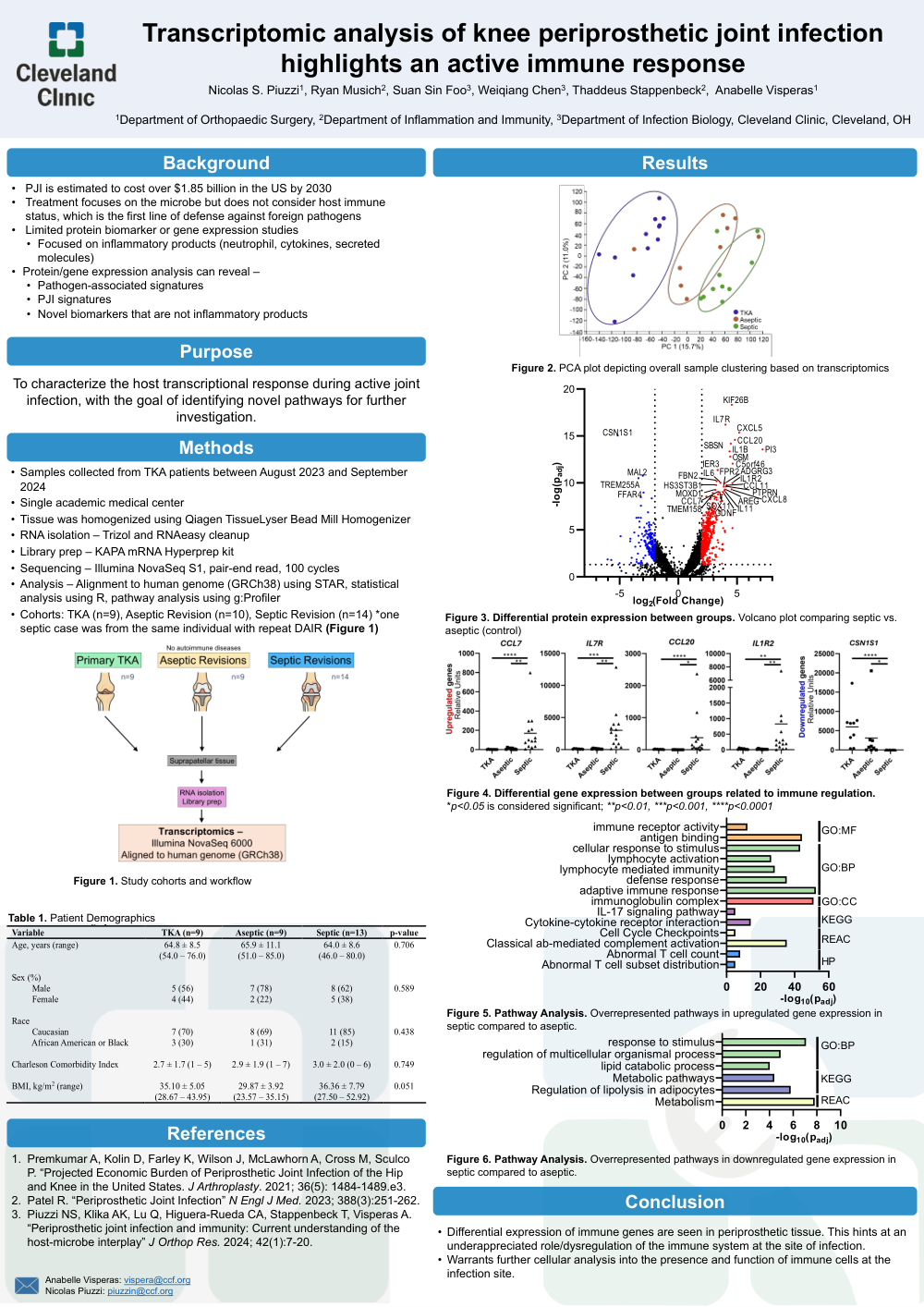
Introduction and Aims: Periprosthetic joint infection (PJI) is a serious complication of total joint arthroplasty with unclear pathophysiology. As one of the leading causes of revision surgery, it carries substantial morbidity, increased mortality risk, and significant healthcare burden. This study aimed to characterize the host transcriptional response during active joint infection, with the goal of identifying novel pathways for further investigation.
Methods: This study was conducted at a single academic institution, where patient samples were prospectively collected from August 2023-September 2024. Suprapatellar fat pad tissue was obtained during arthroplasty surgery from 33 patients undergoing primary total knee arthroplasty (TKA; n = 9), aseptic revision TKA (n = 9), and septic revision TKA meeting the 2018 International Consensus Meeting (ICM) criteria for PJI (n = 14). Bulk RNA sequencing was performed using the Illumina NovaSeq 6000 (paired-end 2 x 100bp reads), aligned to the human reference genome (GRCh38) using STAR, and analyzed using R. RNA expression changes with ≥ 2-fold and adjusted P ≤ 0.05 were considered significant for further functional enrichment pathway analysis using g:Profiler.
Results: Principal component analysis (PCA) showed clear group clustering along PC1 (15.7%) and PC2 (11.0%), explaining 26.7% of total variance (Figure 1A). Compared to aseptic controls, septic samples contained 579 uniquely upregulated and 228 uniquely downregulated genes (Figure 2). Notably, immune-related genes were significantly upregulated including (fold-change reported septic/aseptic) CCL7 (10.9, P < 0.0001), CCL20 (28.28, P < 0.0001), IL1R2 (24.47, P < 0.0001), and IL7R (16.25, P < 0.0001) while CSN1S1 (-35.97, P < 0.0001) was markedly downregulated (Figure 1C). Enrichment analysis revealed activation of immune and inflammatory pathways, including cytokine signaling and lymphocyte-mediated immunity, alongside suppression of metabolic processes (Figure 1D).
Conclusions: These findings demonstrate a strong immune activation response in PJI. The results highlight key immune pathways involved in infection and support further investigation into the host immune response to guide future diagnostic and therapeutic strategies.