477 posters, 14 topics, 2,052 authors, 1,056 institutions
ePostersLive by SciGen Technologies S.A. All rights reserved.
The Joint EBJIS-MSIS 2026 Conference
17 - 19 September, 2026 | Porto, Portugal
EP007
Antibiotic prophylaxis in orthopedic surgery: high adherence but persistent postoperative overuse � a clinical audit
Poster Presenter
Authors
Jawhar Ben Dhief, Jacem Saadana, mariem abdeljelil, aymen fekih, abderrazak abid
Affiliations
The Orthopedics and Traumatology Department, Fattouma Bourguiba University Hospital, Monastir, Monastir, Tunisia, Infectious Diseases Department, Fattouma Bourguiba University Hospital, Tunisia, The Orthopedics and Traumatology Department, Habib Bourguiba University Hospital, Sfax
Part of Topic
Antibiotics
Background : Surgical site infections (SSI) significantly impact patient outcomes and healthcare systems. Antibiotic prophylaxis is a key preventive measure, yet adherence to guidelines remains variable. vObjectives: To evaluate adherence to antibiotic prophylaxis guidelines and assess their effectiveness in preventing surgical site infections in orthopedic and trauma surgery.
Materials and Methods : Prospective observational study conducted in the orthopedic and trauma surgery department of Fattouma Bourguiba University Hospital (Monastir, Tunisia). Data were collected between December 1, 2023, and February 29, 2024. Patients were followed for three months postoperatively to detect SSI. Antibiotic prophylaxis practices were assessed according to French Society of Anesthesia and Resuscitation recommendations.
Study cohort : A total of 224 patients were included (mean age 53.35 years; sex ratio 1.46). All patients underwent orthopedic or trauma surgery and were prospectively monitored for postoperative infection.
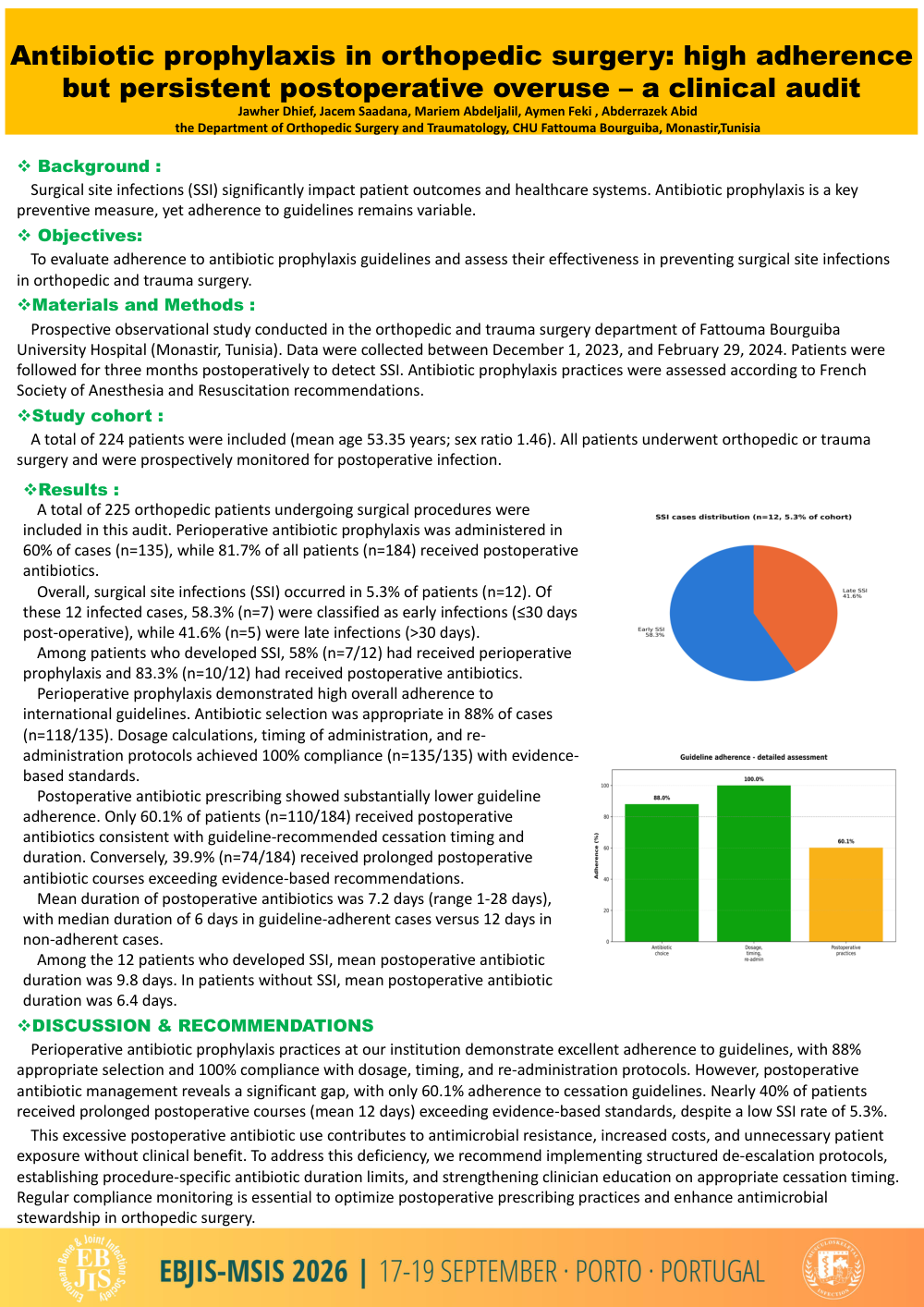
Results : A total of 225 orthopedic patients undergoing surgical procedures were included in this audit. Perioperative antibiotic prophylaxis was administered in 60% of cases (n=135), while 81.7% of all patients (n=184) received postoperative antibiotics. Overall, surgical site infections (SSI) occurred in 5.3% of patients (n=12). Of these 12 infected cases, 58.3% (n=7) were classified as early infections (≤30 days post-operative), while 41.6% (n=5) were late infections (>30 days). Among patients who developed SSI, 58% (n=7/12) had received perioperative prophylaxis and 83.3% (n=10/12) had received postoperative antibiotics. Perioperative prophylaxis demonstrated high overall adherence to international guidelines. Antibiotic selection was appropriate in 88% of cases (n=118/135). Dosage calculations, timing of administration, and readministration protocols achieved 100% compliance (n=135/135) with evidencebased standards. Postoperative antibiotic prescribing showed substantially lower guideline adherence. Only 60.1% of patients (n=110/184) received postoperative antibiotics consistent with guideline-recommended cessation timing and duration. Conversely, 39.9% (n=74/184) received prolonged postoperative antibiotic courses exceeding evidence-based recommendations. Mean duration of postoperative antibiotics was 7.2 days (range 1-28 days), with median duration of 6 days in guideline-adherent cases versus 12 days in non-adherent cases. Among the 12 patients who developed SSI, mean postoperative antibiotic duration was 9.8 days. In patients without SSI, mean postoperative antibiotic duration was 6.4 days.
DISCUSSION & RECOMMENDATIONS Perioperative antibiotic prophylaxis practices at our institution demonstrate excellent adherence to guidelines, with 88% appropriate selection and 100% compliance with dosage, timing, and re-administration protocols. However, postoperative antibiotic management reveals a significant gap, with only 60.1% adherence to cessation guidelines. Nearly 40% of patients received prolonged postoperative courses (mean 12 days) exceeding evidence-based standards, despite a low SSI rate of 5.3%. This excessive postoperative antibiotic use contributes to antimicrobial resistance, increased costs, and unnecessary patient exposure without clinical benefit. To address this deficiency, we recommend implementing structured de-escalation protocols, establishing procedure-specific antibiotic duration limits, and strengthening clinician education on appropriate cessation timing. Regular compliance monitoring is essential to optimize postoperative prescribing practices and enhance antimicrobial stewardship in orthopedic surgery.