477 posters, 14 topics, 2,065 authors, 1,055 institutions
ePostersLive by SciGen Technologies S.A. All rights reserved.
The Joint EBJIS-MSIS 2026 Conference
17 - 19 September, 2026 | Porto, Portugal

EP004
How to detect low-level fluoroquinolone resistance in Staphylococcus using an antimicrobial susceptibility testing card* on an automated susceptibility testing system*: consequence for treatment choice
Poster Presenter
Part of Topic
Antibiotics
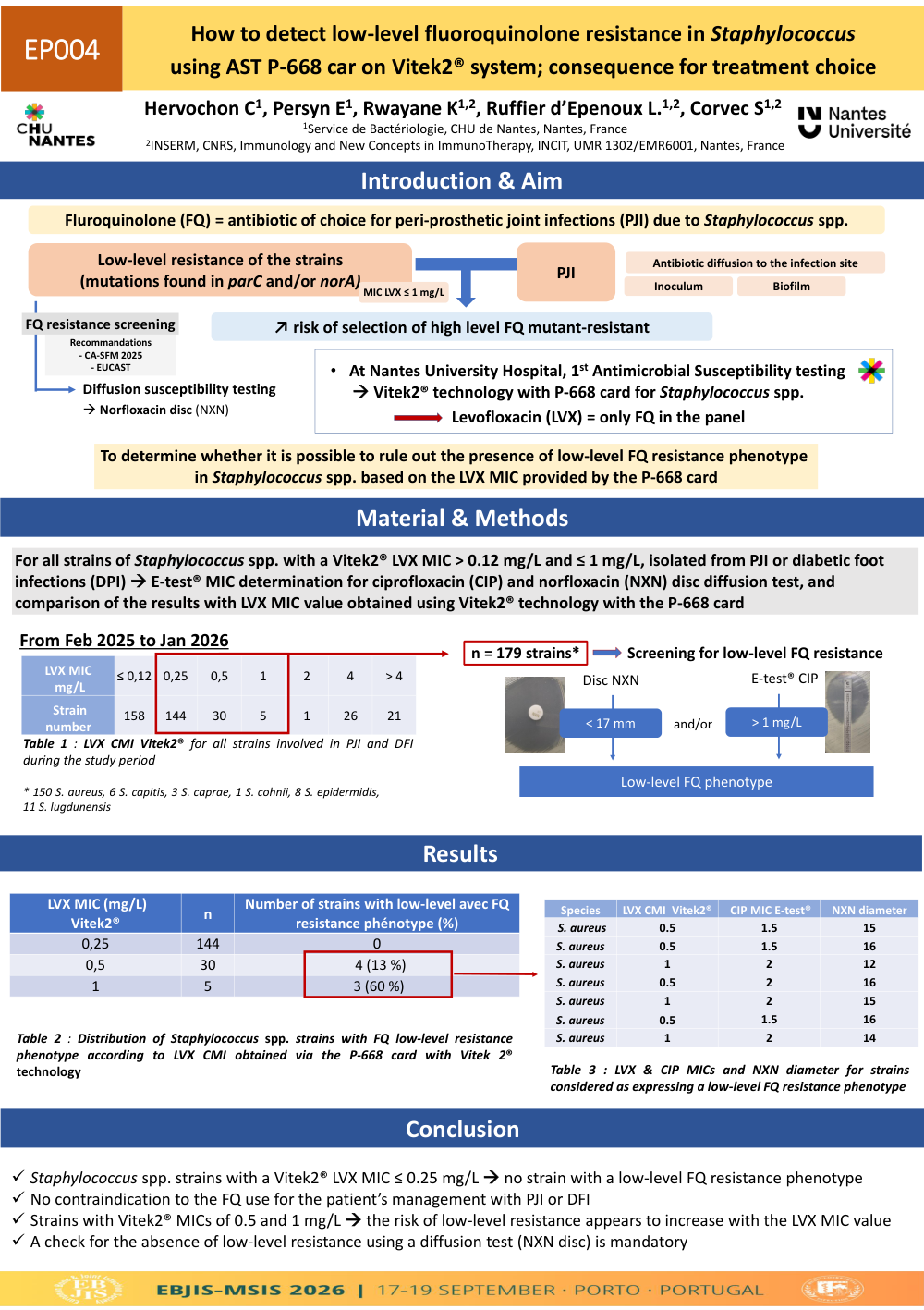
How to detect low-level fluoroquinolone resistance in Staphylococcus spp. involved in Bone and joint infection using the AST P-668 card on the Vitek 2® system: consequence for treatment choice
Introduction
Fluoroquinolones (FQs) are among the drugs of choice for the treatment of bone and joint infections (BJIs), particularly those caused by Staphylococcus spp.
Addition of norfloxacin (NFX) disk to the testing panel allows easy detection of low-level resistance in laboratories using firstly disk diffusion methods. However, it is probably more difficult for laboratories using the Vitek 2® automated system, with AST P-668 cards including only levofloxacin (LVX).
The aim of this study was to determine whether low-level FQ-resistance in Staphylococcus spp. can be ruled out based on the LVX MIC obtained with the Vitek2® card.
Materials and Methods
A total of 136 clinical isolates from BJIs and diabetic foot wound infections (112 S. aureus, 24 coagulase-negative staphylococci) with LVX MICs ranging from 0.25 mg/L to 1 mg/L as determined by the AST-P668 card were prospectively included. Low-level FQ-resistance was screened using norfloxacin (NFX) disk and ciprofloxacin (CPX) MIC determined by E-test®. Isolates with an inhibition zone diameter <17 mm around the NFX disk or a CPX MIC >1 mg/L were considered to exhibit low-level FQ-resistance, according to the 2025 CASFM guidelines.
Results
Among the 136 isolates, 4 S. aureus exhibited a low-level resistance phenotype (2.9%). These strains had LVX MICs of 0.5 mg/L or 1 mg/L. Among the 110 isolates with an LVX MIC of 0.25 mg/L, no low-level resistance was detected. Of the 22 isolates with an LVX MIC of 0.5 mg/L, 2 screened positive (9%). Among the 4 isolates with an LVX MIC of 1 mg/L, 2 screened positive (50%).
Conclusion
Low-level fluoroquinolone resistance can be ruled out in isolates with an LVX MIC of 0.25 mg/L as determined by the Vitek 2® system.
These findings showed that isolates with an LVX MIC of 0.12 mg/L do not harbor first-step resistance mechanisms, and extend this observation to isolates with an LVX MIC of 0.25 mg/L using Vitek2®. Therefore FQ can be used for BJI treatment.
For isolates with LVX MICs of 0.5 mg/L and 1 mg/L, the risk of low-level resistance appears to increase with the MIC value. Indeed, screening was positive in 9% and 50% respectively. Thus, the use of FQ in BJIs appears appropriate when Staphylococcus isolates exhibit an LVX MIC ≤0.25 mg/L using Vitek 2®.
Finally, for isolates with LVX MICs of 0.5 mg/L or 1 mg/L, additional testing to detect low-level resistance is recommended before considering FQ therapy.