477 posters, 14 topics, 2,065 authors, 1,055 institutions
ePostersLive by SciGen Technologies S.A. All rights reserved.
The Joint EBJIS-MSIS 2026 Conference
17 - 19 September, 2026 | Porto, Portugal

EP008
Real-World Oritavancin PK-Guided Suppressive Therapy for Chronic Non-faecalis Enterococci Prosthetic Joint and Fracture-Related Infections: A Case Series from Reference Centre
Poster Presenter
Authors
Francesco Petri, Letizia Scandiffio, Carlo Montagna, Giovanni De Capitani, Dario Cattaneo, Simona Landonio, Stefania Merli, Massimo Coen, Alberto Dolci, Andrea Gori, Matteo Passerini
Affiliations
Department of Infectious Diseases, "Luigi Sacco" University Hospital, Milan, Milano, Italy, Unit of Clinical Pathology, ASST Fatebenefratelli-Sacco, Luigi Sacco University Hospital, Milan, Italy., Milano, Italy, Department of Biomedical and Clinical Sciences, Universit? degli Studi di Milano, Milano, Italy, Milano, Italy, IRCCS Humanitas Research Hospital, Milan, Italy; Department of Biomedical Sciences, Humanitas University, Pieve Emanuele, Italy., Milano, Italy, Department of Pathophysiology and Transplantation, Universit? degli Studi di Milano, Milano, Italy, Milano, Italy, Department of Infectious Diseases, "Luigi Sacco" University Hospital, Milan
Part of Topic
Antibiotics
Background. Suppressive antibiotic treatment (SAT) for prosthetic joint infections (PJIs) or fracture-related infections (FRIs) due to non-faecalis enterococci remains challenging. Long-acting lipoglycopeptides such as oritavancin may facilitate outpatient management, yet real-world experience is limited, especially for therapeutic drug monitoring (TDM)-guided administration. We describe the first four off-label oritavancin cases treated at our referral centre.
Methods. Clinical, laboratory, tolerability, and PK data were collected prospectively during oritavancin therapy for non-faecalis enterococci isolated from intraoperative deep bone cultures. Oritavancin was administered as 1200 mg on days 1 and 8, with TDM monitoring, and then weekly. Multiple serial PK samples (including Cmin and Cmax) were collected for each infusion up to 72-hour post-dose when feasible.
Results.
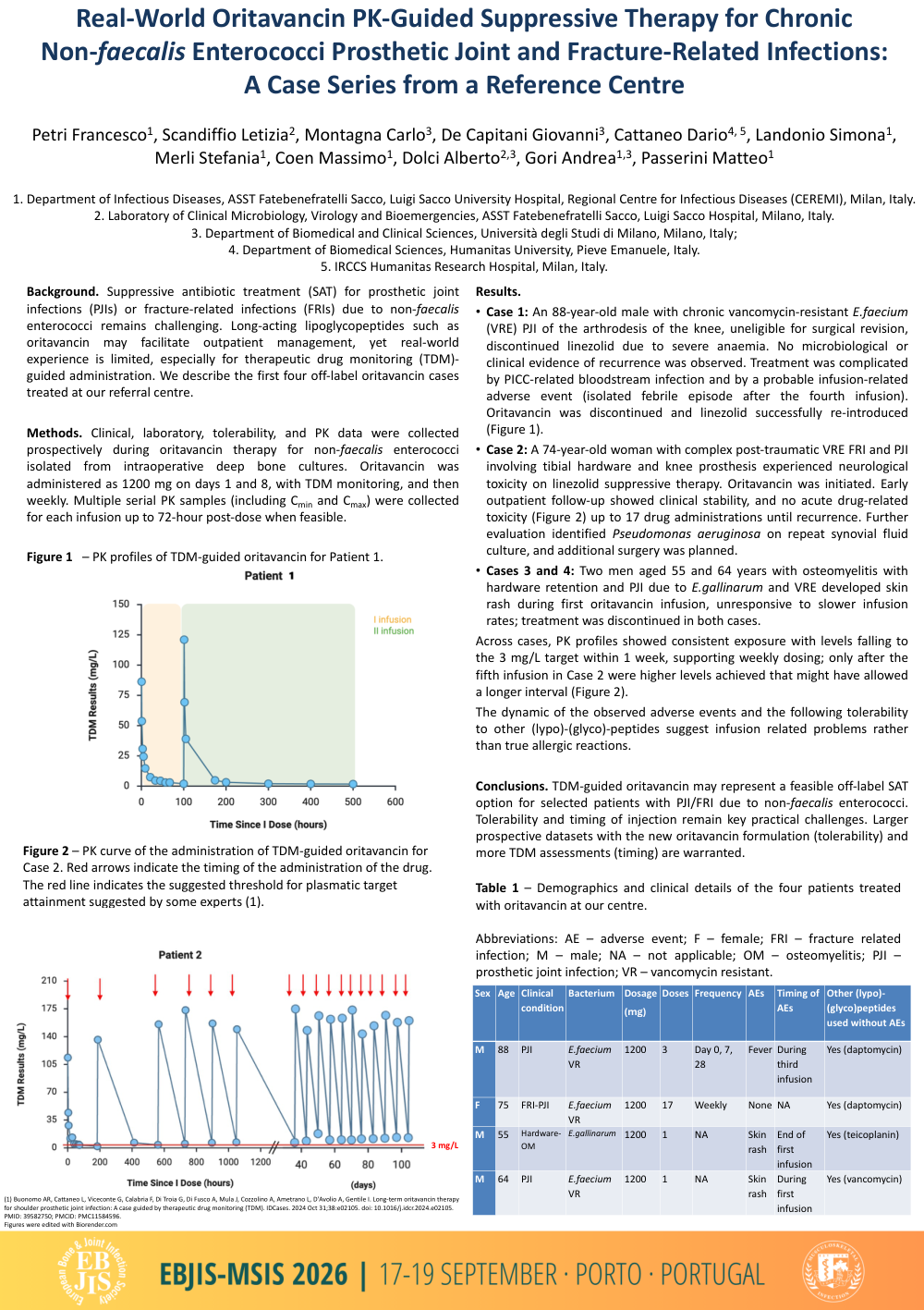
Across cases, PK profiles showed consistent exposure with levels falling to the 3 mg/L target within 1 week, supporting weekly dosing; only after the fifth infusion in Case 2 were higher levels achieved that might have allowed a longer interval (Figure 2).
The dynamic of the observed adverse events and the following tolerability to other (lypo)-(glyco)-peptides suggest infusion related problems rather than true allergic reactions.
Conclusions. TDM-guided oritavancin may represent a feasible off-label SAT option for selected patients with PJI/FRI due to non-faecalis enterococci. Tolerability and timing of injection remain key practical challenges. Larger prospective datasets with the new oritavancin formulation (tolerability) and more TDM assessments (timing) are warranted.
(1) Buonomo AR, Cattaneo L, Viceconte G, Calabria F, Di Troia G, Di Fusco A, Mula J, Cozzolino A, Ametrano L, D'Avolio A, Gentile I. Long-term oritavancin therapy for shoulder prosthetic joint infection: A case guided by therapeutic drug monitoring (TDM). IDCases. 2024 Oct 31;38:e02105. doi: 10.1016/j.idcr.2024.e02105. PMID: 39582750; PMCID: PMC11584596.