477 posters, 14 topics, 2,052 authors, 1,056 institutions
ePostersLive by SciGen Technologies S.A. All rights reserved.
The Joint EBJIS-MSIS 2026 Conference
17 - 19 September, 2026 | Porto, Portugal
EP244
Septic Arthritis Outcomes: ASA Outperforms Biomarkers in Predicting Mortality
Poster Presenter
Authors
Jose Banza, Andre Grenho, Ines Alturas, Maria Parreira, Jorge Rebola, Bruno Silva, Hugo Rafael
Affiliations
Part of Topic
Prognosis
Introduction
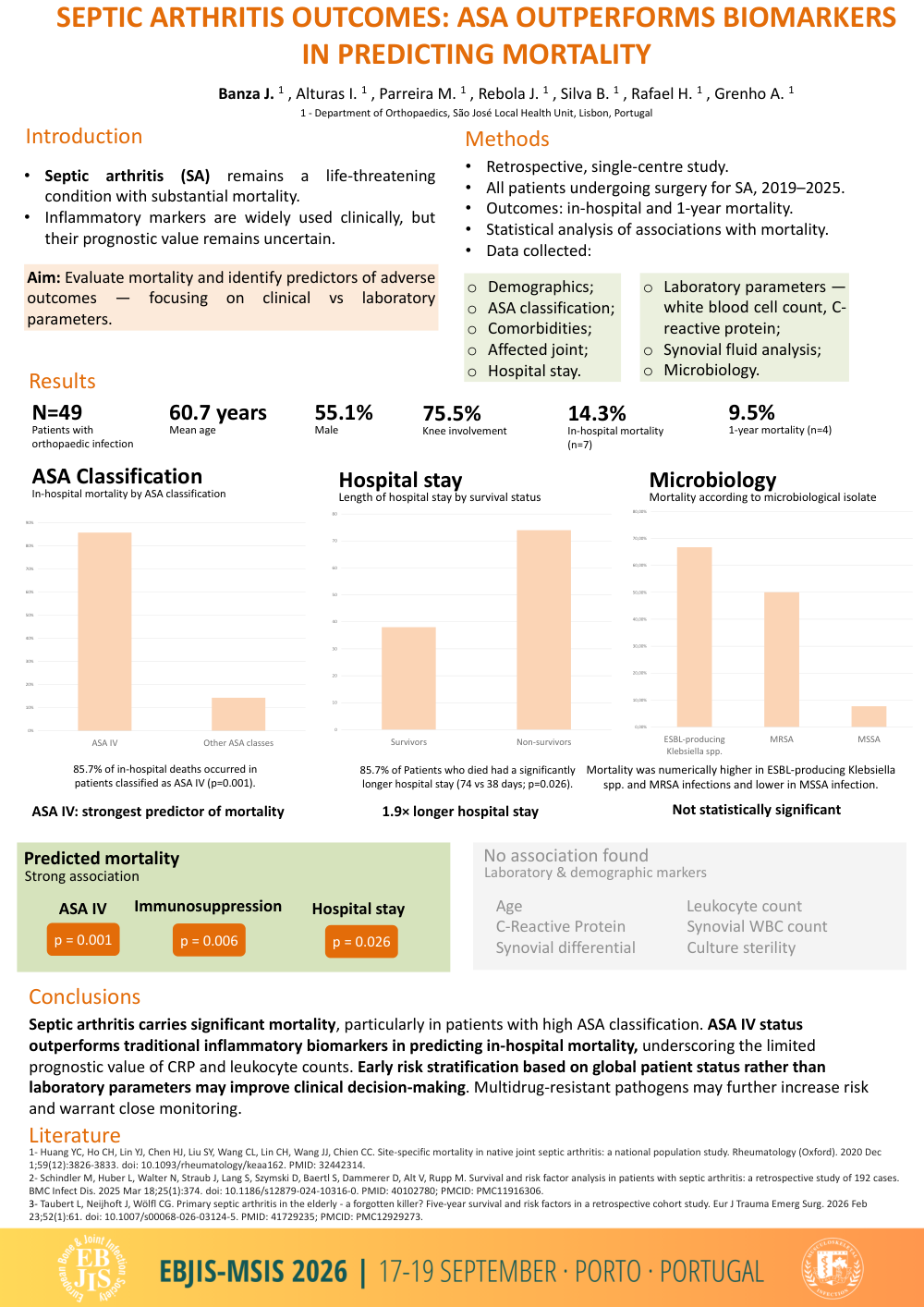
Septic arthritis (SA) remains a life-threatening condition with substantial mortality. • Inflammatory markers are widely used clinically, but their prognostic value remains uncertain.
Aim: Evaluate mortality and identify predictors of adverse outcomes — focusing on clinical vs laboratory parameters.
Methods
Retrospective, single-centre study. • All patients undergoing surgery for SA, 2019–2025. • Outcomes: in-hospital and 1-year mortality. • Statistical analysis of associations with mortality. • Data collected: Demographics; o ASA classification; o Comorbidities; o Affected joint; o Hospital stay; Laboratory parameters — white blood cell count, Creactive protein; o Synovial fluid analysis; o Microbiology.
Results
N=49 Patients with orthopaedic infection, 60.7 years Mean age, 55.1% Male, 75.5% Knee involvement, 14.3% In-hospital mortality (n=7), 9.5% 1-year mortality (n=4)
ASA Classification In-hospital mortality by ASA classification - 85.7% of in-hospital deaths occurred in patients classified as ASA IV (p=0.001). ASA IV: strongest predictor of mortality
Hospital stay Length of hospital stay by survival status - 85.7% of Patients who died had a significantly longer hospital stay (74 vs 38 days; p=0.026). 1.9× longer hospital stay
Microbiology Mortality according to microbiological isolate. Mortality was numerically higher in ESBL-producing Klebsiella spp. and MRSA infections and lower in MSSA infection. Not statistically significant.
Predicted mortality - Strong association ASA IV Immunosuppression Hospital stay ( p = 0.001 p = 0.006 p = 0.026)
No association found - Laboratory & demographic markers - Age Leukocyte count C-Reactive Protein Synovial WBC count Synovial differential Culture sterility
Conclusions - Septic arthritis carries significant mortality, particularly in patients with high ASA classification. ASA IV status outperforms traditional inflammatory biomarkers in predicting in-hospital mortality, underscoring the limited prognostic value of CRP and leukocyte counts. Early risk stratification based on global patient status rather than laboratory parameters may improve clinical decision-making. Multidrug-resistant pathogens may further increase risk and warrant close monitoring.