477 posters, 14 topics, 2,065 authors, 1,055 institutions
ePostersLive by SciGen Technologies S.A. All rights reserved.
The Joint EBJIS-MSIS 2026 Conference
17 - 19 September, 2026 | Porto, Portugal

EP239
Redefining Success it the Treatment of Periprosthetic Joint Infections: A Qualitative Analysis Guided by Artificial Intelligence
Poster Presenter
Authors
Francesco Mancuso, Leonardo Maschio, Frediana Briante, Barbara Cadeo, Araldo Causero, Paolo Di Benedetto
Affiliations
Infectious Diseases Clinic, University Hospital, Udine, Italy, Orthopedics Clinic, DMED, University of Udine, Orthopedics Clinic, University Hospital, Udine, Italy; Medicine Department - DMED, University of Udine, Udine, Italia
Part of Topic
Prognosis
Aim
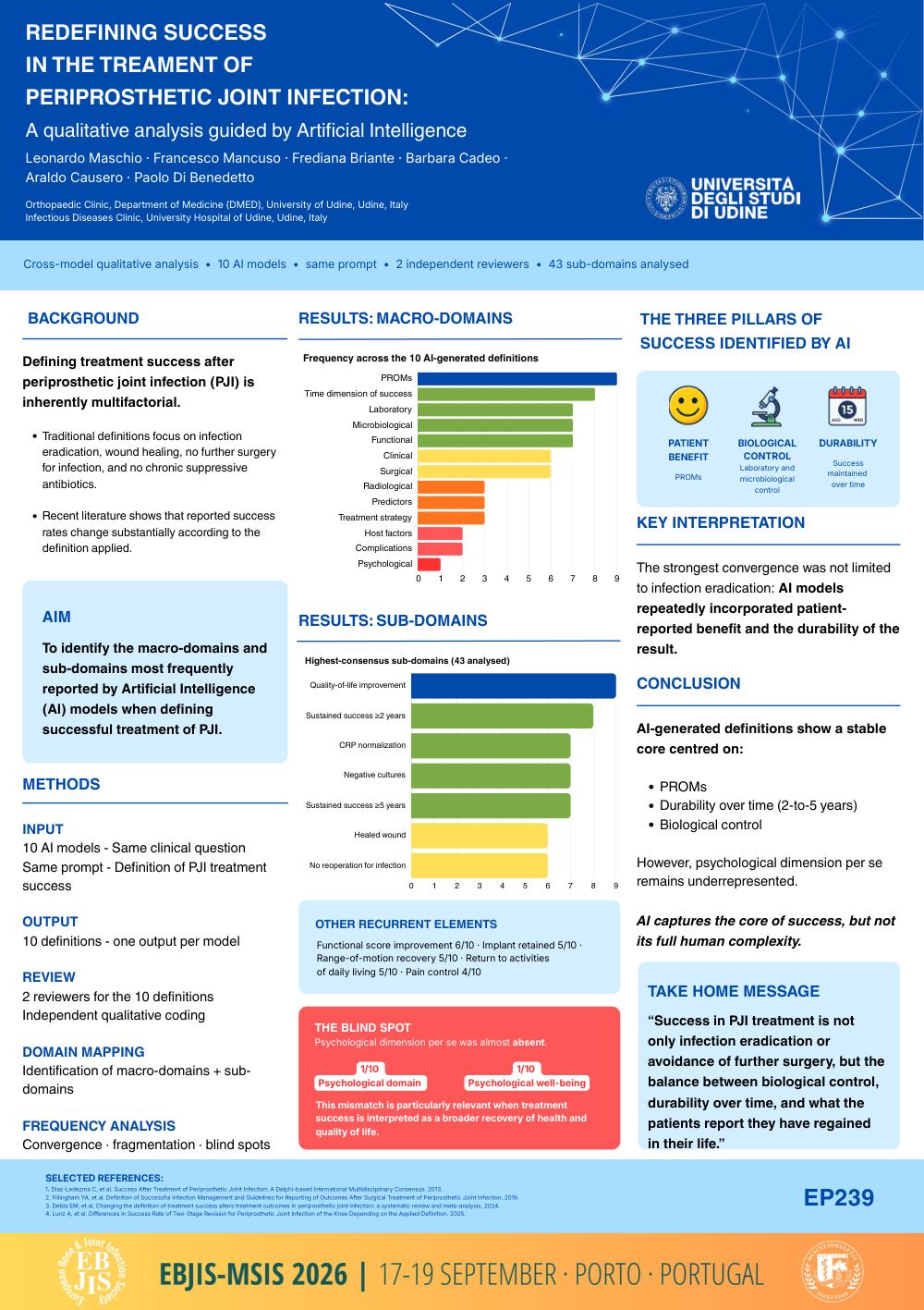
Periprosthetic joint infections (PJIs) represent one of the most complex and burdensome complications in orthopedic surgery, with a significant impact on patient morbidity, implant survival, and healthcare costs. Despite the considerable progress achieved in recent decades in diagnosis, surgery, and treatment, the concept of “success” in PJI treatment remains heterogeneous and poorly standardized. In the literature, outcomes are defined in variable ways. This heterogeneity limits comparability among studies, weakens the robustness of systematic reviews, and hinders the application of evidence in clinical practice.
The aim of this study was to develop a standardized, integrated, and reproducible definition of treatment success in periprosthetic joint infections through an exploratory qualitative analysis based on content generated by artificial intelligence (AI) systems.
Methods
A qualitative study with inductive thematic analysis was conducted. Definitions of therapeutic success in PJIs were generated by ten different AI models using an identical, predefined prompt, without constraints on length or structure, in order to maximize conceptual diversity. Data collection continued until thematic saturation was reached. All definitions were anonymized and treated as independent units of analysis. Two independent reviewers, experienced in musculoskeletal infection management and qualitative research methodologies, performed open coding and grouped the codes into macro-areas and subthemes. Interpretive discrepancies were resolved through discussion and consensus, according to an investigator triangulation approach.
Results
The thematic analysis identified several recurring conceptual macro-areas contributing to the definition of successful PJI treatment. In particular, the most frequent themes included patient-reported outcomes (9/10), the chronological criterion (8/10), hematochemical profile (7/10), and microbiological profile (7/10). The psychological aspect was recognized by only one AI model. The qualitative analysis also led to the identification of about 40 more or less recurrent subthemes. The integration of these domains made it possible to formulate a standardized definition that reflects the multidimensional nature of PJI management.
Conclusions
This study lays the groundwork for a structured and integrated definition of treatment success in periprosthetic joint infections, based on a systematic analysis of AI-generated content. The adoption of a shared definition could improve outcome uniformity, facilitate comparison among therapeutic strategies, and support the development of future evidence-based guidelines. Future studies should validate this definition by integrating the contribution of clinical experts and patients.