477 posters, 14 topics, 2,052 authors, 1,056 institutions
ePostersLive by SciGen Technologies S.A. All rights reserved.
The Joint EBJIS-MSIS 2026 Conference
17 - 19 September, 2026 | Porto, Portugal
EP214
Antibiotic therapy in pediatric acute osteomyelitis: a clinical audit of adherence to international guidelines
Poster Presenter
Authors
Jawhar Ben Dhief, Jacem Saadana, mariem abdeljalil, aymen fekih, abderrazak abid
Affiliations
The Orthopedics and Traumatology Department, Fattouma Bourguiba University Hospital, Monastir, Monastir, Tunisia, Infectious Diseases Department, Fattouma Bourguiba University Hospital, Tunisia, The Orthopedics and Traumatology Department, Habib Bourguiba University Hospital, Sfax
Part of Topic
Osteomyelitis/ Spondylitis
Background : Acute osteomyelitis (AO) in children is a medical emergency requiring early and appropriate antibiotic therapy. Despite established international guidelines, real-world practices remain variable and often inconsistent with evidence-based recommendations.
Objectives: To describe clinical and therapeutic characteristics of pediatric acute osteomyelitis and assess adherence of antibiotic prescriptions to international recommendations.
Materials and Methods : Retrospective descriptive clinical audit conducted at the orthopedic and trauma department of Fattouma Bourguiba University Hospital (Monastir, Tunisia) between January 2015 and December 2022. Data included epidemiological, clinical, microbiological, and therapeutic variables. Antibiotic regimens were evaluated for compliance with international guidelines, including choice, dosage, and duration.
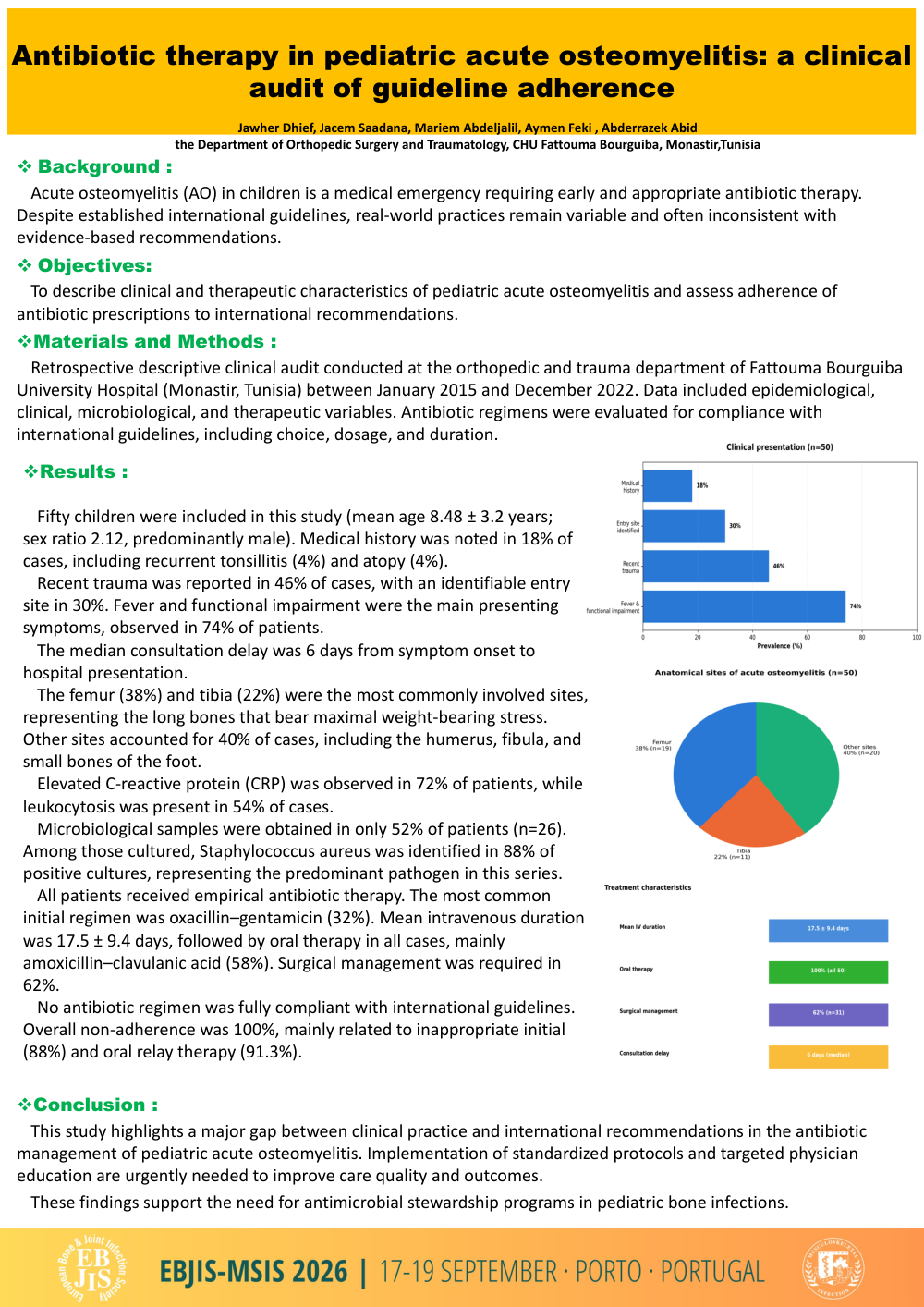
Results : Fifty children were included in this study (mean age 8.48 ± 3.2 years; sex ratio 2.12, predominantly male). Medical history was noted in 18% of cases, including recurrent tonsillitis (4%) and atopy (4%). Recent trauma was reported in 46% of cases, with an identifiable entry site in 30%. Fever and functional impairment were the main presenting symptoms, observed in 74% of patients. The median consultation delay was 6 days from symptom onset to hospital presentation. The femur (38%) and tibia (22%) were the most commonly involved sites, representing the long bones that bear maximal weight-bearing stress. Other sites accounted for 40% of cases, including the humerus, fibula, and small bones of the foot. Elevated C-reactive protein (CRP) was observed in 72% of patients, while leukocytosis was present in 54% of cases. Microbiological samples were obtained in only 52% of patients (n=26). Among those cultured, Staphylococcus aureus was identified in 88% of positive cultures, representing the predominant pathogen in this series. All patients received empirical antibiotic therapy. The most common initial regimen was oxacillin–gentamicin (32%). Mean intravenous duration was 17.5 ± 9.4 days, followed by oral therapy in all cases, mainly amoxicillin–clavulanic acid (58%). Surgical management was required in 62%. No antibiotic regimen was fully compliant with international guidelines. Overall non-adherence was 100%, mainly related to inappropriate initial (88%) and oral relay therapy (91.3%).
Conclusion : This study highlights a major gap between clinical practice and international recommendations in the antibiotic management of pediatric acute osteomyelitis. Implementation of standardized protocols and targeted physician education are urgently needed to improve care quality and outcomes. These findings support the need for antimicrobial stewardship programs in pediatric bone infections.