477 posters, 14 topics, 2,065 authors, 1,055 institutions
ePostersLive by SciGen Technologies S.A. All rights reserved.
The Joint EBJIS-MSIS 2026 Conference
17 - 19 September, 2026 | Porto, Portugal

EP204
TREATMENT OF OSTEOMYELITIS WITH DEBRIDEMENT AND LOCAL ANTISEPTIC/ANTIBIOTIC CARRIERS WITHOUT BONE RESECTION: EXPERIENCE AND RESULTS IN A SINGLE CENTER
Part of Topic
Osteomyelitis/ Spondylitis
TREATMENT OF OSTEOMYELITIS WITH DEBRIDEMENT AND LOCAL ANTISEPTIC/ANTIBIOTIC CARRIERS WITHOUT BONE RESECTION: EXPERIENCE AND RESULTS IN A SINGLE CENTER
Brioschi D1, Moretti F, Larghi M, Manzotti A
1Ospedale L Sacco, Milano, Italy
Aim: Osteomyelitis of the long bones is a medical challenge influenced by many factors: etiology, pathogenesis, extent and duration of bone involvement, and intrinsic systemic or local patient characteristics. Thanks to the use of devices to deliver high-dose local antibiotics or antiseptics, the treatment of osteomyelitis can be reconsidered, although it remains complex, with significant morbidity and costs.
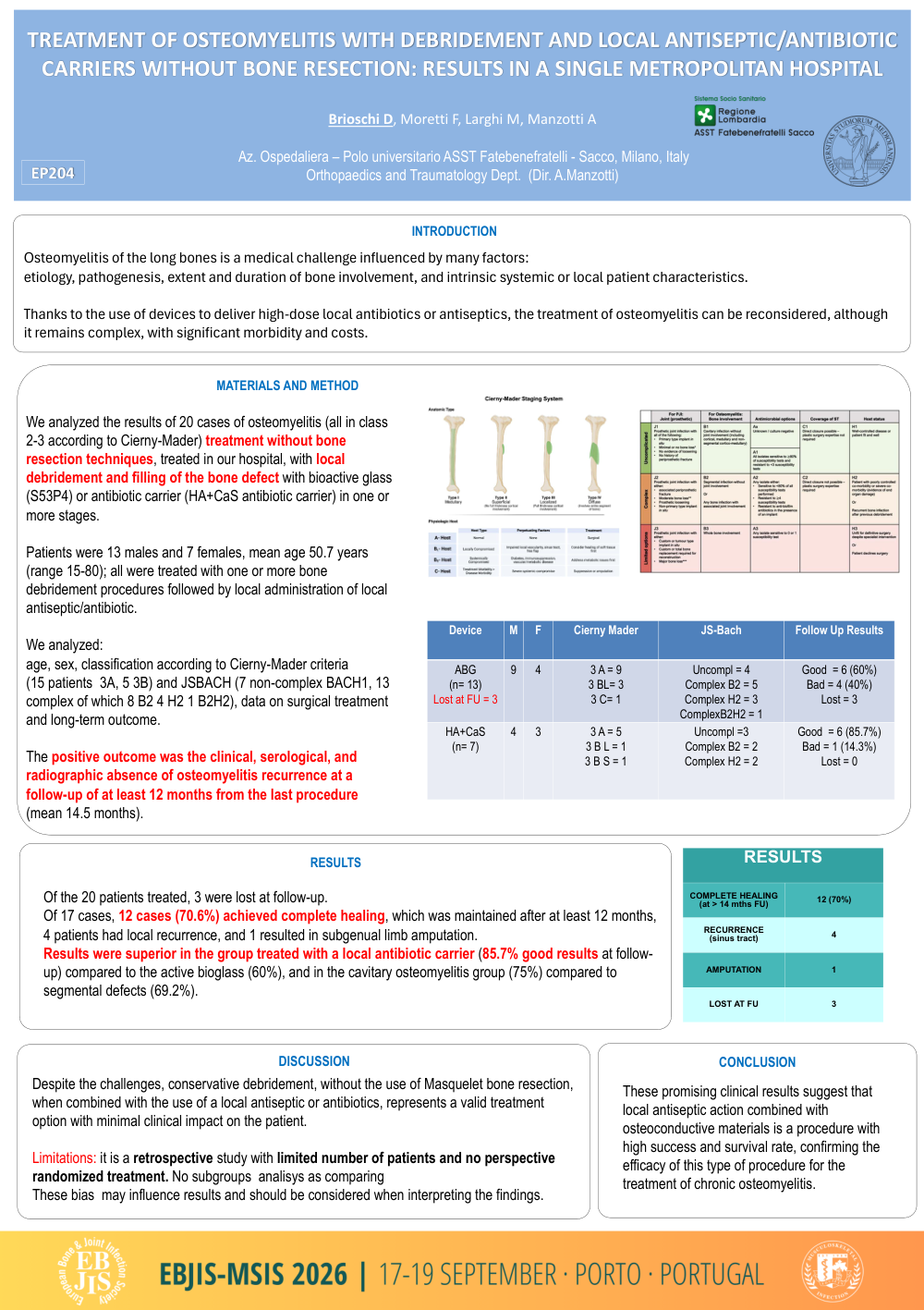
Methods: We analyzed the treatment results of 20 cases of osteomyelitis (all in class 2-3 according to Cierny-Mader) without bone resection techniques, treated in our hospital, with local debridement and filling of the bone defect with bioactive glass (S53P4) or antibiotic carrier (HA+CaS antibiotic carrier) in one or more stages. Patients were 13 males and 7 females, mean age 50.7 years (range 15-80); all were treated with one or more bone remediation procedures followed by local administration of local antiseptic/antibiotic. We analyzed age, sex, classification according to Cierny-Mader criteria (15 patients 3A, 5 3B) and JSBACH (7 non-complex BACH1, 13 complex of which 8 B2 4 H2 1 B2H2), data on surgical treatment and long-term outcome. The positive outcome was the clinical, serological, and radiographic absence of osteomyelitis recurrence at a follow-up of at least 12 months from the last procedure (mean 14.5 months).
Results: Of the 20 patients treated, 3 were lost at follow-up. Of 17 cases, 12 cases (70.6%) achieved complete healing, which was maintained after at least 12 months, 4 patients had local recurrence, and 1 resulted in subgenual limb amputation.
Results were superior in the group treated with a local antibiotic carrier (85.7% positive results at follow-up) compared to the active bioglass (60%), and in the cavitary osteomyelitis group (75%) compared to segmental defects (69.2%).
Conclusions: Despite the challenges, conservative debridement, without the use of Masquelet bone resection, when combined with the use of a local antiseptic or antibiotics, represents a valid treatment option with minimal clinical impact on the patient.These great clinical results suggest that local antiseptic action combined with osteoconductive materials is a procedure with high success and survival rate, confirming the efficacy of this type of procedure for the treatment of chronic osteomyelitis.