477 posters, 14 topics, 2,065 authors, 1,055 institutions
ePostersLive by SciGen Technologies S.A. All rights reserved.
The Joint EBJIS-MSIS 2026 Conference
17 - 19 September, 2026 | Porto, Portugal

EP209
USE OF SYNTHETIC BONE GRAFT SUBSTITUTES IN FOOT AND ANKLE INFECTIONS: OUR EXPERIENCE IN A SINGLE METROPOLITAN HOSPITAL
Part of Topic
Osteomyelitis/ Spondylitis
USE OF SYNTHETIC BONE GRAFT SUBSTITUTES IN FOOT AND ANKLE INFECTIONS: OUR EXPERIENCE IN A SINGLE METROPOLITAN HOSPITAL
Grassi M1, Brioschi D1, Falasco D1,2, Manzotti A1,2
1Ospedale L Sacco, Milano, Milano, Italy, 2Università degli Studi di Milano, Milano, italy
AIM:
Local antibiotic carriers (LAC) and bioactive glass (BAG) are increasingly used in the management of foot and ankle bone infections (FABI). However, evidence regarding their efficacy in this specific anatomical region remains limited. Based on our clinical experience, these devices may represent an effective strategy for enhancing infection control and functional recovery in both acute and chronic osteomyelitis.
Methods:
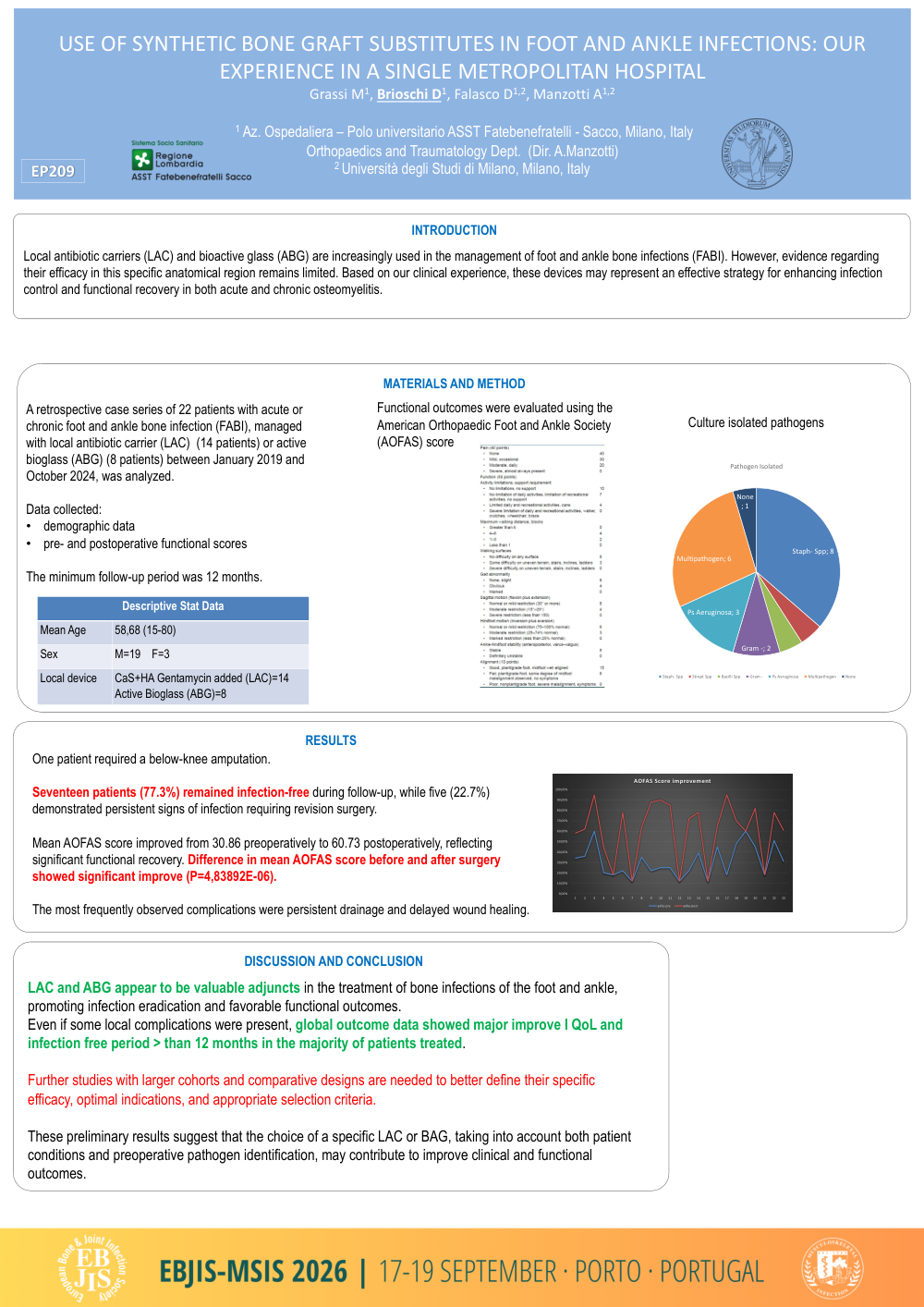
A retrospective case series of 22 patients with acute or chronic FABI, managed with LAC (14 patients) or BAG (8 patients) between January 2019 and October 2024, was analyzed. Demographic data, time to surgery, surgical approach, and pre- and postoperative functional scores were collected. The minimum follow-up period was 12 months. Functional outcomes were evaluated using the American Orthopaedic Foot and Ankle Society (AOFAS) score.
Results:
One patient required a below-knee amputation. Seventeen patients (77.3%) remained infection-free during follow-up, while five (22.7%) demonstrated persistent signs of infection requiring revision surgery. The mean AOFAS score improved from 30.86 preoperatively to 60.73 postoperatively, reflecting significant functional recovery. The most frequently observed complications were persistent drainage and delayed wound healing.
Conclusions:
LAC and BAG appear to be valuable adjuncts in the treatment of bone infections of the foot and ankle, promoting infection eradication and favorable functional outcomes. Further studies with larger cohorts and comparative designs are needed to better define their specific efficacy, optimal indications, and appropriate selection criteria. These preliminary results suggest that the choice of a specific LAC or BAG, taking into account both patient conditions and preoperative pathogen identification, may contribute to improved clinical and functional outcomes.