20 posters, 13 topics, 1 sessions, 54 authors, 27 institutions
ePostersLive by SciGen Technologies S.A. All rights reserved.
Clinical Radiology Audit and Quality Improvement ePoster Competitions 2026
30 September, 2026 | London, UK

103
One and Done. Achieving diagnostic Adequacy and Reducing Complications with Single-Core Renal Biopsies; An Audit at Ipswich Hospital (ESNEFT).
Poster Presenter
Part of Topic
One and Done: Audit of Ultrasound Guided Renal Biopsy Adequacy of Sampling and Complications at Ipswich Hospital (ESNEFT)
Introduction and Aims:
USS guided percutaneous renal biopsy removes a small core of the renal parenchyma or mass to allow histopathological diagnosis of renal disease. Although relatively safe, it carries a risk of bleeding due to the high renal vascularity. Haematuria and small perirenal haematomas are common but these do not usually require intervention. Whilst major haemorrhage occurs in less than 1%, costs of any complications are high due to extended hospital stays. USS Guided renal biopsy is a relatively frequent investigation at Ipswich Hospital. In 2024 there were several cases with major complications which sparked a need to investigate and address local complication rates.
Standards:
Standards were drawn from the RCR AuditLive template with the addition of renal mass biopsies which made up ~25% of cases in Ipswich Hospital. - Diagnostic adequacy >75% (Native kidney biopsy showing >10 glomeruli, Transplant Kidney biopsy showing > 10 glomeruli and 2 arteries and Renal mass biopsy adequate volume to provide a histological diagnosis)
Major complications <1% ( Haemorrhage requiring surgery, arterial embolisation, blood transfusion or bladder irrigation.)
Minor complications <5% ( Visible haematuria or perirenal haematoma without further intervention)
Methodology:
A retrospective review of all ultrasound guided renal biopsies undertaken at Ipswich Hospital in 2024 and second data set in 2025.
Data was collected from patient e-records including operator, size and number of samples taken, adequacy of histology, patient factors, complications and management. Analysis was conducted to determine compliance with criteria and identify areas for improvement.
Cycle 1 results:
89 patients underwent renal biopsy between Jan 2024 and Dec 2024.
96% had 2 or more samples taken.
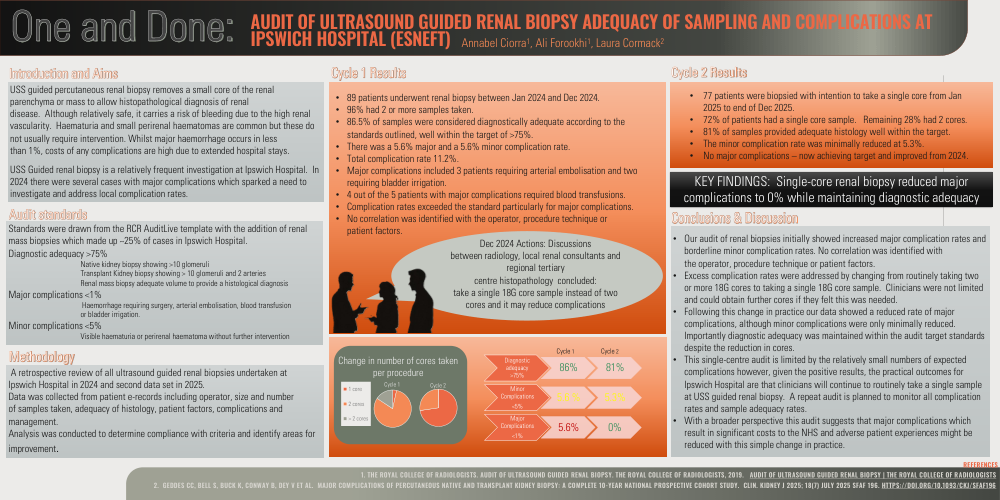
86.5% of samples were considered diagnostically adequate according to the standards outlined, well within the target of >75%.
There was a 5.6% major and a 5.6% minor complication rate.
Total complication rate 11.2%.
Major complications included 3 patients requiring arterial embolisation and two requiring bladder irrigation.
4 out of the 5 patients with major complications required blood transfusions.
Complication rates exceeded the standard particularly for major complications.
No correlation was identified with the operator, procedure technique or patient factors.
Actions in December 2024: Discussions between radiology, local renal consultants and regional tertiary centre histopathology concluded:
take a single 18G core sample instead of two cores and it may reduce complications
Cycle 2 results:
77 patients were biopsied with intention to take a single core from Jan 2025 to end of Dec 2025.
72% of patients had a single core sample. Remaining 28% had 2 cores.
81% of samples provided adequate histology well within the target.
The minor complication rate was minimally reduced at 5.3%.
No major complications – now achieving target and improved from 2024.
Key Findings: Single‑core renal biopsy reduced major complications to 0% while maintaining diagnostic adequacy
Conclusions and discussion
Our audit of renal biopsies initially showed increased major complication rates and borderline minor complication rates. No correlation was identified with the operator, procedure technique or patient factors.
Excess complication rates were addressed by changing from routinely taking two or more 18G cores to taking a single 18G core sample. Clinicians were not limited and could obtain further cores if they felt this was needed.
Following this change in practice our data showed a reduced rate of major complications, although minor complications were only minimally reduced. Importantly diagnostic adequacy was maintained within the audit target standards despite the reduction in cores.
This single-centre audit is limited by the relatively small numbers of expected complications however, given the positive results, the practical outcomes for Ipswich Hospital are that clinicians will continue to routinely take a single sample at USS guided renal biopsy. A repeat audit is planned to monitor all complication rates and sample adequacy rates.
With a broader perspective this audit suggests that major complications which result in significant costs to the NHS and adverse patient experiences might be reduced with this simple change in practice.