20 posters, 13 topics, 1 sessions, 54 authors, 27 institutions
ePostersLive by SciGen Technologies S.A. All rights reserved.
Clinical Radiology Audit and Quality Improvement ePoster Competitions 2026
30 September, 2026 | London, UK

149
Artificial Intelligence in Acute Stroke Pathways: Initial findings from Survey 1 of RCR National Audit (Procurement, Governance and Sustainability)
Poster Presenter
Part of Topic
AI
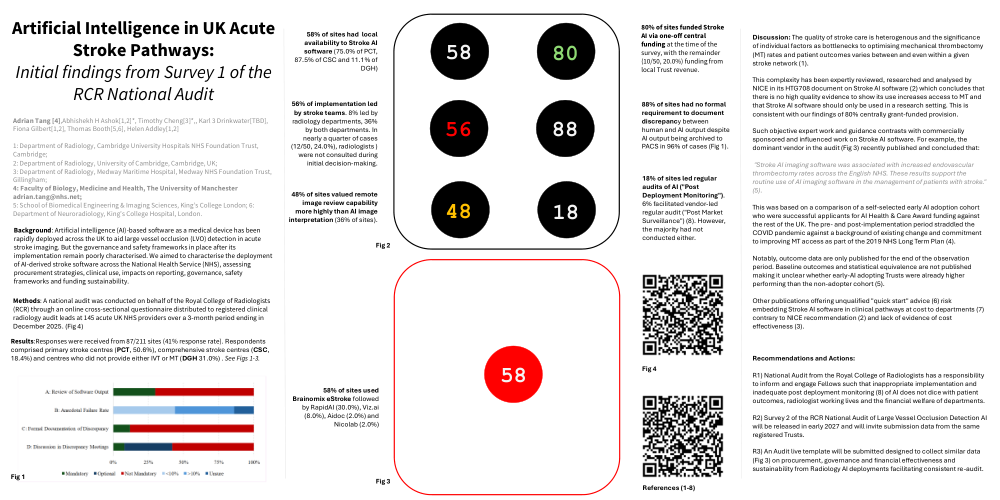
Artificial Intelligence in UK Acute Stroke Pathways: Initial findings from Survey 1 of the RCR National Audit Adrian Tang [4],Abhishekh H Ashok[1,2]*, Timothy Cheng[3]*,, Karl 3 Drinkwater[TBD], Fiona Gilbert[1,2], Thomas Booth[5,6], Helen Addley[1,2] 1: Department of Radiology, Cambridge University Hospitals NHS Foundation Trust, Cambridge; 2: Department of Radiology, University of Cambridge, Cambridge, UK; 3: Department of Radiology, Medway Maritime Hospital, Medway NHS Foundation Trust, Gillingham; 4: Faculty of Biology, Medicine and Health, The University of Manchester adrian.tang@nhs.net; 5: School of Biomedical Engineering & Imaging Sciences, King’s College London; 6: Department of Neuroradiology, King’s College Hospital, London. Background: Artificial intelligence (AI)-based software as a medical device has been rapidly deployed across the UK to aid large vessel occlusion (LVO) detection in acute stroke imaging. But the governance and safety frameworks in place after its implementation remain poorly characterised. We aimed to characterise the deployment of AI-derived stroke software across the National Health Service (NHS), assessing procurement strategies, clinical use, impacts on reporting, governance, safety frameworks and funding sustainability. Methods: A national audit was conducted on behalf of the Royal College of Radiologists (RCR) through an online cross-sectional questionnaire distributed to registered clinical radiology audit leads at 145 acute UK NHS providers over a 3-month period ending in December 2025. (Fig 3) Results:Responses were received from 87/211 sites (41% response rate). Respondents comprised primary stroke centres (PCT, 50.6%), comprehensive stroke centres (CSC, 18.4%) and centres who did not provide either IVT or MT (DGH 31.0%) 58% of sites had local availability to Stroke AI software (75.0% of PCT, 87.5% of CSC and 11.1% of DGH) 56% of implementation led by stroke teams. 8% led by radiology departments, 36% by both departments. In nearly a quarter of cases (12/50, 24.0%), radiologists ) were not consulted during initial decision-making. 48% of sites valued remote image review capability more highly than AI image interpretation (36% of sites). 58% of sites used Brainomix eStroke followed by RapidAI (30.0%), Viz.ai (8.0%), Aidoc (2.0%) and Nicolab (2.0%) 58 56 80 88 48 18 Fig 1 Fig 2 58 80% of sites funded Stroke AI via one-off central funding at the time of the survey, with the remainder (10/50, 20.0%) funding from local Trust revenue. 88% of sites had no formal requirement to document discrepancy between human and AI output despite AI output being archived to PACS in 96% of cases. 18% of sites led regular audits of AI ("Post Deployment Monitoring"). 6% facilitated vendor-led regular audit ("Post Market Surveillance"). However, the majority had not conducted either. Fig 3 References Discussion: The quality of stroke care is heterogenous and the significance of individual factors as bottlenecks to optimising mechanical thrombectomy (MT) rates and patient outcomes varies between and even within a given stroke network (1). This complexity has been expertly reviewed, researched and analysed by NICE in its HTG708 document on stroke AI software (2) and concludes that there is no high quality evidence to show its use increases access to MT which should only be used in a research setting. This is consistent with our findings of 80% centrally grant funded provision. Such objective expert work and guidance contrasts with commercially sponsored and influenced work on Stroke AI software. The dominant vendor in the audit (Fig 2) recently published and concluded that "Stroke AI imaging software was associated with increased endovascular thrombectomy rates across the English NHS. These results support the routine use of AI imaging software in the management of patients with stroke." (5). This was based on a comparison of a self-selected early AI adoption cohort who were successful applicants for AI Health & Care Award funding against the rest of the UK. The pre- and post-implementation period straddled the COVID pandemic against a background of existing change and commitment to improving MT access as part of the 2019 NHS Long Term Plan (4). Notably, outcome data are only published for the end of the observation period. Baseline outcomes and statistical equivalence are not published making it unclear whether early-AI adopting Trusts were already higher performing than the non-adopter cohort. Other publications offering unqualified "quick start" advice risk embedding Stroke AI software in clinical pathways at cost to departments (7) contrary to NICE recommendation (2) and lack of evidence of cost effectiveness (3). Recommendations and Actions: National Audit from the Royal College of Radiologists has a responsibility to ensure that inappropriate implementation and inadequate post deployment monitoring of AI does not dice with patient outcomes, radiologist working lives and the financial welfare of departments. Survey 2 of the RCR National Audit of Large Vessel Occlusion Detection AI will be released in early 2027 and will invite submission data from the same registered Trusts. An Audit live template will be submitted designed to collect similar data (Fig 3) on procurement, governance and financial effectiveness and sustainability from Radiology AI deployments facilitating consistent re-audit.