20 posters, 13 topics, 1 sessions, 54 authors, 27 institutions
ePostersLive by SciGen Technologies S.A. All rights reserved.
Clinical Radiology Audit and Quality Improvement ePoster Competitions 2026
30 September, 2026 | London, UK

143
Enhancing Timely Diagnosis and Intervention in Carotid Stenosis: A Stroke-Led Audit in Collaboration with Radiology and Vascular Surgery.
Poster Presenter
Authors
Affiliations
Part of Topic
Neuroradiology
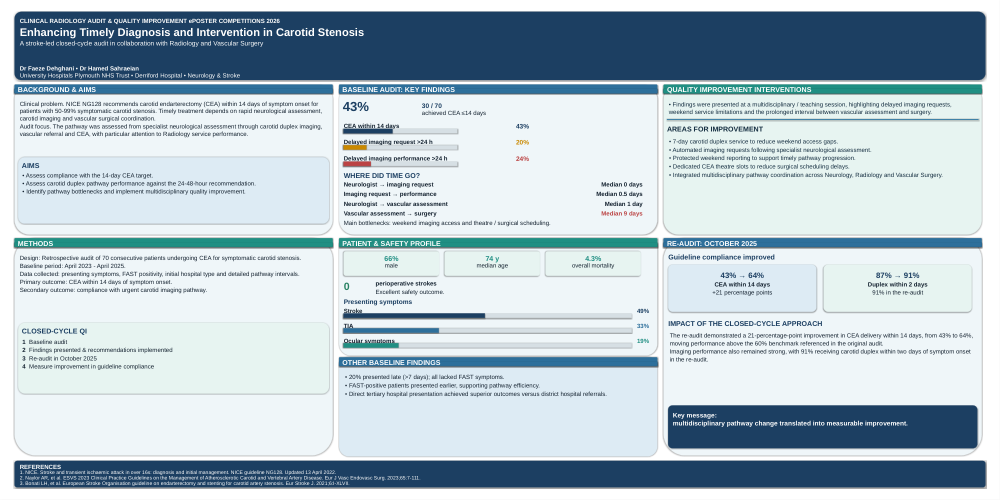
Enhancing Timely Diagnosis and Intervention in Carotid Stenosis
A stroke-led closed-cycle audit in collaboration with Radiology and Vascular Surgery
Dr Faeze Dehghani • Dr Hamed Sahraeian
University Hospitals Plymouth NHS Trust • Derriford Hospital • Neurology & Stroke
BACKGROUND & AIMS
Clinical problem
NICE NG128 recommends carotid endarterectomy (CEA) within 14 days of symptom onset for patients with 50–99% symptomatic carotid stenosis. Timely treatment depends on rapid neurological assessment, carotid imaging and vascular surgical coordination.
Audit focus
The pathway was assessed from specialist neurological assessment through carotid duplex imaging, vascular referral and CEA, with particular attention to Radiology service performance.
Aims
- Assess compliance with the 14-day CEA target.
- Assess carotid duplex pathway performance against the 24–48-hour recommendation.
- Identify pathway bottlenecks and implement multidisciplinary quality improvement.
METHODS
Design: Retrospective audit of 70 consecutive patients undergoing CEA for symptomatic carotid stenosis.
Baseline period: April 2023 – April 2025.
Data collected: Presenting symptoms, FAST positivity, initial hospital type and detailed pathway intervals.
Primary outcome: CEA within 14 days of symptom onset.
Secondary outcome: Compliance with urgent carotid imaging pathway.
CLOSED-CYCLE QI
- Baseline audit
- Findings presented & recommendations implemented
- Re-audit in October 2025
- Measure improvement in guideline compliance
BASELINE AUDIT: KEY FINDINGS
CEA within 14 days was achieved in 43% of patients.
Delayed imaging requests (>24 hours) occurred in 20% of patients.
Delayed imaging performance (>24 hours) occurred in 24% of patients.
WHERE DID TIME GO?
Median neurologist-to-imaging request interval: 0 days.
Median imaging request-to-performance interval: 0.5 days.
Median neurologist-to-vascular assessment interval: 1 day.
Median vascular assessment-to-surgery interval: 9 days.
PATIENT & SAFETY PROFILE
66% were male.
Median age was 74 years.
Overall mortality was 4.3%.
There were 0 perioperative strokes.
Presenting symptoms
Stroke: 49%
TIA: 33%
Ocular symptoms: 19%
OTHER BASELINE FINDINGS
20% presented late (>7 days); all lacked FAST symptoms.
FAST-positive patients presented earlier, supporting pathway efficiency.
Direct tertiary hospital presentation achieved superior outcomes versus district hospital referrals.
RADIOLOGY
Rapid imaging performance was demonstrated, with a median interval of 0.5 days from imaging request to performance.
However, delayed imaging requests and delayed imaging performance remained important pathway gaps, with weekend service limitations contributing to delays.
QUALITY IMPROVEMENT INTERVENTIONS
Findings were presented at a multidisciplinary / teaching session, highlighting delayed imaging requests, weekend service limitations and the prolonged interval between vascular assessment and surgery.
Areas for Improvement
- 7-day carotid duplex service to reduce weekend access gaps.
- Automated imaging requests following specialist neurological assessment.
- Protected weekend reporting to support timely pathway progression.
- Dedicated CEA theatre slots to reduce surgical scheduling delays.
- Integrated multidisciplinary pathway coordination across Neurology, Radiology and Vascular Surgery.
RE-AUDIT: OCTOBER 2025
Guideline compliance improved, with CEA within 14 days increasing from 43% to 64%, representing a 21-percentage-point improvement.
Carotid duplex within two days increased from 87% to 91% in the re-audit.
IMPACT OF THE CLOSED-CYCLE APPROACH
The re-audit demonstrated a 21-percentage-point improvement in CEA delivery within 14 days, from 43% to 64%, moving performance above the 60% benchmark referenced in the original audit.
Imaging performance also remained strong, with 91% receiving carotid duplex within two days of symptom onset in the re-audit.
Key message: Multidisciplinary pathway change translated into measurable improvement.
REFERENCES
- National Institute for Health and Care Excellence (NICE). Stroke and transient ischaemic attack in over 16s: diagnosis and initial management (NG128). 2022.
- Naylor AR, et al. European Society for Vascular Surgery (ESVS) 2023 Clinical Practice Guidelines on the Management of Atherosclerotic Carotid and Vertebral Artery Disease. European Journal of Vascular and Endovascular Surgery. 2023;65:7–111.
- Naylor AR, et al. European Stroke Organisation guideline on endarterectomy and stenting for carotid artery stenosis. European Stroke Journal. 2021;6(2):I–XLVII.