457 posters, 2 videos, 2 audios, 8 topics, 45 sessions, 401 authors, 265 institutions
ePostersLive by SciGen Technologies S.A. All rights reserved.
49th Annual Regional Anesthesiology and Acute Pain Medicine Meeting
March 21-23, 2024 | The Hilton Bayfront San Diego | San Diego, California

5431
IS KETAMINE INFUSION ASSOCIATED WITH HIGHER INCIDENCE OF NEUROLOGICAL ADVERSE EFFECTS IN THE ELDERLY POPULATION?
Poster Presenter
Authors
Affiliations
Part of Topic
Scientific Abstracts > Acute Pain
Incidence of neurological adverse effects with Ketamine infusion in the elderly population
Korey Marshall MD, Yuta Kashiwagi MD, Priyanka Singla MD, , Lynn Kohan, MD, Nabil Elkassabany MD
Department of Anesthesiology, University of Virginia, Charlottesville, Virginia
INTRODUCTION
-
Ketamine infusions have been used widely for the treatment of acute pain. It is generally well-tolerated1.
-
The incidence of Central Nervous System (CNS) adverse events is about 5%.
-
These adverse effects include dizziness, nystagmus, and postoperative delirium2. Elderly patients may be more susceptible to develop these side effects.
-
Our hypothesis was that ketamine infusion for elderly patients is associated with increased rate of adverse neurological events when compared with younger adults.
-
We sought to compare the prevalence of delirium in elderly patients receiving ketamine infusion to the prevalence in younger adults.
METHODS
This study was exempt from full IRB review by the IRB at the University of Virginia. Patient records from a single tertiary care institution were analyzed from 2018 to 2023.
-
Inclusion criteria - Age > 65 years, received ketamine infusion for at least 12 hours for the treatment of acute pain or as part of an enhanced recovery protocol after surgery
-
Data collected included, patient demographics, medical comorbidities, ketamine dose and duration, and type of surgical procedure.
RESULTS
-
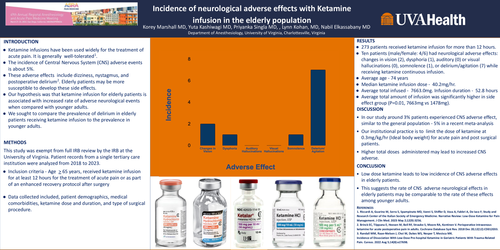
273 patients received ketamine infusion for more than 12 hours.
-
Ten patients (male/female: 4/6) had neurological adverse effects: changes in vision (2), dysphoria (1), auditory (0) or visual hallucinations (0), somnolence (1), or delirium/agitation (7) while receiving ketamine continuous infusion.
-
Average age - 74 years
-
Median ketamine infusion dose - 40.2mg/hr.
-
Average total infused - 7663.0mg. Infusion duration - 52.8 hours
-
Average total amount of infusion was significantly higher in side effect group (P=0.01, 7663mg vs 1478mg).
DISCUSSION
-
In our study around 3% patients experienced CNS adverse effect, similar to the general population - 5% in a recent meta-analysis
-
Our institutional practice is to limit the dose of ketamine at 0.3mg/kg/hr (Ideal body weight) for acute pain and post surgical patients.
-
Higher total doses administered may lead to increased CNS adverse.
CONCLUSION
-
Low dose ketamine leads to low incidence of CNS adverse effects in elderly patients.
-
This suggests the rate of CNS adverse neurological effects in elderly patients may be comparable to the rate of these effects among younger adults.
REFERENCES
1. Riccardi A, Guarino M, Serra S, Spampinato MD, Vanni S, Shiffer D, Voza A, Fabbri A, De Iaco F; Study and Research Center of the Italian Society of Emergency Medicine. Narrative Review: Low-Dose Ketamine for Pain Management. J Clin Med. 2023 May 2;12(9):3256.
2. Brinck EC, Tiippana E, Heesen M, Bell RF, Straube S, Moore RA, Kontinen V. Perioperative intravenous ketamine for acute postoperative pain in adults. Cochrane Database Syst Rev. 2018 Dec 20;12(12):CD012033.
3. Randall MM, Raae-Nielsen J, Choi M, Dukes WS, Nesper T, Mesisca MK.
Incidence of Dissociation With Low-Dose Pre-hospital Ketamine in Geriatric Patients With Trauma-Related Pain. Cureus. 2022 Aug 5;14(8):e27698.