Loading...

457 posters, 2 videos, 2 audios, 8 topics, 45 sessions, 401 authors, 265 institutions

ePostersLive by SciGen Technologies S.A. All rights reserved.

49th Annual Regional Anesthesiology and Acute Pain Medicine Meeting

March 21-23, 2024 | The Hilton Bayfront San Diego | San Diego, California

49th Annual Regional Anesthesiology and Acute Pain Medicine Meeting banner

5068

PERCUTANEOUS AURICULAR NEUROMODULATION FOLLOWING TOTAL KNEE ARTHROPLASTY: A RANDOMIZED, DOUBLE-MASKED, SHAM-CONTROLLED PILOT STUDY
Part of Topic

Scientific Abstracts > Emerging Technology

Percutaneous Auricular Neuromodulation following Total Knee Arthroplasty: A Randomized, Double-Masked, Sham-Controlled Pilot Study

Introduction

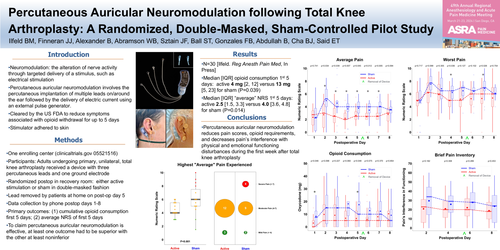
Neuromodulation: the alteration of nerve activity through targeted delivery of a stimulus, such as electrical stimulation. Percutaneous auricular neuromodulation involves the percutaneous implantation of multiple leads on/around the ear followed by the delivery of electric current using an external pulse generator. Cleared by the US FDA to reduce symptoms associated with opioid withdrawal for up to 5 days. Stimulator adhered to skin.

Methods

One enrolling center (clinicaltrials.gov 05521516). Participants: Adults undergoing primary, unilateral, total knee arthroplasty received a device with three percutaneous leads and one ground electrode. Randomized postop in recovery room:  either active stimulation or sham in double-masked fashion. Lead removed by patients at home on post-op day 5. Data collection by phone postop days 1-8. Primary outcomes: (1) cumulative opioid consumption first 5 days; (2) average NRS of first 5 days. To claim percutaneous auricular neuromodulation is effective, at least one outcome had to be superior with the other at least noninferior.
 
Results
N=30 [Ilfeld. Reg Anesth Pain Med, In Press]. Median [IQR] opioid consumption 1st 5 days:  active 4 mg [2, 12] versus 13 mg [5, 23] for sham (P=0.039). Median [IQR] “average” NRS 1st 5 days:  active 2.5 [1.5, 3.3] versus 4.0 [3.6, 4.8] for sham (P=0.014)
 
Conclusion
Percutaneous auricular neuromodulation reduces pain scores, opioid requirements, and decreases pain’s interference with physical and emotional functioning disturbances during the first week after total knee arthroplasty.
49th Annual Regional Anesthesiology and Acute Pain Medicine Meeting » banner
Copyright © 2015-2026, ePostersLive® SciGen is a registered trademark of SciGen Technologies S.A. Patent pending.

This website and third-party tools we use rely on cookies for the best user experience. By selecting "I agree", you agree to cookie usage as described in our Privacy Policy.