457 posters, 2 videos, 2 audios, 8 topics, 45 sessions, 401 authors, 265 institutions
ePostersLive by SciGen Technologies S.A. All rights reserved.
49th Annual Regional Anesthesiology and Acute Pain Medicine Meeting
March 21-23, 2024 | The Hilton Bayfront San Diego | San Diego, California

5064
ASSOCIATIONS BETWEEN PREOPERATIVE OPIOID PRESCRIPTIONS AND POST-HOSPITAL DISCHARGE DISPOSITION: A POPULATION-BASED COHORT STUDY
Poster Presenter
Authors
Affiliations
Part of Topic
Scientific Abstracts > Chronic Pain
Associations Between Preoperative Opioid Prescriptions and Post-Hospitalization Discharge Disposition
Introduction: Patients with opioid dependence undergoing spine surgery exhibit higher rates of nonroutine discharges (19.18% compared to 10.21%). Despite the rising rates of opioid usage and the associated economic burden, there exists a gap in the existing literature concerning the influence of opioid availability on postoperative discharge outcomes following spinal surgery.
Hypothesis: The goal of the study was to evaluate the association between preoperative opioid availability and discharge disposition after major spine surgery. Hypothesis: Patients with preoperative opioid usage are more likely to be discharged to a skilled nursing facility or rehabilitation facility.
Methods: All adult patients (age ≥18 years) residing in the 11-county area included in the Rochester Epidemiology Project who underwent spine surgery from January 1, 2005, through December 31, 2016. All outpatient opioid analgesic prescriptions for the study cohort from 180 days before to 1 year after the index surgical procedure were obtained through REP resources. Patients were categorized as having no opioid availability if they had no opioid prescriptions within 180 days before surgery.
Types of Opioid Availability:
• No Availability: Patients with no opioid prescriptions within 180 days before surgery.
• Short-term Availability: Patients with a prescribing period of fewer than 90 days within the 180 days before surgery.
• Long-term Availability: Patients with a prescribing period of 90 days or more and either more than 10 prescriptions during this period or opioids available more than 120 days based on the maximum prescribed rate.
• Episodic Availability: Patients with a prescribing period of more than 90 days but who did not meet the criteria for long-term
availability.
Outcomes: Pattern between preoperative opioid availability and discharge disposition after major spine surgery.
Results:
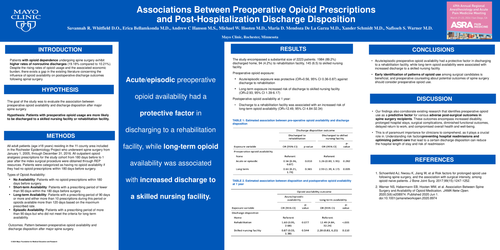
The study encompassed a substantial size of 2223 patients. 1984 (89.2%) discharged home, 94 (4.2%) to rehabilitation facility, 145 (6.5) to skilled nursing facility.
Preoperative opioid exposure:
• Acute/episodic exposure was protective (OR=0.56, 95% CI 0.36-0.87) against discharge to rehabilitation
• Long-term exposure increased risk of discharge to skilled nursing facility (OR=2.93, 95% CI 1.39-6.17)
Postoperative opioid availability at 1 year:
• Discharge to a rehabilitation facility was associated with an increased risk of long-term opioid availability (OR=12.49, 95% CI 4.84-32.34)
Conclusions:
• Acute/episodic preoperative opioid availability had a protective factor in discharging to a rehabilitation facility, while long-term opioid availability were associated with increased discharge to a skilled nursing facility.
• Early identification of patterns of opioid use among surgical candidates is beneficial, and preoperative counseling about potential outcomes of spine surgery should consider preoperative opioid use.
Discussion:
• Our findings also corroborate existing research that identifies preoperative opioid use as a predictive factor for various adverse post-surgical outcomes in spine surgery recipients. These outcomes encompass increased disability, prolonged hospital stays, surgical complications, diminished functional outcomes, delayed return to work, and compromised overall health and well-being.
• This is of paramount importance for clinicians to comprehend, as it plays a crucial role in. Understanding risk factorspreventing hospital readmissions and optimizing patient care that lead to a certain discharge disposition can reduce the hospital length of stay and risk of readmission