457 posters, 2 videos, 2 audios, 8 topics, 45 sessions, 401 authors, 265 institutions
ePostersLive by SciGen Technologies S.A. All rights reserved.
49th Annual Regional Anesthesiology and Acute Pain Medicine Meeting
March 21-23, 2024 | The Hilton Bayfront San Diego | San Diego, California

5079
A RANDOMIZED TRIAL OF LIPOSOMAL BUPIVACAINE COMPARED TO CONVENTIONAL BUPIVACAINE IN ADULTS RECEIVING ADDUCTOR CANAL BLOCKS FOR TKA
Poster Presenter
Authors
Affiliations
Part of Topic
Scientific Abstracts > Regional Anesthesia
Introduction
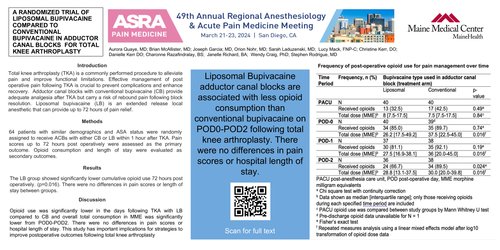
Total knee arthroplasty (TKA) is a commonly performed procedure to alleviate pain and improve functional limitations. Effective management of post operative pain following TKA is crucial to prevent complications and enhance recovery. Adductor canal blocks with conventional bupivacaine (CB) provide adequate analgesia after TKA but carry a risk of rebound pain following block resolution. Liposomal bupivacaine (LB) is an extended release local anesthetic that can provide up to 72 hours of pain relief.
Methods
64 patients with similar demographics and ASA status were randomly assigned to receive ACBs with either CB or LB within 1 hour after TKA. Pain scores up to 72 hours post operatively were assessed as the primary outcome. Opioid consumption and length of stay were evaluated as secondary outcomes.
Results
The LB group showed significantly lower cumulative opioid use 72 hours post operatively. (p=0.016). There were no differences in pain scores or length of stay between groups.
Discussion
Opioid use was significantly lower in the days following TKA with LB compared to CB and overall total consumption in MME was significantly lower from POD0-POD2. There were no differences in pain scores or hospital length of stay. This study has important implications for strategies to improve postoperative outcomes following total knee arthroplasty