457 posters, 2 videos, 2 audios, 8 topics, 45 sessions, 401 authors, 265 institutions
ePostersLive by SciGen Technologies S.A. All rights reserved.
49th Annual Regional Anesthesiology and Acute Pain Medicine Meeting
March 21-23, 2024 | The Hilton Bayfront San Diego | San Diego, California

5650
RACIAL DISPARITIES IN THE USE OF REGIONAL ANESTHESIA IN UPPER EXTREMITY VASCULAR SURGERIES
Poster Presenter
Authors
Affiliations
Part of Topic
Scientific Abstracts > Regional Anesthesia
Racial Disparities in Use of Regional Anesthesia in Upper Extremity Vascular Surgeries
Regional anesthesia (RA) may improve surgical outcomes, lead to shorter recovery times, and decreased readmission rates [1]. However, its application has been found to differ based on patient demographics like race, insurance, and type of surgery [1]. Our goal was to assess whether there is a difference in the use of regional anesthesia within vascular surgery procedures depending on our patients’ race. We hypothesized that non-white patients would receive RA less frequently even when corrected for demographic and health factors.
This was an IRB approved, retrospective study that evaluated patients undergoing upper-extremity vascular surgery between June 2019 and December 2023 within an urban academic health system. Demographic and medical data were queried and extracted via the EPIC EHR system. Identification of the patient population was done via CPT codes related to AV fistula creation/repair and upper extremity vascular repair. The nerve blocks associated with these procedures include interscalene, supraclavicular, infraclavicular, axillary, intercostobrachial, musculocutaneous, and digital nerve blocks. Associated comorbidities were identified with the relevant ICD10 codes. Multivariate logistic regression accounting for each patient’s demographic and medical data was conducted to evaluate the association of race and RA utilization. The delta-method was then utilized to calculate the probability of receiving a block for each race based on the above parameters. Continuous variables were compared using a Student t-test, and categorical variables were compared using a chi-square test. P-values were reported for all statistical tests, and P<0.05 was considered statistically significant.
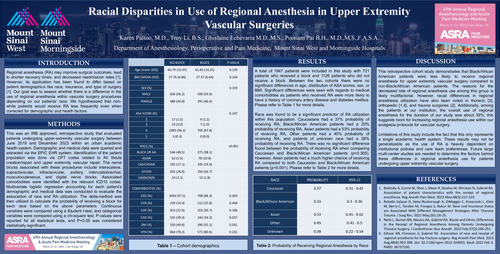
A total of 1847 patients were included in this study with 721 patients who received a block and 1126 patients who did not receive a block. Between the two cohorts there were no significant differences in age, distribution of ASA scores, sex, or BMI. Significant differences were seen with regards to medical comorbidities as patients who received RA were more likely to have a history of coronary artery disease and diabetes mellitus. Please refer to Table 1 for more details. Race was found to be a significant predictor of RA utilization within this population. Caucasians had a 37% probability of receiving RA, Black/African American patients had a 33% probability of receiving RA, Asian patients had a 53% probability of receiving RA, Other patients had a 45% probability of receiving RA, and patients of unknown race had a 38% probability of receiving RA. There was no significant difference found between the probability of receiving RA when comparing Caucasian and Black/African American patients (p=0.305). However, Asian patients had a much higher chance of receiving RA compared to both Caucasian and Black/African American patients (p=0.001). Please refer to Table 2 for more details.
This retrospective cohort study demonstrates that Black/African American patients were less likely to receive regional anesthesia for upper extremity vascular surgery compared to non-Black/African American patients. The reasons for the decreased rate of regional anesthesia use among this group is likely multifactorial. However, racial differences in regional anesthesia utilization have also been noted in thoracic [3], orthopedic [1,4], and trauma surgeries [2]. Additionally, among the patients at our institution, the overall use of regional anesthesia for the duration of our study was about 39%; this suggests room for increasing regional anesthesia use within our analgesia protocols for vascular surgery. Limitations of this study include the fact that this only represents a single academic health system. These results may not be generalizable as the use of RA is heavily dependent on institutional policies and care team preferences. Future large multi-center studies are needed to determine the factors behind these differences in regional anesthesia use for patients undergoing upper extremity vascular surgery.