457 posters, 2 videos, 2 audios, 8 topics, 45 sessions, 401 authors, 265 institutions
ePostersLive by SciGen Technologies S.A. All rights reserved.
49th Annual Regional Anesthesiology and Acute Pain Medicine Meeting
March 21-23, 2024 | The Hilton Bayfront San Diego | San Diego, California

5487
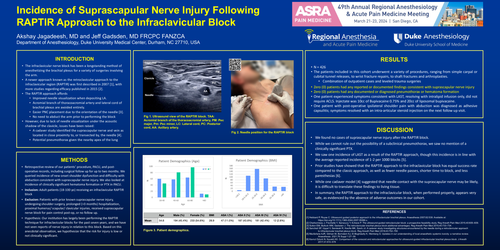
SUPRASCAPULAR NERVE INJURY FOLLOWING RAPTIR APPROACH TO THE INFRACLAVICULAR BLOCK
Poster Presenter
Authors
Affiliations
Part of Topic
Scientific Abstracts > Regional Anesthesia
Incidence of Suprascapular Nerve InjuryFollowing RAPTIR Approach to the Infraclavicular Block.
INTRODUCTION
•The infraclavicular nerve block has been a longstanding method of anesthetizing the brachial plexus for a variety of surgeries involving the arm.
•A newer approach known as the retroclavicular approach to the infraclavicular region (RAPTIR) was first described in 2007 [1], with more studies regarding efficacy published in 2015 [2].
•The RAPTIR approach affords
•Improved needle visualization when depositing LA.
•Acromial branch of thoracoacromial artery and lateral cord of brachial plexus are avoided entirely.
•Easier PNC placement due to the orientation of the needle [3].
•No need to abduct the arm prior to performing the block
•However, due to lack of needle visualization under the acoustic shadow of the clavicle, issues have been raised:
•A cadaver study identified the suprascapular nerve and vein as located in close proximity to, or transected by, the needle [4].
•Potential pneumothorax given the nearby apex of the lung
METHODS
•Retrospective review of our patients’ procedure, PACU, and post-operative records, including surgical follow up for up to two months. We queried incidence of new onset shoulder dysfunction and difficulty with abduction consistent with suprascapular nerve injury. We also looked at incidence of clinically significant hematoma formation or PTX in PACU.
•Inclusion: Adult patients (18-100 yo) receiving an infraclavicular RAPTIR block
•Exclusion: Patients with prior known suprascapular nerve injury, undergoing shoulder surgery, prolonged (>3 months) hospitalization, proximal humerus/ scapular/ clavicular injuries, received suprascapular nerve block for pain control post-op, or no follow up.
•Hypothesis: Our institution has largely been performing the RAPTIR technique for infraclavicular blocks for the past seven years, and we have not seen reports of nerve injury in relation to this block. Based on this anecdotal observation, we hypothesize that the risk for injury is low or not clinically significant.
RESULTS
•N = 426
•The patients included in this cohort underwent a variety of procedures, ranging from simple carpal or cubital tunnel releases, to wrist fracture repairs, to shaft fractures and arthroplasties.
•Combination of outpatient cases and leveled trauma surgeries
•Zero (0) patients had any reported or documented findings consistent with suprascapular nerve injury
•Zero (0) patients had any documented or diagnosed pneumothorax or hematoma formation
•One patient experienced symptoms consistent with LAST, resolving with intralipid infusion only, did not require ACLS. Injectate was 10cc of Bupivacaine 0.75% and 20cc of liposomal bupivacaine.
•One patient with post-operative ipsilateral shoulder pain with abduction was diagnosed as adhesive capsulitis; symptoms resolved with an intra-articular steroid injection on the next follow up visit.
DISCUSSION
•We found no cases of suprascapular nerve injury after the RAPTIR block.
•While we cannot rule out the possibility of a subclinical pneumothorax, we saw no mention of a clinically significant PTX.
•We saw one incidence of LAST as a result ofthe RAPTIR approach, though this incidence is in line with the average reported incidence of 1-2 per 1000 blocks [5].
•Prior studies have showed that the RAPTIR approach to the infraclavicular block has equal success rate compared to the classic approach, as well as fewer needle passes, shorter time to block, and less paresthesias [6].
•While one cadaver model [4] suggested that needle contact with the suprascapular nerve may be likely, it is difficult to translate these findings to living tissue.
•In summary, the RAPTIR approach to the infraclavicular block, when performed properly, appears very safe, as evidenced by the absence of adverse outcomes in ourcohort.