457 posters, 2 videos, 2 audios, 8 topics, 45 sessions, 401 authors, 265 institutions
ePostersLive by SciGen Technologies S.A. All rights reserved.
49th Annual Regional Anesthesiology and Acute Pain Medicine Meeting
March 21-23, 2024 | The Hilton Bayfront San Diego | San Diego, California

5472
TRENDS IN COMORBIDITIES AND COMPLICATIONS AMONG PATIENTS UNDERGOING ELECTIVE TOTAL HIP AND KNEE ARTHROPLASTY
Poster Presenter
Authors
Affiliations
Part of Topic
Scientific Abstracts > Regional Anesthesia
Introduction
•Total Joint Arthroplasty (TJA) is commonly performed as the only definitive treatment in end-stage osteoarthritis aiming to facilitate significant enhancement in physical activities and quality of life.
•Earlier studies have shown that in the United States alone, more than one million TJAs were performed annually with projections of significant increase.
•As the population ages, the volume of total hip and knee arthroplasty (THA, TKA) procedures has been on the rise with currently over 1 million procedures annually and expected continued growth in demand.
•In addition to increased demand, these procedures are also increasingly performed in the outpatient setting for appropriate patients.
•This emphasizes the need for continued monitoring of trends in patient comorbidity burden and perioperative complications.
Methods
•Using a large national database, we aimed to describe trends in patient and hospital related factors, patient comorbidities, and perioperative outcomes among THA/TKA recipients.
•We included patients undergoing elective THA or TKA between 2016 and 2021 as recorded in the Premier Healthcare database.
•Trends were reported and graphed for a variety of variables including age, gender, race, and hospital-specific variables such as type of anesthesia, in-patient and out-patient procedures and hospital length of stay.
•Complications were reported per 1000 inpatient days including mortality, acute myocardial infarction, arrhythmia, acute renal failure, delirium, other cerebral complications, hematoma formation, wound infection and sepsis. Cochran-Armitage trend tests or simple linear regression analyses measured significance of linear trends.
Results
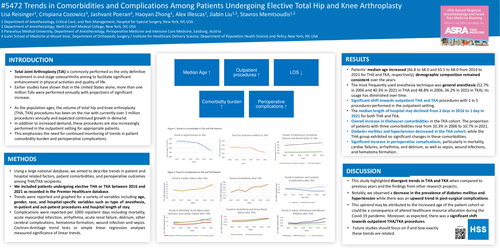
•Patients’ median age increased (66.8 to 68.0 and 65.5 to 68.0 from 2016 to 2021 for THA and TKA, respectively), demographic composition remained consistent over the years.
•The most frequently used anesthesia technique was general anesthesia (52.7% in 2006 and 40.3% in 2021 in THA and 48.8% in 2006, 36.2% in 2021 in TKA), its usage has diminished over time.
•Significant shift towards outpatient THA and TKA procedures with 1 in 5 procedures performed in the outpatient setting.
•The median length of hospital stay declined from 2 days in 2016 to 1 day in 2021 for both THA and TKA.
•Overall increase in Elixhauser comorbidities in the TKA cohort. The proportion of patients with three comorbidities rose from 10.3% in 2006 to 10.7% in 2021.
•Diabetes mellitus and hypertension decreased in the TKA cohort, while the THA group exhibited no significant changes in these comorbidities.
•Significant increase in perioperative complications, particularly in mortality, cardiac failures, arrhythmia, and delirium, as well as sepsis, wound infections, and hematoma formation.
Discussion
•This study highlighted divergent trends in THA and TKA when compared to previous years and the findings from other research projects.
•Notably, we observed a decrease in the prevalence of diabetes mellitus and hypertension while there was an upward trend in post-surgical complications.
•This uptrend may be attributed to the increased age of the patient cohort or could be a consequence of altered healthcare resource allocation during the Covid-19 pandemic. Moreover, as expected, there was a significant shift towards outpatient THA/TKA procedures.
• Future studies should focus on if and how exactly these trends are related.