457 posters, 2 videos, 2 audios, 8 topics, 45 sessions, 401 authors, 265 institutions
ePostersLive by SciGen Technologies S.A. All rights reserved.
49th Annual Regional Anesthesiology and Acute Pain Medicine Meeting
March 21-23, 2024 | The Hilton Bayfront San Diego | San Diego, California

5183
ADDUCTOR CANAL AND IPACK BLOCKS REDUCE PAIN LEVELS AND NARCOTIC CONSUMPTION FOLLOWING TOTAL KNEE ARTHROPLASTY
Poster Presenter
Authors
Affiliations
Part of Topic
Scientific Abstracts > Regional Anesthesia
Adductor Canal and iPACK Blocks reduce pain levels and narcotic consumption following Total Knee Arthroplasty
Introduction
•Multimodal analgesic pain protocols, such as the use of nerve block techniques, have been implemented in TKA procedures to improve recovery and limit the use of prescribed narcotics.
•Traditionally, the adductor canal block (ACB) has utilized local anesthetics for pain management, however recent data shows that pain management is improved when administering liposomal bupivacaine into the ACB and using additional nerve blocks such as the iPACK(interspace between the popliteal artery and capsule of the posterior knee) block.
•This study compares postoperative outcomes of patients that received either the ACB block alone or in addition to the iPACKblock.
Methods
1.Retrospective cohort study of all primary, unilateral TKA patients between 2015-2021.
2.Patient demographics, preoperative, perioperative, and postoperative data was collected from EPIC.
3.Statistical analysis was performed in Excel.
Results
•There were 2,321 patients identified for this study.
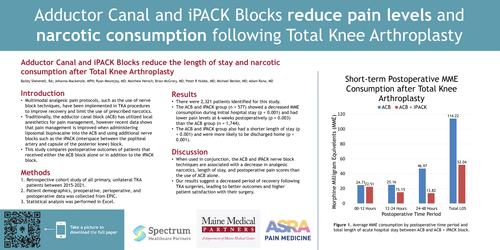
•The ACB and iPACKgroup (n = 577) showed a decreased MME consumption during initial hospital stay (p < 0.001) and had lower pain levels at 6-weeks postoperatively (p = 0.003)than the ACB group (n = 1,744).
•The ACB and iPACKgroup also had a shorter length of stay (p < 0.001) and were more likely to be discharged home (p < 0.001).
Discussion
•When used in conjunction, the ACB and iPACKnerve block techniques are associated with a decrease in analgesic narcotics, length of stay, and postoperative pain scores than the use of ACB alone.
•Our results suggest a decreased period of recovery following TKA surgeries, leading to better outcomes and higher patient satisfaction with their surgery.