457 posters, 2 videos, 2 audios, 8 topics, 45 sessions, 401 authors, 265 institutions
ePostersLive by SciGen Technologies S.A. All rights reserved.
49th Annual Regional Anesthesiology and Acute Pain Medicine Meeting
March 21-23, 2024 | The Hilton Bayfront San Diego | San Diego, California

5624
ULTRASOUND ASSESSMENT OF PERI-OPERATIVE PRANDIAL STATUS IN FRAGILITY HIP FRACTURE SURGICAL FIXATION PATIENTS
Poster Presenter
Authors
Affiliations
Part of Topic
Scientific Abstracts > Regional Anesthesia
Pulmonary aspiration, the inhalation of gastric contents into the respiratory tract, is the most significant cause of airway-related mortality and accounts for 50% of anesthetic-related deaths.
Protective reflexes of the larynx, upper esophageal sphincter, and gastro-esophageal junction are attenuated by anesthetic drugs rendering non-fasted patients at risk of aspiration.
There is an increased risk of aspiration when greater than 1.5 ml/kg of gastric content is within the stomach lumen. Aspiration pneumonitis is a serious complication arising in 1 of 3,000 operations in which anesthesia is administered attributing to 9% of all anesthetic related deaths.
To reduce the risk of aspiration, the American Society of Anesthesiologists Task Force (ASATF) on Preoperative Fasting recommends fasting from the intake of clear liquids for 2 hours before elective procedures requiring general anesthesia.These guidelines do not apply to fragility fracture patients.
Measurement of the cross-sectional area of the gastric antrum by ultrasound has been validated to determine the presence of gastric contents and determine gastric volumes using geometric models.
Fragility fracture patients tend to have comorbidities as well as a recent traumatic event and opioid consumption that can all contribute to delayed gastric emptying.
These patients also require sedation for lateral positioning for spinal anesthetics as well as during the procedure if deficits in cognitive function make them noncooperative.
Cohort
This is a single-center prospective observational study at a Level I trauma center. We included patients aged 65 years and older who presented with a fragility hip fracture. Exclusion criteria include prior gastric surgery, hiatal hernia, prior diagnosis of gastroparesis, and non surgical management.
Primary Outcome
The primary outcome was the measurement of volume of contents of the stomach in patients that have presented for fragility hip fracture fixation. Specifically to see if the patient has less than 1.5mL/kg of clear fluids seen in the stomach lumen to deem them low risk of pulmonary aspiration. Patients are defined as “full stomach” if they have greater than 1.5mL/kg of clear liquid or any solid contents are seen during gastric ultrasound.
Statistical Analysis
In this prospective observational study, we estimated the mean gastric volume (GV) by ultrasonography as our primary outcome. Based on a previous study, the expected population standard deviation of GV is 25.7 mL. Cross-sectional area of the gastric antrum was used to determine gastric volume. Antrum maximum AP (D1) and longitudinal (D2) were measured in nonempty stomachs from serosa to serosa in the semirecumbent position.
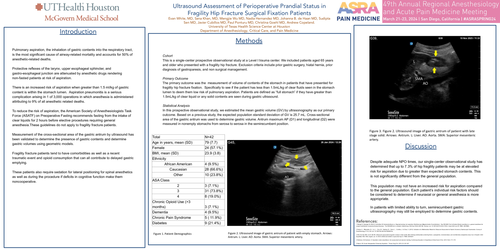
Despite adequate NPO times, our single-center observational study has determined that up to 7.3% of hip fragility patients may be at elevated risk for aspiration due to greater than expected stomach contents. This is not significantly different from the general population.
This population may not have an increased risk for aspiration compared to the general population. Each patient’s individual risk factors should be considered to determine if neuraxial or general anesthesia is more appropriate.
In patients with limited ability to turn, semirecumbent gastric ultrasonography may still be employed to determine gastric contents.