457 posters, 2 videos, 2 audios, 8 topics, 45 sessions, 401 authors, 265 institutions
ePostersLive by SciGen Technologies S.A. All rights reserved.
49th Annual Regional Anesthesiology and Acute Pain Medicine Meeting
March 21-23, 2024 | The Hilton Bayfront San Diego | San Diego, California

5565
ANALYSIS OF POSTOPERATIVE PAIN, OPIOID REQUIREMENTS, AND SURGICAL TIME IN ROBOTIC CYSTECTOMY WITH OR WITHOUT REGIONAL ANESTHESIA
Poster Presenter
Part of Topic
Scientific Abstracts > Regional Anesthesia
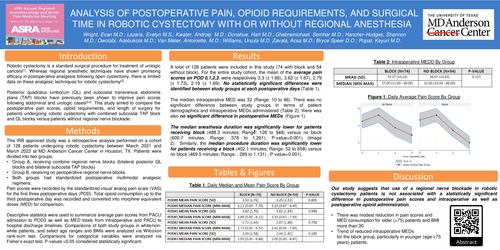
Wright, Evan M.D.; Lazaris, Evelyn M.S.; Kwater, Andrzej M.D.; Donahue, Hart M.D.; Ghebremichael, Semhar M.D.; Hancher-Hodges, Shannon M.D.; Owolabi, Adebukola M.D.; Van Meter, Antoinette, M.D.; Williams, Ursula M.D. Zavala, Acsa M.D.; Bryce Speer D.O.; Popat, Keyuri M.D. Robotic cystectomy is a standard surgical procedure for treatment of urologic cancers[1] . Whereas regional anesthetic techniques have shown promising efficacy in postoperative analgesia following open cystectomy, there is limited data on these analgesic techniques for robotic cystectomy[2] . Posterior quadratus lumborum (QL) and subcostal transversus abdominis plane (TAP) blocks have previously been shown to improve pain scores following abdominal and urologic cases[3,4] . This study aimed to compare the postoperative pain scores, opioid requirements, and length of surgery for patients undergoing robotic cystectomy with combined subcostal TAP block and QL blocks versus patients without regional nerve blockade. A total of 128 patients were included in this study (74 with block and 54 without block). For the entire study cohort, the mean of the average pain scores on POD 0,1,2,3, were respectively 3.3 (± 1.66), 3.62 (± 1.67), 2.79 (± 1.73), 2.19 (± 1.69). No statistically significant differences were identified between study groups at each postoperative days (Table 1). The median intraoperative MED was 32 (Range: 10 to 86). There was no significant difference between study groups in terms of patient demographics and intraoperative MEDs administered (Table 2); there was also no significant difference in postoperative MEDs (Figure 1). The median anesthesia duration was significantly lower for patients receiving block (488.3 minutes; Range: 128 to 948) versus no block (600.7 minutes; Range:: 378 to 1,261); P-value=0.001) (Image 2). Similarly, the median procedure duration was significantly lower for patients receiving a block (402.1 minutes; Range: 52 to 858) versus no block (469.5 minutes; Range: : 289 to 1,131) ; P-value=0.001). ANALYSIS OF POSTOPERATIVE PAIN, OPIOID REQUIREMENTS, AND SURGICAL TIME IN ROBOTIC CYSTECTOMY WITH OR WITHOUT REGIONAL ANESTHESIA Discussion Results Methods Introduction This IRB approved study was a retrospective analysis performed on a cohort of 128 patients undergoing robotic cystectomy between March 2021 and March 2023 at MD Anderson Cancer Center in Houston, TX. Patients were divided into two groups: • Group A, receiving combine regional nerve blocks (bilateral posterior QL blocks and bilateral subcostal TAP blocks) • Group B, receiving no perioperative regional nerve blocks. • Both groups had standardized postoperative multimodal analgesic regimens. Pain scores were recorded by the standardized visual analog pain scale (VAS) for the first three postoperative days (POD). Total opioid consumption up to the third postoperative day was recorded and converted into morphine equivalent doses (MED) for comparison. Descriptive statistics were used to summarize average pain scores from PACU admission to POD3 as well as MED totals from intraoperative and PACU to hospital discharge timelines. Comparisons of both study groups in white/nonwhite patients, and select age ranges and BMIs were analyzed via Wilcoxon rank-sum test. Comparisons for categorical variables were analyzed via Fisher’s exact test. P-values <0.05 considered statistically significant. Tables & Figures • Our study suggests that use of a regional nerve blockade in robotic cystectomy patients is not associated with a statistically significant difference in postoperative pain scores and intraoperative as well as postoperative opioid administration. Figure 1: Daily Average Pain Score By Group Table 2: Intraoperative MEDD By Group Table 1: Daily Median and Mean Pain Score By Group • There was modest reduction in pain scores and MED consumption for older (>75) patients and BMI more than 30. • Trend of reduced intraoperative MEDs for the block group, particularly in younger (age <75 years) patients.