457 posters, 2 videos, 2 audios, 8 topics, 45 sessions, 401 authors, 265 institutions
ePostersLive by SciGen Technologies S.A. All rights reserved.
49th Annual Regional Anesthesiology and Acute Pain Medicine Meeting
March 21-23, 2024 | The Hilton Bayfront San Diego | San Diego, California

5530
ABDOMINAL PLANE BLOCKS FOR PATIENT WITH PRUNE BELLY SYNDROME UNDERGOING EXPLORATORY LAPAROTOMY: A CASE REPORT
Poster Presenter
Authors
Affiliations
Part of Topic
Scientific Abstracts > Regional Anesthesia
Abdominal Plane Blocks for Patient with Prune Belly Syndrome Undergoing Exploratory Laparotomy: A Case Report]
Introduction
Prune Belly Syndrome (PBS), or Eagle-Barrett syndrome, involves a triad of underdeveloped abdominal wall musculature, urinary tract dysfunction, and cryptorchidism. Patients often undergo multiple abdominal surgeries to manage complications. The underdevelopment of the abdominal wall, diaphragm, and kidneys puts them at a significantly increased risk of peri-operative complications, which can be provoked by analgesic opiate-related side effects. A multimodal approach to analgesia including regional techniques, such as abdominal plane blocks, offer a significant benefit. Patients with PBS may have insufficient abdominal planes to safely perform a TAP block, therefore Quadratus Lumborum (QL) blocks can be a better alternative when appropriate anatomy can be identified.
Case Report
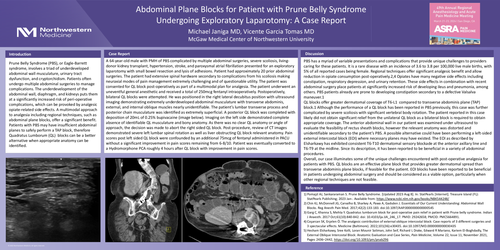
A 64-year-old male with PMH of PBS complicated by multiple abdominal surgeries, severe scoliosis, living-donor kidney transplant, hypertension, stroke, and paroxysmal atrial fibrillation presented for an exploratory laparotomy with small bowel resection and lysis of adhesions. Patient had approximately 20 prior abdominal surgeries. The patient had extensive spinal hardware secondary to complications from his scoliosis making neuraxial modes of pain management extremely challenging and of questionable utility. The patient was consented for QL block post-operatively as part of a multimodal plan for analgesia. The patient underwent an uneventful general anesthetic and received a total of 250mcg fentanyl intraoperatively. Postoperatively, bilateral QL blocks were attempted. He was positioned in the right lateral decubitus position with ultrasound imaging demonstrating extremely underdeveloped abdominal musculature with transverse abdominis, external, and internal oblique muscles nearly unidentifiable. The patient’s lumbar transverse process and posterior chain musculature was identified as extremely superficial. A posterior QL block was completed with deposition of 20mL of 0.25% bupivacaine (image below). Imaging on the left side demonstrated complete absence of identifiable QL musculature and bony anatomy. As there was no clear QL anatomy or angle of approach, the decision was made to abort the right sided QL block. Post-procedure, review of CT images demonstrated severe left lumbar spinal rotation as well as liver obstructing QL block relevant anatomy. Pain scores post left sided QL block were confounded by an additional 75mcg of fentanyl administered in PACU without a significant improvement in pain scores remaining from 6-8/10. Patient was eventually converted to a Hydromorphone PCA roughly 4 hours after QL block with improvement in pain scores.
Discussion
PBS has a myriad of variable presentations and complications that provide unique challenges to providers caring for these patients. It is a rare disease with an incidence of 3.6 to 3.8 per 100,000 live male births, with 5% of all reported cases being female. Regional techniques offer significant analgesic benefit and allow reduction in opiate consumption post-operatively.2,4 Opiates have many negative side effects including constipation, respiratory depression, and urinary retention. These side effects in combination with recent abdominal surgery place patients at significantly increased risk of developing ileus and pneumonia, among others. PBS patients already are prone to developing constipation secondary to a defective Valsalva maneuver.1
QL blocks offer greater dermatomal coverage of T6-L1 compared to transverse abdominis plane (TAP) block.1 Although the performance of a QL block has been reported in PBS previously, this case was further complicated by severe scoliosis with significant vertebral body rotation. The patient reported in this case likely did not obtain significant relief from the unilateral QL block as a bilateral block is required to obtain appropriate coverage. The anterior abdominal wall in our patient was examined under ultrasound to evaluate the feasibility of rectus sheath blocks, however the relevant anatomy was distorted and unidentifiable secondary to the patient’s PBS. A possible alternative could have been performing a left-sided external intercostal block (EOI) where necessary planes may have existed. The EOI as described by Elsharkawy has exhibited consistent T6-T10 dermatomal sensory blockade at the anterior axillary line and T6-T9 at the midline. Since its description, it has been reported to be beneficial in a variety of abdominal procedures.
Overall, our case illuminates some of the unique challenges encountered with post-operative analgesia for patients with PBS. QL blocks are an effective plane block that provides greater dermatomal spread than transverse abdominis plane blocks, if feasible for the patient. EOI blocks have been reported to be beneficial in patients undergoing abdominal surgery and should be considered as a viable option, particularly when other regional techniques are not feasible.
Reference