457 posters, 2 videos, 2 audios, 8 topics, 45 sessions, 401 authors, 265 institutions
ePostersLive by SciGen Technologies S.A. All rights reserved.
49th Annual Regional Anesthesiology and Acute Pain Medicine Meeting
March 21-23, 2024 | The Hilton Bayfront San Diego | San Diego, California

5464
COMPARISON OF TARGETED SCALP BLOCK VERSUS LOCAL INFILTRATION ON AWAKE DEEP BRAIN STIMULATION SURGERY
Poster Presenter
Authors
Affiliations
Part of Topic
Scientific Abstracts > Regional Anesthesia
Comparison of Targeted Scalp Block Versus Local Infiltration on Awake Deep Brain Stimulation Surgery
BOSSAKARA SOKHOM, HEIDI YOUNG, HANWOOL CHOI
VIRGINIA MASON FRANCISCAN HEALTH
Introduction
● Deep brain stimulation (DBS) surgery is primarily used to treat movement
disorders.
● Unique anesthetic technique is needed for patient to be sedated and tolerate
rigid headframe placement while able to respond to verbal questioning during
surgical exposure.
● Tight hemodynamic control is paramount in order to avoid complications such
as subarachnoid hemorrhage.
● We aim to compare the effectiveness of the use of local anesthetic by the
surgical team versus a targeted preoperative scalp block by anesthesia
providers in the first stage of DBS surgery.
Materials and Methods
● IRB approval was obtained for a retrospective chart review of previous DBS
stage 1 cases from December 1st
, 2020 to March 1st, 2023.
● Consents obtained as part of anesthesia and surgical consent for procedure.
● 54 cases identified, with 27 from the local anesthetic group (LA) and 27 from
the scalp block group (SB).
● Scalp block was performed preoperatively in the induction area following a
standard protocol with a total of 16mL of 0.5% bupivacaine. See Figure 1.
● LA group was administered local anesthetic at the pinning sites by the surgical
team just prior to pinning and headframe placement.
● We manually collected data from the patient’s electronic anesthesia and
medical records and used a two-tailed Welch’s test or Chi square test to test for
significance at p < 0.05.
Results
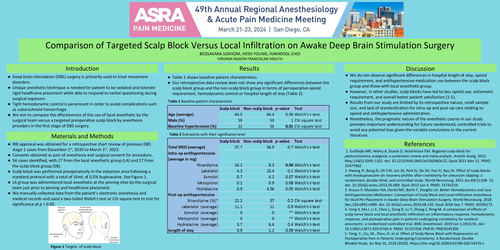
● Table 1 shows baseline patient characteristics.
● Our retrospective data review does not show any significant differences between the
scalp block group and the non-scalp block group in terms of perioperative opioid
requirement, hemodynamic control or hospital length of stay (Table 2).
Discussions
● We do not observe significant differences in hospital length of stay, opioid
requirement, and antihypertensive medication use between the scalp block
group and those with local anesthetic group.
● However, in other studies, scalp blocks have led to less opioid use, antiemetic
requirement, and overall better patient satisfaction (1-5).
● Results from our study are limited by its retrospective nature, small sample
size, and lack of standardization for intra-op and post-op care relating to
opioid and antihypertensive administration.
● Nonetheless, the pragmatic nature of the anesthetic course in our study
provides important understanding for future randomized, controlled trials to
avoid any potential bias given the variable conclusions in the current
literature.