457 posters, 2 videos, 2 audios, 8 topics, 45 sessions, 401 authors, 265 institutions
ePostersLive by SciGen Technologies S.A. All rights reserved.
49th Annual Regional Anesthesiology and Acute Pain Medicine Meeting
March 21-23, 2024 | The Hilton Bayfront San Diego | San Diego, California

5321
ABSENCE OF GENDER DISPARITIES IN ACADEMIC PRODUCTIVITY AMONG REGIONAL ANESTHESIOLOGY AND ACUTE PAIN MEDICINE PROGRAM DIRECTORS
Poster Presenter
Authors
Affiliations
Part of Topic
Scientific Abstracts > Regional Anesthesia
Introduction
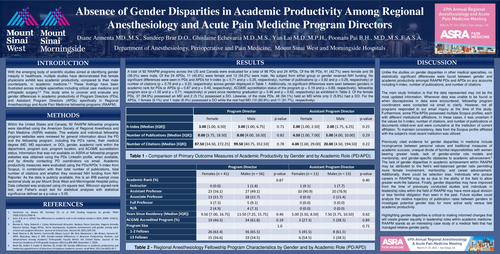
With the emerging body of scientific studies aimed at identifying gender inequity in healthcare, multiple studies have demonstrated that female physicians exhibit less academic productivity, compared to their male counterparts, in academic medicine.1,2 These findings have been illustrated across multiple specialties including critical care medicine and orthopedic surgery.3,4 This study aims to uncover and evaluate any gender differences in academic productivity of Program Directors (PDs) and Assistant Program Directors (APDs) specifically in Regional Anesthesiology and Acute Pain Medicine fellowship programs (RAAPM).
Materials and Methods
Within the United States and Canada, 92 RAAPM fellowship programs were identified using the American Society of Regional Anesthesia and Pain Medicine (ASRA) website. This website and individual fellowship program websites were reviewed for general information about the PD and the fellowship program, including the PD’s name, their medical degree (MD, MD equivalent, or DO), gender, academic rank within the department, program size, program location, and ACGME accreditation status. Information that was not available on ASRA or fellowship program websites was obtained using the PDs LinkedIn profile, when available, and by directly contacting PD coordinators via email. Academic productivity measures were evaluated using the PDs/APDs’ h-index from Scopus, in combination with their total number of publications, total number of citations and whether they received NIH funding from NIH Reporter. As the data is publicly available, this is an IRB exempt cross sectional study as per Mount Sinai West and Morningside Hospital policy. Data collected was analyzed using chi-square test, Wilcoxon signed-rank test, and Fisher's exact test for statistical analyses with statistical significance defined as a p-value < 0.05.
Results
A total of 92 RAAPM programs across the US and Canada were evaluated for a total of 96 PDs and 24 APDs. Of the 96 PDs, 41 (42.7%) were female and 56 (58.3%) were male. Of the 24 APDs, 11 (45.8%) were female and 13 (54.2%) were male. No subject from either group or gender received NIH funding. No significant differences were seen in PDs and APDs for h-index (p = 0.71 and p = 0.25, respectively), number of publications (p = 0.82 and p = 0.29, respectively) or number of citations (p = 0.78 and p = 0.22, respectively) across gender displayed in Table 1. Additionally, no significant differences were seen between genders in academic rank for PDs or APDs (p = 0.87 and p = 0.40, respectively), ACGME accreditation status of the program (p = 0.19 and p = 0.89, respectively), fellowship program size (p =1.00 and p = 0.71, respectively) or years since residency graduation (p = 0.46 and p = 0.62, respectively) as exhibited in Table 2. Of the female PDs, 37 (94.9%) possessed an MD and 2 (5.1%) possessed a DO. Likewise, of the male PDs, 48 (94.1%) held an MD while only 3 (5.9%) had a DO. For the APDs, 1 female (9.1%) and 1 male (8.3%) possessed a DO while the rest had MD (10 (90.9%) and 11 (91.7%), respectively).
Discussion
Unlike the studies on gender disparities in other medical specialties, no statistically significant differences were found between gender and academic productivity amongst RAAPM PDs and APDs on any accounts including h-index, number of publications, and number of citations.
The main study limitation is that the data represented may not be the most updated information. Whenever data was unable to be found or when discrepancies in data were encountered, fellowship program coordinators were contacted via email to clarify. However, not all programs responded to our email inquiry at the time of this study. Furthermore, some PDs/APDs possessed multiple Scopus profiles, each with different institutional affiliations. In these cases, it was uncertain if the values for h-index, number of citations, and number of publications or documents rolled-over and were cumulative at the institution of current affiliation. To maintain consistency, data from the Scopus profile affiliated with the subject's most recent institution was utilized.
Previously cited evidence for gender disparities in medicine include incongruence between personal values and traditional measures of academic success, unequal divide of familial responsibilities with women bearing greater loads, lack of gender-similar role models and mentorship, and gender-specific obstacles to academic advancement.5 The lack of gender disparities in academic achievement within RAAPM may be attributed to the field’s well-balanced gender ratio permitting more female involvement, mentorship, and career advancement. Additionally, there could be selection bias. Individuals who pursue careers in RAAPM may do so due to the ability of the field to allow greater work-life balance. Finally, gender disparities may have improved from the time of previously conducted studies and individuals in leadership roles within the field of RAAPM may have more equal division or less familial obligation than seen in the past. Future studies could analyze the relative trajectory of publication rates between genders to investigate potential gender bias for more active early versus late academic productivity.
Highlighting gender disparities is critical to making informed changes that will create greater equality in leadership roles within academic medicine. RAAPM stands as an interesting case study of a medical field that has managed relative gender parity.
Resources
-
Hetchman LA, Moore NP, Schulkey CE, et al. NIH funding longevity by gender. PNAS 2018;115(31):7943–8. https://doi.org/10.1073/pnas.1800615115.
-
Jena, A.B. et al. (2015) ‘Sex differences in academic rank in US medical schools in 2014, JAMA, 314(11), p. 1149. https://doi:10.1001/jama.2015.10680.
-
Brenda G. Fahy, Deborah J. Culley, Mohammed Almualim, Barbara Flores González, Rogerio Almeida Moreno Santos, Peggy White, Terrie Vasilopoulos. Academic achievement and gender among adult critical care program directors. Journal of Critical Care, Volume 63, 2021,139-145. https://doi.org/10.1016/j.jcrc.2020.09.022.
-
Hoof, Marcus A. BS; Sommi, Corinne BS; Meyer, Lucy E. BA; Bird, Mackenzie L. BA; Brown, Symone M. MPH; Mulcahey, Mary K. MD. Gender-related Differences in Research Productivity, Position, and Advancement Among Academic Orthopaedic Faculty Within the United States. Journal of the American Academy of Orthopaedic Surgeons 28(21):p 893-899, November 1, 2020.https://doi:10.5435/JAAOS-D-19-00408
-
Reed DA, Enders F, Lindor R, McClees M, Lindor KD. Gender differences in academic productivity and leadership appointments of physicians throughout academic careers. Acad Med. 2011 Jan;86(1):43-7. doi: 10.1097/ACM.0b013e3181ff9ff2. PMID: 21099390.