457 posters, 2 videos, 2 audios, 8 topics, 45 sessions, 401 authors, 265 institutions
ePostersLive by SciGen Technologies S.A. All rights reserved.
49th Annual Regional Anesthesiology and Acute Pain Medicine Meeting
March 21-23, 2024 | The Hilton Bayfront San Diego | San Diego, California

5318
LIPOSOMAL BUPIVACAINE FOR REGIONAL ANESTHESIA IN ADOLESCENTS UNDERGOING ORTHOPEDIC SURGERY: A SINGLE INSTITUTION EXPERIENCE
Poster Presenter
Authors
Affiliations
Part of Topic
Scientific Abstracts > Regional Anesthesia
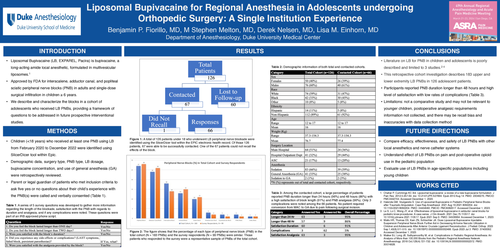
Liposomal Bupivacaine for Regional Anesthesia in Adolescents undergoing Orthopedic Surgery: A Single Institution Experience
Benjamin P. Fiorillo, MD, M Stephen Melton, MD, Derek Nelsen, MD, Lisa M. Einhorn, MD
Department of Anesthesiology, Duke University Medical Center
INTRODUCTION
- Liposomal Bupivacaine (LB, EXPAREL, Pacira) is bupivacaine, a long-acting amide local anesthetic, formulated in multivesicular liposomes.1
- Approved by FDA for interscalene, adductor canal, and popliteal sciatic peripheral nerve blocks (PNB) in adults and single-dose surgical infiltration in children ≥ 6 years.
- We describe and characterize the blocks in a cohort of adolescents who received LB PNBs, providing a framework of questions to be addressed in future prospective interventional studies.
METHODS
- Children (<18 years) who received at least one PNB using LB from February 2020 to December 2022 were identified using SlicerDicer tool within Epic.
- Demographic data, surgery type, PNB type, LB dosage, bupivacaine concentration, and use of general anesthesia (GA) were retrospectively reviewed.
- Parent or legal guardian of patients who met inclusion criteria to ask five yes or no questions about their child’s experience with the PNB(s) were called and verbally consented (Table 1).
CONCLUSIONS
- Literature on LB for PNB in children and adolescents is poorly described and limited to 3 studies.2-4
- This retrospective cohort investigation describes 183 upper and lower extremity LB PNBs in 126 adolescent patients.
- Participants reported PNB duration longer than 48 hours and high level of satisfaction with low rates of complications (Table 3).
- Limitations: not a comparative study and may not be relevant to younger children, postoperative analgesic requirements information not collected, and there may be recall bias and inaccuracies with data collection method
FUTURE DIRECTIONS
- Compare efficacy, effectiveness, and safety of LB PNBs with other local anesthetics and nerve catheter systems
- Understand effect of LB PNBs on pain and post-operative opioid use in the pediatric population
- Evaluate use of LB PNBs in age-specific populations including young children
REFERENCES
1. Chahar P, Cummings KC 3rd. Liposomal bupivacaine: a review of a new bupivacaine formulation. J Pain Res. 2012;5:257-64. doi: 10.2147/JPR.S27894. Epub 2012 Aug 14. PMID: 23049275; PMCID: PMC3442744. Accessed December 1, 2023.
2. Halenda GM, Voulgarelis S. Use of Liposomal Bupivacaine in Pediatric Peripheral Nerve Blocks after Traumatic Amputation. Case Rep Anesthesiol. 2021 Aug 16;2021:8092204. doi: 10.1155/2021/8092204. PMID: 34434583; PMCID: PMC8382517. Accessed December 1, 2023.
3. Le S, Lo C, Wong JY, et al. Effectiveness of liposomal bupivacaine in adductor canal blocks for pediatric knee procedures: A case series. J Clin Anesth. 2021 Dec;75:110517. doi: 10.1016/j.jclinane.2021.110517. Epub 2021 Sep 9. PMID: 34509964. Accessed December 1, 2023.
4. Walls HR, Thomas ES, Kain ZN, Schlechter JA. Does Liposomal Bupivacaine Injectable Suspension Peripheral Nerve Block Further Aid in Decreasing At-home Narcotic Utilization in Children and Adolescents After Anterior Cruciate Ligament Reconstruction. J Pediatr Orthop. 2023 Sep 1;43(8):511-515. doi: 10.1097/BPO.0000000000002466. Epub 2023 Jul 3. PMID: 37400092. Accessed December 1, 2023.
5. Walker BJ, Long JB, Sathyamoorthy M, et al. Complications in Pediatric Regional Anesthesia: An Analysis of More than 100,000 Blocks from the Pediatric Regional Anesthesia Network. Anesthesiology. 2018 Oct;129(4):721-732. doi: 10.1097/ALN.0000000000002372. PMID: 30074928.