457 posters, 2 videos, 2 audios, 8 topics, 45 sessions, 401 authors, 265 institutions
ePostersLive by SciGen Technologies S.A. All rights reserved.
49th Annual Regional Anesthesiology and Acute Pain Medicine Meeting
March 21-23, 2024 | The Hilton Bayfront San Diego | San Diego, California

5113
THE IMPACT OF THORACIC EPIDURALS ON HOSPITAL LENGTH OF STAY: AN OBSERVATIONAL STUDY
Poster Presenter
Authors
Affiliations
Part of Topic
Scientific Abstracts > Regional Anesthesia
The Impact of Thoracic Epidurals on Hospital Length of Stay An Observational Study
Gerard J Kerins, MD, MBA1; Anuj B Patel1, DO; Brian D. Sites1,2, MD, MS; Chloe Nadine M. Duprat1, MD; and Matthew A. Davis3,4, MPH, PhD
1. Dartmouth Hitchcock Medical Center, Department of Anesthesiology, Lebanon, NH
2. Geisel School of Medicine at Dartmouth, Hanover, NH
3. University of Michigan Medical School, Department of Learning Health Sciences, Ann Arbor, MI
4. University of Michigan School of Nursing, Department of Systems, Populations, and Leadership, Ann Arbor, MI
RESULTS
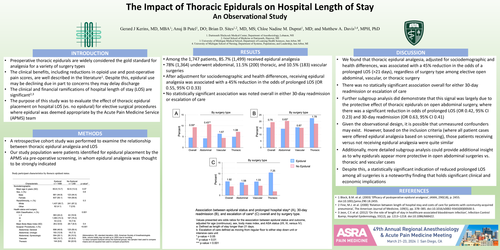
• Among the 1,747 patients, 85.7% (1,499) received epidural analgesia
• 78% (1,364) underwent abdominal, 11.5% (200) thoracic, and 10.5% (183) vascular
surgeries
• After adjustment for sociodemographic and health differences, receiving epidural
analgesia was associated with a 45% reduction in the odds of prolonged LOS (OR
0.55, 95% CI 0.33)
• No statistically significant association was noted overall in either 30-day readmission
or escalation of care
INTRODUCTION
-
Preoperative thoracic epidurals are widely considered the gold standard for analgesia for a variety of surgery types
-
The clinical benefits, including reductions in opioid use and post-operative pain scores, are well described in the literature1. Despite this, epidural use may be declining due in part to concerns they may delay discharge
-
The clinical and financial ramifications of hospital length of stay (LOS) are significant2,3
-
The purpose of this study was to evaluate the effect of thoracic epidural placement on hospital LOS (vs. no epidural) for elective surgical procedures where epidural was deemed appropriate by the Acute Pain Medicine Service (APMS) team
METHODS
-
A retrospective cohort study was performed to examine the relationship between thoracic epidural analgesia and LOS
-
Our study population were patients identified for epidural placement by the APMS via pre-operative screening, in whom epidural analgesia was thought to be strongly indicated
DISCUSSION
-
We found that thoracic epidural analgesia, adjusted for sociodemographic and health differences, was associated with a 45% reduction in the odds of a prolonged LOS (>21 days), regardless of surgery type among elective open abdominal, vascular, or thoracic surgery
-
There was no statically significant association overall for either 30-day readmission or escalation of care
-
Further subgroup analysis did demonstrate that this signal was largely due to the protective effect of thoracic epidurals on open abdominal surgery, where there was a significant reduction in odds of prolonged LOS (OR 0.42, 95% CI 0.23) and 30-day readmission (OR 0.63, 95% CI 0.41)
-
Given the observational design, it is possible that unmeasured confounders may exist. However, based on the inclusion criteria (where all patient cases were offered epidural analgesia based on screening), those patients receiving versus not receiving epidural analgesia were quite similar
-
Additionally, more detailed subgroup analysis could provide additional insight as to why epidurals appear more protective in open abdominal surgeries vs. thoracic and vascular cases
-
Despite this, a statistically significant indication of reduced prolonged LOS among all surgeries is a noteworthy finding that holds significant clinical and economic implications
REFERENCES
-
1Block,B.M.etal.(2003)‘Efficacyofpostoperativeepiduralanalgesia’,JAMA,290(18),p.2455. doi:10.1001/jama.290.18.2455.
-
2Fine,M.J.etal.(2000)‘Relationbetweenlengthofhospitalstayandcostsofcareforpatientswithcommunity-acquired pneumonia’, The American Journal of Medicine, 109(5), pp. 378–385. doi:10.1016/s0002-9343(00)00500-3.
-
3Jeon,C.Y.etal.(2012)‘Ontheroleoflengthofstayinhealthcare-associatedbloodstreaminfection’,InfectionControl & Hospital Epidemiology, 33(12), pp. 1213–1218. doi:10.1086/668422.