457 posters, 2 videos, 2 audios, 8 topics, 45 sessions, 401 authors, 265 institutions
ePostersLive by SciGen Technologies S.A. All rights reserved.
49th Annual Regional Anesthesiology and Acute Pain Medicine Meeting
March 21-23, 2024 | The Hilton Bayfront San Diego | San Diego, California

5496
POPULATION PHARMACOKINETICS OF LIDOCAINE TO GUIDE DOSING OF ERECTOR SPINAE PLANE CATHETERS IN ADULT CARDIAC SURGERY
Poster Presenter
Authors
Affiliations
Part of Topic
Scientific Abstracts > Regional Anesthesia
Population Pharmacokinetics of Lidocaine to Guide Drug Dosing of Erector Spinae Plane Catheters in Adult Cardiac Surgery
Jessica L. Brodt, MBBS FASA, Steven L. Shafer MD, Eric Simon, MD, Ban C. Tsui, MD
Department of Anesthesiology, Perioperative and Pain Medicine, Stanford University, Stanford, California
Introduction
Design: Single-center retrospective review
Population: Cardiac surgical patients receiving programmed intermittent bolus lidocaine via ESP catheters between May 2018 to June 2020.
Exclusions: lidocaine by any other route, non-lidocaine local anesthetic administered, incomplete record of lidocaine dosing or dose change.
Catheter technique: T4-5 ESP catheters placed in preop, parasaggital technique under in-plane ultrasound guidance, patients sitting or prone
Lidocaine dosing: Lidocaine 0.5% 0.75mg/kg q2h, alternating sides, using NIMBUS II PainPRO pumps (Infutronix LLC Natick, MA). Maximum dose per side 20mL. Initiated on arrival to ICU. Dose changes permitted at discretion of attending (ICU or pain service).
Lidocaine levels: in-house homogenous enzyme immunoassay, Cobas 8000 platform (Roche Diagnostics, Indianapolis, IN).
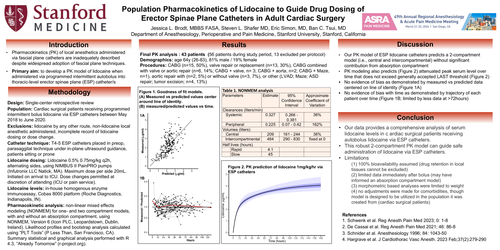
Pharmacokinetic analysis: non-linear mixed effects modeling (NONMEM) for one- and two compartment models, with and without an absorption compartment, using NONMEM, Version 6 (Icon PLC, Leopardstown, Dublin, Ireland). Likelihood profiles and bootstrap analysis calculated using “PLT Tools” (P Less Than, San Francisco, CA). Summary statistical and graphical analysis performed with R 4.3, “Already Tomorrow” (r-project.org)
Results
Final PK analysis : 43 patients (56 patients during study period, 13 excluded per protocol)
Demographics: age 64y (26-83), 81% male / 19% female
Procedures: CABG (n=15, 50%), valve repair or replacement (n=13, 30%), CABG combined with valve or aortic repair (n=6, 14%; CABG + valve, n= 3; CABG + aorta, n=2; CABG + Maze, n=1), aortic repair with (n=2, 5%) or without valve (n=3, 7%), or other (LVAD; Maze; ASD repair; tumor excision; n=4, 13%)
Discussion
(1) 100% bioavailability assumed (drug retention in local tissues cannot be excluded)
(2) limited data immediately after bolus (may have informed an absorption compartment model)
(3) morphometric based analyses were limited to weight
(4) no adjustments were made for comorbidities, though model is designed to be utilized in the population it was created from (cardiac surgical patients)